
The Portugieser Story: How a Simple Request Created an Icon
There are certain watches in this industry that feel less like products and more like destiny. The IWC Portugieser is one of them.
Unlike the Submariner, which was born from military specifications, or the Calatrava, which emerged from the spirit of Bauhaus, the Portugieser has a creation myth that feels almost accidental. It begins not with a boardroom strategy or a marketing gimmick, but with a simple request from two businessmen in a country famous for its maritime history.
This is the story of how a pocket watch found its way onto the wrist and, in doing so, changed the trajectory of IWC Schaffhausen forever.
The Lisbon Request
The year is the late 1930s. The world is on the brink of war, but in Lisbon, Portugal, two merchant wholesalers—Messrs Rodrigues and Teixeira—approach IWC with a specific demand.
They didn’t want a delicate, Art-Deco dress watch, which was the style of the era. They wanted a wristwatch that possessed the accuracy of a marine chronometer. These were the men of the Portuguese merchant navy—captains and officers who needed precision instruments, not just jewelry.
The problem? In the 1930s, wristwatches were small. They used tiny, fragile movements that couldn’t match the timekeeping stability of a large pocket watch. To achieve chronometer-grade precision, you needed size.
Enter the watchmakers in Schaffhausen. They took a seemingly radical approach: they stopped trying to shrink the movement and simply enlarged the case. They took a “hunter” pocket watch caliber—specifically the Calibre 74—and placed it directly into a wristwatch case.
The result was the Reference 325. At 41.5mm in diameter, it was absurdly large for its time. Most men wore 31mm or 33mm watches; this was a dinner plate on the wrist. But that size allowed for a robust, precise movement, a clean, open dial, and a railroad minute track.
The “Ukraine First” Correction
Now, here is a detail that separates the casual enthusiast from the true scholar. We call it the “Portugieser,” and we associate it with the sunny shores of Lisbon. However, historical shipping logs show that the very first delivery of this new oversized watch wasn’t sent to Portugal.
According to the archives, the first units of the Ref. 325 were shipped in February 1939 to Odessa, Ukraine. Shortly after, others went to Lviv.
It wasn’t until 1942 that the watches finally landed in Lisbon via a wholesaler named Pacheco. So, while the spark for the watch came from Portugal, the fire spread across Europe first. But the name “Portugieser” stuck as a tribute to the visionaries who requested it—a nod to the maritime navigation that defined the aesthetic.
The Forgotten Decades (And The Missing Link)
Here is something that surprises most collectors. Between 1939 and 1981, IWC produced only about 690 pieces of the Reference 325. It was not a bestseller. In fact, it was a niche product, quietly sitting in the catalog while IWC focused on other tool watches.
The design languished for decades. There was a brief production run in the late 70s known as the “German Edition” or the “Missing Link”—a series of 57 watches that bridged the old pocket-watch era and the mechanical renaissance to come. But for the most part, the Portugieser was a ghost.
Had it not been for the Quartz Crisis, we might not have the Portugieser we know today.
1993: Rebirth
By the early 1990s, mechanical watchmaking was making a fragile comeback. IWC had survived, but it needed a hero. In 1993, to celebrate its 125th anniversary, the brand decided to revive the old 325.
Marketing Director Hannes Pantli pushed for the re-launch. The result was the Ref. 5441, the “Jubilee” edition.
They updated the dimensions slightly to 42mm, used a sapphire caseback (a rarity then, allowing us to see the stunning Calibre 9828 inside), and kept the DNA pure: the Arabic numerals, the slim feuille hands, and the clean, uncluttered dial.
It sold out. It proved that the market was ready for large, legible, classic watches again. It wasn’t just a vintage re-issue; it was the start of the modern luxury sports watch era.
The Modern Legend: Complications and Chronographs
The real explosion of the Portugieser family began after the Jubilee.
- 1995: The Minute Repeater proved the collection could host haute couture complications.
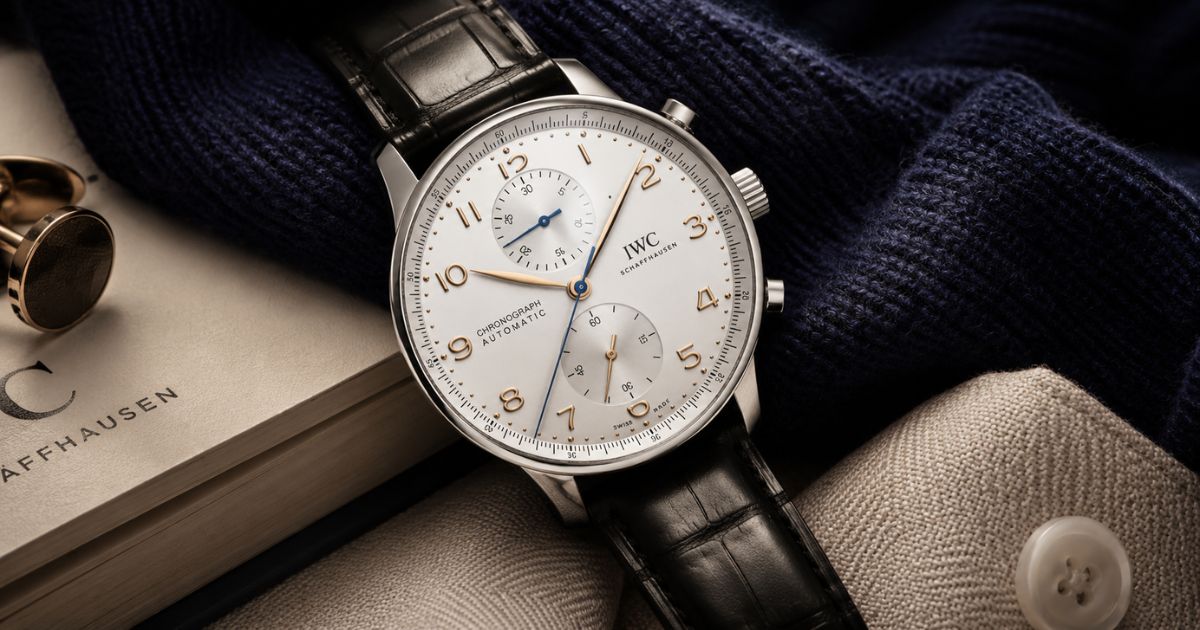
- 1998: The Chronograph (Ref. 3714) arrived. With its vertical sub-dials at 12 and 6 o’clock, it became the definitive modern Portugieser. For years, it was powered by a highly modified Valjoux 7750 movement hidden behind a solid caseback. It was the watch enthusiasts begged to have a clear back.
- 2000: The Automatic 2000 (Ref. 5000) introduced the 5000-calibre family with a 7-day power reserve and the famous Pellaton winding system. The small seconds moved to 9 o’clock to balance the power reserve indicator at 3 o’clock.
- 2003: The Perpetual Calendar combined Kurt Klaus’s ingenious module with the big 5000 movement, creating a “eternal” watch that needs no correction until 2100—and even then, the new Eternal Calendar model (2024) solved that problem too.
Why the Design is Immortal
Let’s talk about why the Portugieser works, because design is subjective, but proportion is science.
The dial is a masterclass in symmetry. The Arabic numerals are applied and polished, catching the light. The “feuille” (leaf) hands are elegant without being fragile. And crucially, the absence of a date window on most core references keeps the dial in perfect visual balance.
IWC has a term for this: “Timeless Modernity”. The watch looks as contemporary today as the 1939 original did in the context of its time. It is bold enough to wear with a t-shirt (a 41mm case demands space) but refined enough for black tie. It is the rare watch that is neither strictly a tool nor strictly a jewel.
A Living Canvas
In 2024 and beyond, IWC has allowed the Portugieser to evolve. We have seen the introduction of “Horizon Blue” and “Obsidian” dials, which require 60 steps to produce, including 15 layers of transparent lacquer . The recent introduction of the Portugieser Hand-Wound Tourbillon Day and Night—a complication dreamt up by an apprentice at IWC—shows that this 85-year-old collection is not resting on its laurels.
The Final Takeaway
The Portugieser is a lesson in conviction. For 40 years, it was a “slow seller” because it was too big. IWC kept the faith, refusing to shrink it to fit the trends of the 1950s or 60s.
When the world finally caught up—when we decided that a watch on the wrist should be legible, confident, and substantial—the Portugieser was ready.
It is the ultimate “insider’s” dress watch. It flies under the radar of the non-initiated, but on the wrist of a collector, it speaks volumes.
It proves that a simple request—”Give us a precise, large watch”—when answered with engineering rigor, can create an eternity.