
The Reine de Naples: A Celebration of Feminine Horology
If you search the archives of horology for the origin of the wristwatch, most history books will point you to the early 20th century and the needs of aviators. But that is a common misconception.
Long before pilots strapped instruments to their wrists, there was a woman. A queen. And she didn’t need a tool for the cockpit; she desired an elegant accessory for her empire-waist gowns.
Today, we are diving deep into one of the most significant, beautiful, and historically untouchable collections in high watchmaking: Breguet’s Reine de Naples.
This isn’t just a “women’s watch” collection. It is a direct lineage to the very first wristwatch ever sold. For any student of luxury watches, understanding the Reine de Naples is essential—not just for its aesthetics, but for its revolutionary spirit.
The Visionary Client: Caroline Murat
To understand the watch, we must first understand the woman who ordered it.
Caroline Murat, the Queen of Naples (Reine de Naples in French), was the youngest sister of Napoleon Bonaparte. She was also one of Abraham-Louis Breguet’s most significant clients.
While many aristocrats of the era owned Breguet’s exquisite pocket watches, Caroline wanted something that did not yet exist. In 1810, she placed an order that would change fashion forever. She commissioned a timepiece that was specifically designed to be worn on the wrist, attached to a bracelet made of hair and gold thread.
On June 8, 1810, the order was logged in Breguet’s archives. The result, delivered in 1812, was the Breguet No. 2639. It was an oblong, ultra-thin repeater watch with a thermometer and a moon phase.
That watch is now lost to history—likely destroyed or misplaced decades ago—but its soul lives on in every Reine de Naples we see today.
The Signature Aesthetic: The “Oviod” Case
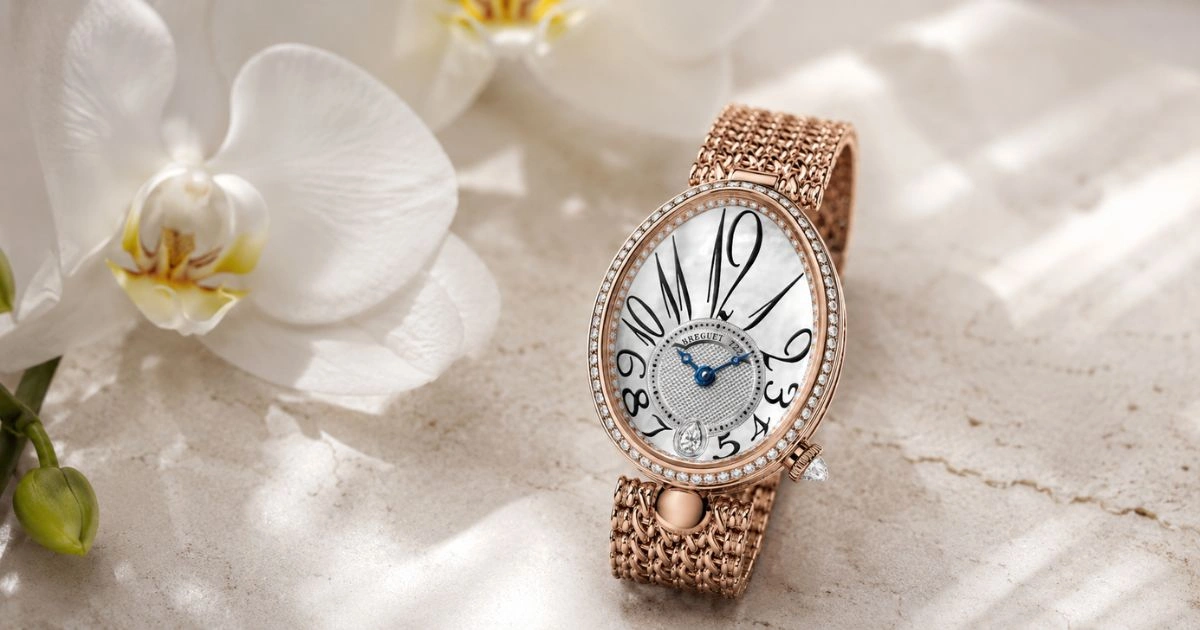
When you look at a Reine de Naples, the first thing that strikes you is the shape. It is not round. It is not quite a rectangle.
Breguet describes it as “ovoid.”
To the rest of us, it is a subtle, elegant egg shape that curves gently to follow the contour of a wrist.
In the modern collection, this is executed with a case that is wider at the bottom than the top, creating a sense of softness absent in standard round watches. The crown is not at the 3 o’clock position; it is characteristically placed at 4 o’clock. This is a deliberate ergonomic and aesthetic choice. It protects the top of the hand from the crown digging in, and it keeps the visual lines of the oval pure.
The caseband is almost always finished with Breguet’s hallmark fluting (the fine vertical lines on the side of the case), a detail that adds texture and catches the light like the pleats of a silk dress.
The Dial: A Canvas of Craftmanship
For a learner in luxury goods, the dial of the Reine de Naples is a masterclass in decorative arts. Breguet uses this canvas to showcase techniques that are rarely taught anymore.
The Grand Feu Enamel
Some references utilize Grand Feu enamel. This is not paint. It is a mixture of silica and oxides applied to the dial and fired in a kiln at extreme temperatures. The result is a deep, pure color—whether it is the soft mint green, the delicate pink, or the intense grey—that never fades. The “secret signature” of Breguet (a barely visible engraving) is often hidden in these dials at 3 o’clock.
The Nature Mother-of-Pearl
Other models use natural Mother-of-Pearl. But this isn’t the flat, boring pearl you might expect. Breguet uses a specific, iridescent grade that shifts color based on the viewing angle—from cream to pink to soft blue.
The Guilloché Main
If you opt for a silvered version, you will see the “Quai de l’Horloge” guilloché pattern—a swirling, wave-like engraving done on a rose engine lathe. It is a nod to the Parisian address where Breguet has worked for 250 years.
The “Expanding Hands” and The Moon
While the Reine de Naples is primarily a celebration of jewelry and elegance, Breguet is a watchmaker first. They insert incredible mechanics where you least expect them.
The Variable Geometry Hand (Ref. 9835)
In 2022, Breguet released a limited edition that is a marvel of micro-mechanics. The minute hand literally changes shape as it moves around the dial.
- When it passes the wide 12 o’clock, it stretches.
- When it reaches the narrow 6 o’clock, it contracts.
This is achieved through a complex patented gear train inside the hand itself. It is whimsical, feminine, and incredibly complex—a perfect metaphor for the collection.
The Larger Moon (Ref. 9935)
For the 250th anniversary of Breguet (2025), the Reine de Naples received a significant upgrade. The moon phase display—a classic Breguet complication—was dramatically enlarged. Without a power reserve indicator cluttering the view, the moon floats beautifully on the dial, surrounded by six pear-shaped diamonds.
Why It Matters to the Modern Learner
If you are studying luxury watches, it is easy to focus on the “tool watches”—the Submariners, the Royal Oaks, the Speedmasters. But the Reine de Naples teaches us a different lesson.
It teaches us that haute horlogerie is not just about diving depth or shock resistance.
The Reine de Naples is about form. It is about the transition of timekeeping from the pocket (a private action) to the wrist (a public display of taste). It is proof that the most complicated thing a watch can do is capture the essence of a person.
When Caroline Murat ordered this watch, she wasn’t just asking for the time. She was asking for freedom—the freedom to glance at her wrist without fumbling for a pocket.
Every time you see an oval case, a Breguet “pomme” (hollow apple) hand, or a crown at 4 o’clock, you are seeing the shadow of the first wristwatch.
It is feminine. It is historic. And it is utterly unbeatable.