- A. Lange & Söhne Watches
- Audemars Piguet Watches
- Bell & Ross Watches
- Blancpain Watches
- Breguet Watches
- Breitling Watches
- Bvlgari Watches
- Cartier Watches
- Chopard Watches
- F.P.Journe Watches
- Franck Muller Watches
- Girard Perregaux Watches
- Glashütte Original Watches
- Hamilton Watches
- Hublot Watches
- IWC Watches
- Jaeger-LeCoultre Watches
- Longines Watches
- Mido Watches
- Nomos Watches
- Omega Watches
- Oris Watches
- Panerai Watches
- Patek Philppe Watches
- Piaget Watches
- Richard Mille Watches
- Roger Dubuis Watches
- Rolex Watches
- Seiko Watches
- Tag Heuer Watches
- Tissot Watches
- Tudor Watches
- Ulysse Nardin Watches
- Vacheron Constantin Watches
- Zenith Watches

What is a Minute Repeater? The Watch That Sings
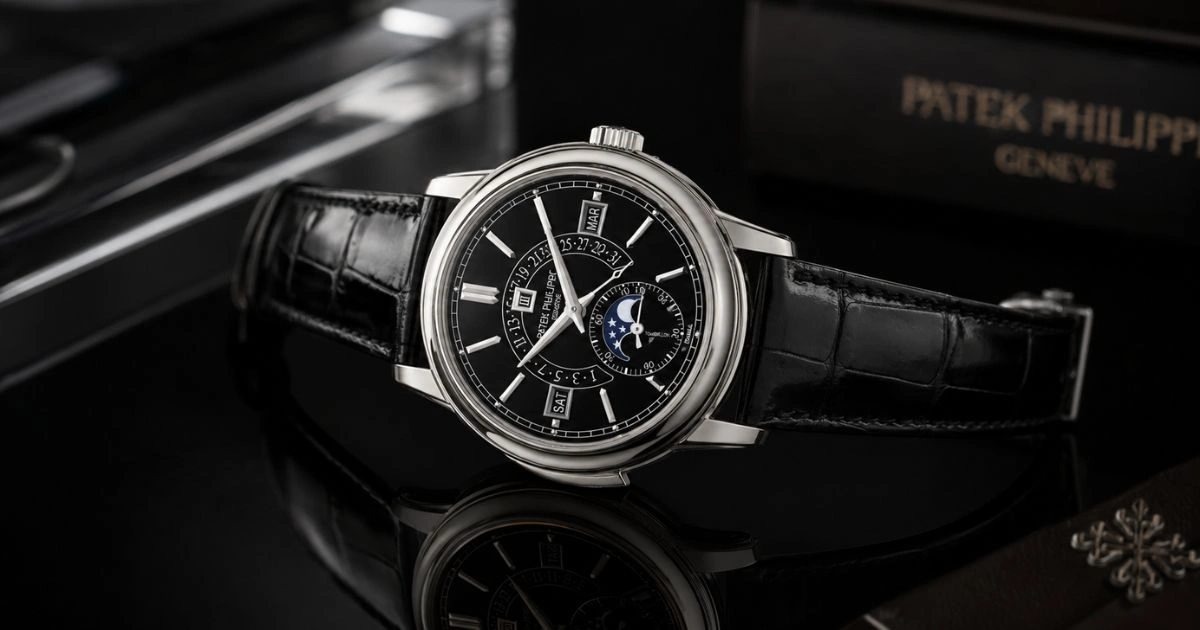
There are watches that tell time, and then there are watches that perform it.
In the quiet world of haute horlogerie, where the slightest mechanical imperfection is audible to a trained ear, one complication stands alone as the undisputed king of acoustic engineering: The Minute Repeater.
Often referred to as “the most complex complication” in watchmaking, the minute repeater is the reason many collectors use the word “music” to describe a movement. Today, we aren’t just looking at a watch; we are listening to it. Welcome to the symphony of the wrists.
The Silent Night’s Solution
To understand the repeater, we have to travel back to a time before electricity. Imagine a gentleman in a black velvet coat pulling a pocket watch from his waistcoat at a candlelit opera. He cannot see the hands, and pulling out a match would be rude.
His solution? He pushes a slide on the side of the case.
Suddenly, the watch “sings.” A series of low tones, high tones, and chimes rings out, telling him exactly what time it is without ever looking at the dial.
The first repeating watches emerged around 1680, invented by English clergyman Edward Barlow and Quaker watchmaker Daniel Quare. Initially, they were a necessity for the blind and for navigating the dark. Today, they are a mechanical art form created for the sheer joy of engineering.
How Does It “Sing”?
Let’s demystify the mechanics. A standard watch tells time with hands. A minute repeater translates that hand position into sound. When you slide the lever (usually located on the left side of the case), you wind a tiny, dedicated mainspring.
When released, this spring doesn’t drive the watch; it drives a “striking train.” Here is the breakdown of the language you will hear:
- The Hours: A low, rich tone. (Dong).
- The Quarter Hours: A double tone, low then high (Ding-Dong), usually struck up to three times for 15, 30, and 45 minutes past the hour.
- The Minutes: A sharp, high-pitched tone (Ding).
Let’s “Listen” to the Time:
If the time is 2:49:
- Hours: You hear 2 low tones (Dong, Dong).
- Quarters: You hear 3 double tones for the 45-minute mark (Ding-Dong, Ding-Dong, Ding-Dong).
- Minutes: Since 49 minutes is 4 minutes past the quarter, you hear 4 high tones (Ding, Ding, Ding, Ding).
The result is a melody that translates audibly to 2:49.
The “All-or-Nothing” Magic
One of the greatest nightmares for a watchmaker is an incomplete chime. In the early days, if you didn’t push the lever hard enough, the watch might only chime the first two hours and stop, leaving you confused.
To solve this, Abraham-Louis Breguet (yes, that Breguet) invented the “All-or-Nothing” mechanism around 1820. This safety system ensures that if the slide isn’t pushed fully home, the watch refuses to chime at all. It ensures that when you do activate it, the concert plays from start to finish without stuttering.
The Orchestra Inside: Gongs vs. Bells
Early repeaters used small bells inside the case, similar to a striking clock. But bells take up a lot of room.
Around 1800, the Swiss introduced wire gongs. These are hardened steel wires coiled inside the case (often twice around the movement). When the tiny hammer strikes the gong, the coil vibrates to produce a purer, longer-lasting sound. Most modern minute repeaters use two gongs (one for high, one for low), but the masters—like Patek Philippe or Armin Strom—use three or even four gongs to create “carillons” or Westminster chimes.
Why the “Death Grip” Runis the Sound
Here is a secret most sales associates won’t tell you: How you hold the watch changes how it sounds.
If you wrap your fingers tightly around the case, your flesh absorbs the vibrations of the steel gongs. The result is a muffled, disappointing “click.” To hear a repeater correctly, you must hold it delicately by the edges, or rest it on a hard surface (like a wooden table), which acts as a sounding board to amplify the resonance.
The Pinnacle of Passion
Why do these watches captivate us so much? In the digital age, an audible beep is cheap. But a minute repeater is organic. It is a tiny mechanical throat. Assembling a minute repeater takes months of work by a single watchmaker. The gongs must be tuned by hand; filing just a thousandth of a millimeter of steel changes the pitch.
These are not tools; they are heirlooms. When you press the slide on a Patek Philippe, a Vacheron Constantin, or an IWC, you aren’t just checking the time. You are starting a conversation with centuries of horological history. You are commanding a tiny, singing robot that lives on your wrist.
Does your watch tell the time, or does it sing it?
Until next time, keep listening to the silence—and the magic that breaks it.