
5 Things You Didn’t Know About the IWC Big Pilot’s Watch
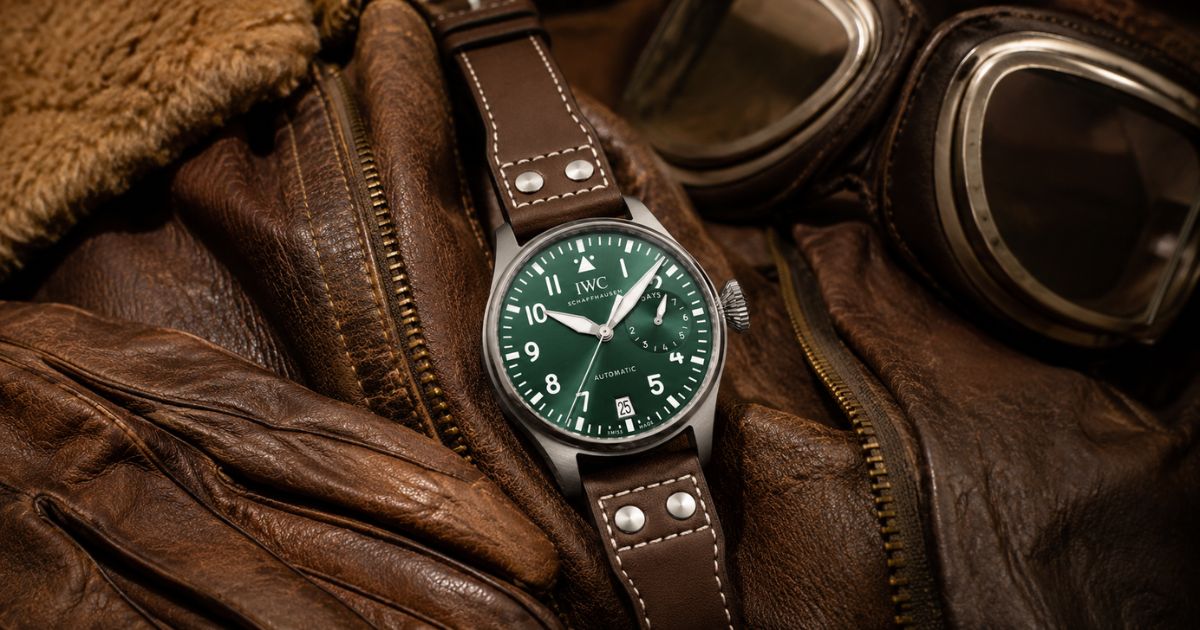
When you think of iconic pilot’s watches, a few heavy-hitters come to mind. But sitting at the top of that list—both in stature and reputation—is the IWC Big Pilot’s Watch.
To the average observer, it’s simply a very large, very legible watch with a diamond-shaped crown. But to us enthusiasts, the “BP” is a story of engineering rebellion, hidden specs, and tragic genius.
Having spent years covering the intersection of horology and history, I thought I knew everything about Schaffhausen’s giant. But while prepping for this piece, I dove deep into the archives (and the brand’s own design interviews) and found five details that completely changed how I look at this icon.
Here are five things you probably didn’t know about the IWC Big Pilot’s Watch.
1. It Was a “Secret Project” That Almost Failed
It is hard to imagine today, when the Big Pilot dominates luxury watch displays, but IWC management was terrified to launch this watch. In the late 1990s and early 2000s, the industry was obsessed with size—but only up to a point. Audemars Piguet had just released the Royal Oak Offshore, and at 42mm, people called it “The Beast.” Rolex’s Sea-Dweller was 40mm.
Then along came IWC designer Günter Blümlein with a prototype that measured 46mm.
According to historical retrospectives, the project was considered a commercial risk that could flop. It was so massive and utilitarian that it didn’t fit the era’s dress-code norms. Blümlein essentially had to sneak the project through. He attached the development of the Big Pilot’s case to the development of the Portuguese Automatic movement (Calibre 5000) because he knew the board wanted the Portuguese.
2. The “7-Day” Power Reserve is Actually a Lie
This is one of my favorite “dirty secrets” in watchmaking. When IWC introduced the Calibre 5000 family, they advertised a massive 7-day power reserve. Technically, the mainspring barrel holds enough energy for 8.5 days.
So why do they lie?
It comes down to the physics of accuracy, specifically Hooke’s Law. As a mainspring unwinds, the torque (force) it delivers drops. In the last day and a half of a spring’s life, the torque drops off a cliff, causing the balance wheel to lose amplitude. The watch would run, but it would run slow.
To protect their reputation for precision, IWC physically blocks the movement from using that last 1.5 days of power. The movement stops completely after 7 days, even though there is still gas in the tank. It ensures that every second of that 7-day run stays within COSC-level accuracy.
3. The Crown Was Designed for Gloves, But the Case Don’t
We all recognize the signature conical diamond crown. It looks cool, but its shape is pure “form follows function.” It was modeled directly after the 1940s Calibre 52 T.S.C. pilot’s watch, designed so Luftwaffe pilots could easily grip and wind it while wearing thick leather flight gloves.
However, the rest of the watch tells a different story. While the crown is historic, the modern Big Pilot’s Watch (Ref. 5002 and onward) lacks the soft-iron inner cage for anti-magnetism found in true “tool” pilot watches like the Mark XI.
IWC’s Creative Director Christian Knoop admitted that when designing the modern iteration, they prioritized the “purity of the dial” and “wearability” over the historical magnetic protection. This is a luxury lifestyle watch inspired by a tool, not a cockpit instrument.
4. The Creator Died Before Seeing Its Success
The man who fought for the Big Pilot’s resurrection, Günter Blümlein, is arguably the most important figure in IWC’s modern history. He was the mastermind behind the 1990s watch renaissance.
However, due to technical delays in perfecting the 7-day movement and sourcing the right materials, the launch of the Big Pilot’s Watch was pushed from 2001 to April 2002 .
Tragically, Blümlein passed away in October 2001. He never saw the finished product on a customer’s wrist. He never saw the Baselworld booth where it won “Watch of the Year.” He launched the concept, but the iconic status it holds today is a legacy he never got to witness.
5. The “Mark XXI” Codename Belongs to Breguet
IWC has a history of naming military watches with “Mark” numbers (e.g., Mark XI, Mark XII). When Blümlein’s team was developing the Big Pilot, they didn’t call it “Big Pilot.” Internally, the project was codenamed Project Mark XXI.
It seemed logical: It was the next step in the evolution of the IWC pilot watch.
But when legal and marketing looked into it, they ran into a wall. Breguet—specifically the Breguet Type XX—already had a stronghold on the “XX” aeronautical naming convention in the watch world. To avoid confusion and legal issues, IWC scrapped the number.
They reverted to the nickname the team had been using in the workshop: “Grosse Fliegeruhr.” Translated, that simply means Big Pilot’s Watch. It turns out the most literal name in horology was actually the backup plan.
The Learner’s Takeaway
Studying the Big Pilot’s Watch is a masterclass in how modern watches are made. It isn’t just a reissue of a 1940s watch. It is a compromise between art and physics (the 7-day lie), a story of marketing guts (the 46mm risk), and a tribute to a lost leader (Günter Blümlein).
Next time you see that massive conical crown glinting under a cuff, you’ll know it represents far more than just a big case—it represents the last roll of the dice that changed an industry.