
The Panerai Luminor: How a Radiomir Evolution Became an Icon
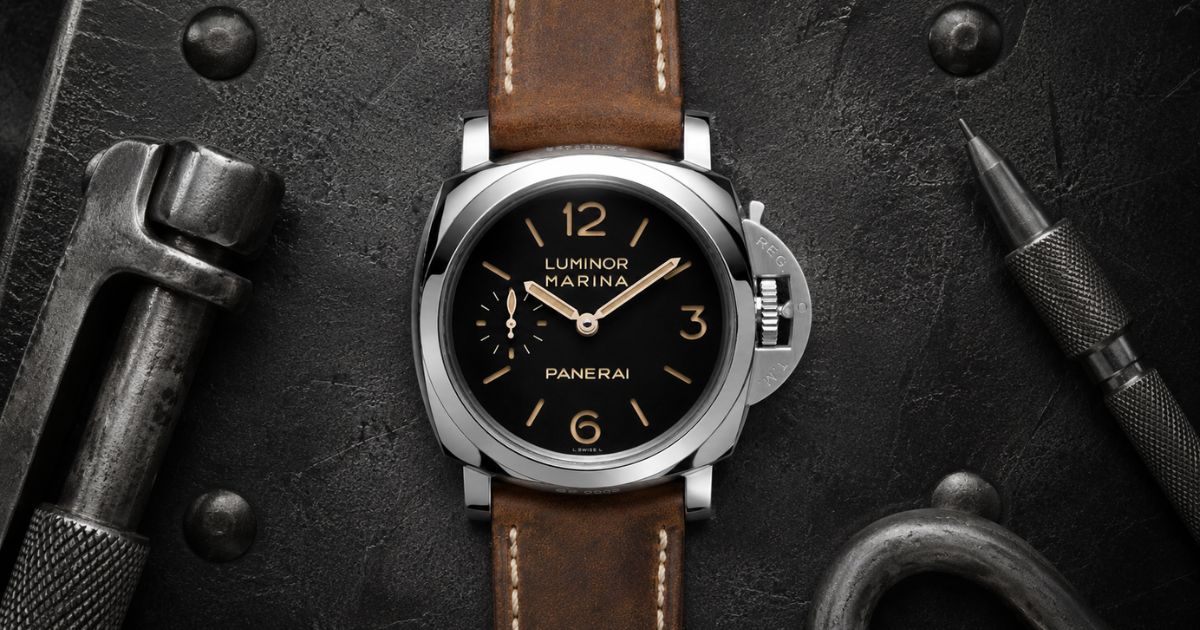
In the pantheon of modern horology, few silhouettes are as instantly recognizable as the Panerai Luminor. With its exaggerated crown-protecting bridge, chunky cushion case, and stark, luminous dial, the Luminor doesn’t just tell time; it announces a presence.
But the Luminor was not born in a boardroom. It was born in the murky waters of the Mediterranean, a necessary evolution of its predecessor, the Radiomir. To understand the Luminor is to understand the shift from fragile vintage origins to a robust, go-anywhere tool—and ultimately, to a cultural phenomenon.
Today, we are going to deconstruct that journey. We will look at how a simple change in luminescent paint and a structural necessity created one of the most faked, loved, and iconic designs in the luxury watch space.
The Predecessor: The Radiomir
To understand the Luminor, we first have to look at the Radiomir.
In the 1930s, the Italian Royal Navy needed a reliable instrument for its frogmen—the “Gamma” divers. Panerai, then a Florence-based workshop, delivered the prototype of the Radiomir in 1936.
These early watches were massive for the era (47mm), featuring a cushion-shaped case, wire lugs welded to the case, and a simple, highly legible dial. The name “Radiomir” came from the radium-based paste used to make the dial glow in the dark.
However, the Radiomir had functional limitations. While revolutionary, the wire lugs were a potential point of failure under extreme duress. Furthermore, the winding crown was exposed. If a diver accidentally knocked the crown underwater, or if it was pulled out by accident, the watch would lose its water resistance instantly. For a combat diver, that was a fatal flaw.
The Birth of the Luminor (1950)
The solution arrived in the 1950s. Panerai patented a new, safer luminous material based on tritium (Hydrogen-3). They named this material “Luminor”.
But the name wasn’t the only thing that changed.
In 1949, the brand patented a “Device protecting the crown”. By 1950, this device debuted on the reference GPF 2/56. It was a massive, bridge-like lever system that clamped down over the winding crown.
When the lever was closed, it pressed the crown tightly against the case, creating a watertight seal far superior to standard screw-down crowns. It also offered physical protection against side impacts. This “Crown Guard” became the defining feature of the new watch: The Luminor.
Alongside the new crown guard, Panerai reinforced the construction. They replaced the fragile wire lugs of the Radiomir with integrated lugs, machined from the same block of steel as the case. This made the watch virtually indestructible compared to its predecessor.
Anatomy of an Icon
If you are a learning collector, here are the absolute hallmarks that make a Luminor a Luminor.
1. The Crown Guard (The Bridge)
As noted, this is the biggest giveaway. It is a semi-circular attachment on the right side of the case with a lever. It is functional, robust, and wholly unique to Panerai.
2. The Sandwich Dial
While Radiomirs often used it, the Luminor perfected the “sandwich” dial. Two thin plates of metal are layered. The bottom plate has the luminous material (now Super-LumiNova, safe and bright). The top plate has the numerals and hour markers cut out of it. This allows the light to shine through the “holes,” creating a depth and brightness that painted lume cannot match.
3. The Cushion Case
The case of the Luminor is more angular and flat-sided than the rounded, tapered Radiomir case. It looks industrial. It looks tough.
4. The 9 o’clock Subdial
Most classic Luminor models feature a small seconds dial at 9 o’clock. Historically, this was because the movements used (originally from Rolex and later Angelus) did not have a central seconds hand; they were pocket watch movements rotated 90 degrees.
The Silent Decades (1950s-1990s)
or nearly 40 years, the Luminor remained a strictly military secret. You could not buy one in a store. They were strictly issued to the Italian Navy, and later, the Egyptian Navy.
This changed in 1993. Panerai released a small commercial collection, the “Pre-Vendôme” or “Pre-V” models, including the Luminor (Ref. 5218-201/A). It was a slow burn initially, limited to military enthusiasts.
The Great Escape: Pop Culture Ignition
The true explosion of the Luminor into mainstream consciousness happened in 1996. Sylvester Stallone was in Italy filming Daylight. He reportedly saw the Luminor, loved its rugged “Rambo-esque” aesthetic, and bought several.
He loved them so much that he commissioned a special edition for the movie: the Luminor “Slytech”. When Daylight hit theaters, the world saw Stallone defusing bombs and navigating a collapsed tunnel wearing a massive, weird, ultra-masculine watch. The public went crazy.
Shortly after, the Vendôme Group (now Richemont) bought Panerai (1997) and began the global rollout. The era of the big watch had begun.
The Luminor vs. Radiomir (A Learning Point)
For those of you studying the brand, remember this simple distinction:
- The Radiomir is the elegant grandpa. Wire lugs, no crown guard. It looks better on a dress shirt or a skinny wrist.
- The Luminor is the bodybuilder grandson. Crown guard, integrated lugs. It looks best on a NATO strap, a leather jacket, or a diving suit.
Modern Era: Expansion and Controversy
Today, the Luminor family has grown exponentially. You have the Luminor Base (simple time-only), the Luminor Marina (with the seconds subdial and usually “Marina” text), and the Luminor 1950 (which mimics the vintage 47mm proportions).
Panerai has also experimented heavily with materials. Since the early 2000s, they have moved beyond steel into Titanium, Ceramic (first seen in 2007), and Carbotech.
For traditionalists, the addition of smaller sizes (like the 40mm or the thinner Luminor Due) is controversial. The Luminor was born as a 47mm tool. Shrinking it to 38mm or 40mm makes it wearable for more people, but some argue it dilutes the “tool watch” DNA.
Conclusion: The Status of the Icon
The Panerai Luminor is not for everyone. It is heavy. It is repetitive (the brand is often joked about for making the same watch in 50 shades of gray). It is easily knocked off by counterfeiters.
However, the Luminor is one of the few designs from the late 20th century that actually created a new archetype. Before the Luminor, luxury watches were generally small, gold, and round. After the Luminor, the industry realized that “ugly” could be beautiful, that “bulky” meant masculine, and that historical authenticity trumps delicate refinement.
For a learner, the Luminor teaches a vital lesson: Function dictates form. Every lump, bump, and lever on this watch exists for a reason—to keep a frogman alive in the dark, cold sea. That honest design is what makes it an icon.