
Day-Date: The “President” Watch Explained
There are iconic watches, and then there is the Rolex Day-Date. In the world of horology, few timepieces carry the same weight of history, status, and instant recognizability as this one.
You have seen it before. Even if you aren’t a “watch person,” you have glimpsed that distinctive arc-shaped window at 12 o’clock or that unique three-link bracelet on the wrist of a world leader, a Hollywood legend, or your favorite rapper.
But what makes the Day-Date the ultimate symbol of success? Why is it called the “President”? And what is the difference between a Day-Date and a Datejust?
Today, we are tearing down the myths and diving into the engineering and legacy of the watch they simply call The President.
The Birth of a Legend (1956)
To understand the Day-Date, we have to travel back to 1956. At the time, Rolex was already famous for the Datejust—the first wristwatch to automatically change the date on the dial. But founder Hans Wilsdorf wanted more.
He wanted a wristwatch that told you everything: the time, the date, and the day of the week, spelled out in full.
Back then, this was a mechanical nightmare. Fitting a disc mechanism large enough to spell “Wednesday” or “Saturday” while keeping the watch slim and waterproof was a massive technical hurdle. But Rolex succeeded. The result was the Oyster Perpetual Day-Date: the first automatic, waterproof chronometer to display both the date and the full day of the week.
However, technical innovation alone wasn’t enough. From day one, Rolex made a decision that would define the watch’s destiny forever: They would never, ever make it in stainless steel.
The Day-Date was reserved strictly for the noble metals: 18k Yellow Gold, White Gold, Everose Gold (Rolex’s proprietary pink gold alloy), or 950 Platinum. It wasn’t just a tool; it was a treasure from the moment it left the factory.
Why Is It Called “The President”
Here is where the history gets juicy. The nickname “President” is actually a case of life imitating art—or rather, the bracelet name influencing reality.
When the Day-Date launched, it came with a brand new bracelet design. Unlike the utilitarian Oyster bracelet (flat, three-piece links) or the Jubilee (five-piece links), this new bracelet featured broad, semi-circular three-piece links that were highly polished and incredibly comfortable. Rolex called this the “President” bracelet.
Shortly after its release, the watch found its way onto the wrist of the most powerful man in the free world. In the early 1960s, photographs surfaced of President Lyndon B. Johnson wearing a yellow gold Day-Date. Johnson was a larger-than-life figure, and the solid gold watch looked like it was made for his wrist.
The public saw the “President bracelet” on the actual President. The association stuck. From that moment on, the Day-Date ceased to be just a reference number; it became The Rolex President.
The Anatomy of an Icon
Let’s break down the specific design codes that make a Day-Date unique. If you are learning to spot watches, look for these three things:
1. The Day Window (12 o’clock)
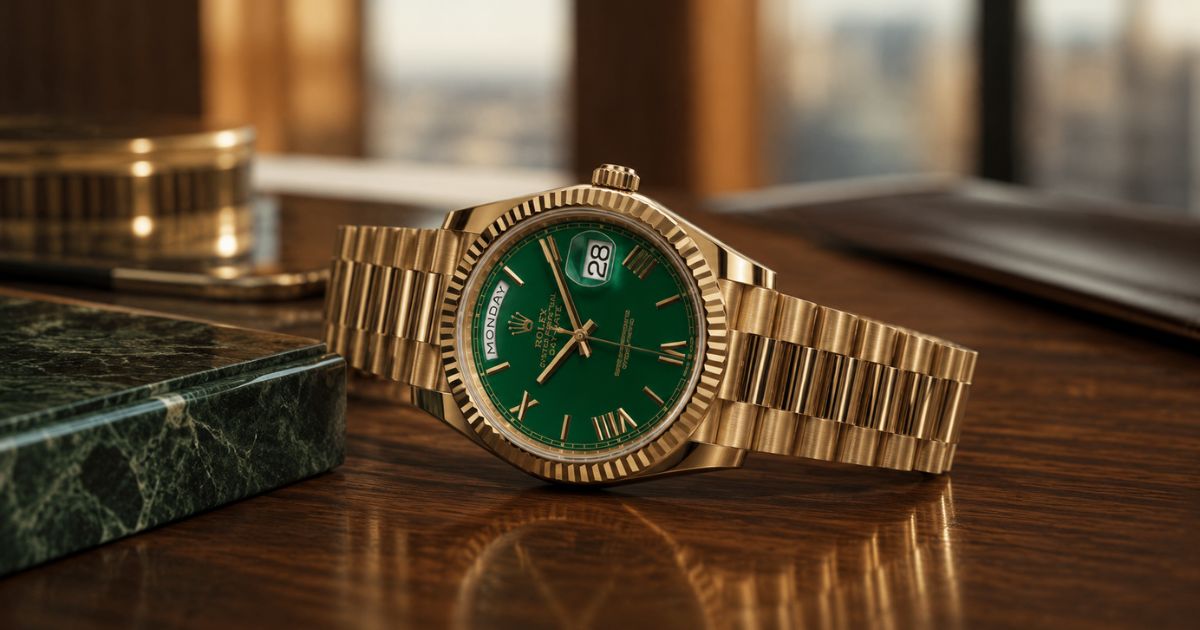
While the Datejust has a date window at 3 o’clock, the Day-Date has a double feature. The day is displayed in a full arc-shaped window at the very top of the dial. Rolex actually produces these discs in 26 different languages, including Arabic, Chinese, Spanish, and Russian. So, a Day-Date sold in Dubai will say “FRIDAY” in Arabic script, while one in Paris says “VENDREDI.”
2. The Fluted Bezel
On a steel Rolex, the fluted bezel is a design choice. On a Day-Date, the fluted bezel is a flex. Originally, the fluting helped screw the bezel down for waterproofing, but today it is a pure aesthetic signature of precious metal. If you see a sharp, gleaming gold fluted bezel, you are almost certainly looking at a Day-Date.
3. The Cyclops
That magnifying bubble over the date at 3 o’clock is a Rolex trademark (introduced in the 1950s). It makes the date instantly readable.
The Bracelet: Form & Function
The President bracelet is arguably the most comfortable precious metal bracelet ever made.
The semi-circular links are actually hollowed out on the inside (though modern versions have solid links for weight and durability). This design allows the bracelet to drape over your wrist like fabric, rather than sitting stiffly like armor.
Modern references also utilize the Concealed Crownclasp. On a standard watch, you see a clasp with a flip-lock. On the President, the clasp is hidden entirely within the bracelet links, opening with a small Rolex crown that lifts up. It turns the bracelet into a continuous, seamless loop of gold or platinum.
The Engine Inside (Calibre 3255)
If you buy a new Day-Date 36 or 40 today, you aren’t buying vintage charm; you are buying state-of-the-art engineering. Since 2015, the Day-Date has been powered by the Calibre 3255.
Here is why that matters for the wearer:
- 70-Hour Power Reserve: You can take it off on Friday night and put it back on Monday morning without winding it.
- Chronergy Escapement: This is the “engine” inside. It is made of nickel-phosphorus, making it highly resistant to magnetic fields—something that plagued vintage watches.
- Superlative Chronometer: Standard COSC certification is good. Rolex’s internal certification is better. They guarantee a precision of -2/+2 seconds per day.
The “Big Three” and Pop Culture
While LBJ gave it the nickname, the Day-Date’s status was cemented by the “Big Three” of Golf: Jack Nicklaus, Arnold Palmer, and Gary Player. Throughout the 60s and 70s, these three titans dominated the sport, and all three wore gold Day-Dates. It became the trophy of the gentleman athlete.
In cinema, it became the villain’s (and the anti-hero’s) watch of choice. Think Scarface (Tony Montana), The Sopranos, and Wall Street. More recently, actors like Denzel Washington and Walton Goggins have been spotted with the “President” on their wrist, proving that its cultural cache is as strong as ever.
How to Spot a “President”
For the learning collector, here is the easiest cheat sheet:
- If it has a date window but NO day window: It is a Datejust (or a Day-Date homage).
- If it has a day window AND the case is steel: It is a Fake. Rolex has never made a mass-produced steel Day-Date.
- If it has a day window and a leather strap: It is likely a Cellini (Rolex’s dress watch line) or a vintage Day-Date where the owner swapped the bracelet. The true “President” must have the metal President bracelet.
Final Thoughts
The Rolex Day-Date is many things. It is a feat of 1950s engineering. It is a symbol of mid-century power. It is a piece of precious jewelry.
But more than that, it is a storyteller. It doesn’t just tell you what time it is; it tells the world what rung of the ladder you are on. The “President” transcends fashion trends because it isn’t just a tool for reading time—it is a tool for broadcasting ambition.
Whether you see it as a grail watch or a gaudy relic of the 80s, you cannot deny its impact. The Day-Date didn’t just enter the history books; it helped write them.