
Datejust vs. Oyster Perpetual: Choosing Your Classic Rolex
There’s a moment every watch enthusiast knows well. You’ve done the research. You’ve admired the pieces. And now, you’re standing at the precipice of a significant decision: which Rolex will be your Rolex? For countless collectors and first-time buyers alike, this journey often narrows down to two iconic models: the Oyster Perpetual and the Datejust.
On the surface, they appear to be siblings from the same illustrious family—sharing the robust Oyster case, the same commitment to precision, and that unmistakable Rolex DNA. But as anyone who has spent time with both will tell you, these two watches offer profoundly different experiences. One whispers understated purity; the other speaks of classic elegance and everyday practicality.
This isn’t a guide about which watch is “better.” It’s about helping you discover which one is more authentically you. Let’s explore the distinct characters of these two pillars of the Rolex catalog.
The Pure Expression: Rolex Oyster Perpetual
To understand the Oyster Perpetual is to understand the very foundation of Rolex. The name itself is a tribute to the brand’s two most pivotal innovations: the Oyster case, the world’s first waterproof wristwatch case, patented in 1926, and the Perpetual rotor, the self-winding mechanism introduced in 1931. The modern Oyster Perpetual is the direct descendant of this legacy, representing Rolex in its most elemental, stripped-back form.
When you wear an Oyster Perpetual, you are wearing a piece of horological history, unadorned and uncompromised.
Design Philosophy: Minimalism as a Statement
The Oyster Perpetual’s design mantra is one of purposeful simplicity. It is a pure time-only watch, displaying hours, minutes, and seconds—and nothing else. This lack of a date function is a defining characteristic, not a shortcoming. It allows for a perfectly symmetrical dial that is clean, legible, and uncluttered.
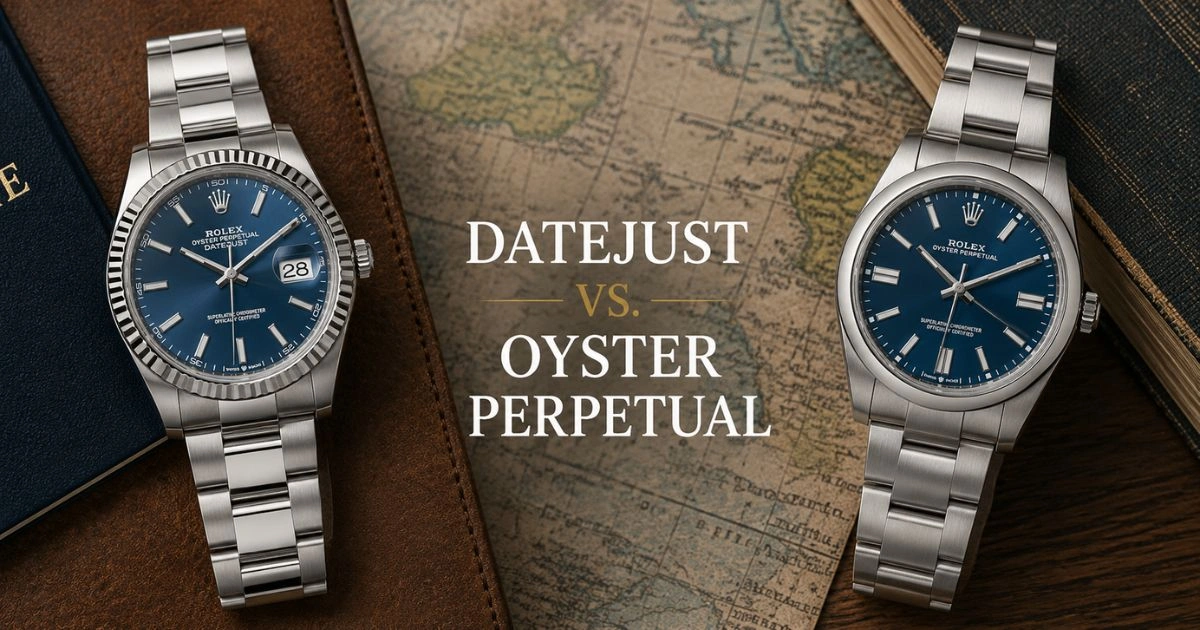
The aesthetics are understated yet contemporary. For the modern 41mm models, you’ll find a smooth, domed bezel and the classic three-link Oyster bracelet. The case features brushed top surfaces on the lugs, contributing to its more casual, sporty character. While this might sound stark, the Oyster Perpetual has a playful side, most famously showcased through its ever-evolving and vibrant palette of dial colors, from the now-iconic “Tiffany” blue to lacquer finishes in pistachio green, coral red, and sunny yellow.
The Soul of an OP: What It’s Like to Wear
Wearing an Oyster Perpetual is an exercise in quiet confidence. It’s a watch that doesn’t shout for attention. Its presence is felt, not flaunted. The flat, restrained silhouette of the domed bezel and the Oyster bracelet make it a supremely comfortable and versatile daily companion.
The decision to forgo a date complication is a powerful one. It means there are no date adjustments to make on the first of the month, and nothing breaks the visual harmony of the dial. For many, this simplicity is the ultimate luxury. As one source aptly puts it, the OP’s essence is “one watch you don’t have to think about”. It’s the ideal choice if you appreciate a tool that excels at its primary function without unnecessary frills.
The Classic Icon: Rolex Datejust
If the Oyster Perpetual is Rolex’s purest expression, the Datejust is its most iconic and versatile. Introduced in 1945 to mark the brand’s 40th anniversary, it was the first self-winding wristwatch to feature a date window that changed automatically at midnight. This was a revolutionary step in practicality and cemented the Datejust’s status as the quintessential daily wearer.
The Power of the Date: More Than a Complication
The Datejust’s defining feature is, of course, the date window at 3 o’clock, paired with the instantly recognizable Cyclops lens—a magnifying crystal introduced in 1953 that makes the date easy to read at a glance. This functional addition transforms the watch from a simple timekeeper into a true “day-to-day” tool.
However, the Datejust’s character is defined by its unparalleled customizability. It is, without question, the most configurable model in Rolex’s current lineup. This is where it truly diverges from its simpler sibling.
A Watch for Every Wrist and Occasion
The Datejust offers a spectrum of choices that allow you to tailor the watch to your exact taste:
- Bezels: Choose between a sporty smooth bezel, the dressy and iconic fluted bezel in white gold, or even a gem-set bezel for an opulent touch.
- Bracelets: Select the robust three-link Oyster bracelet for a sportier feel, or opt for the elegant and comfortable five-link Jubilee bracelet.
- Materials and Dials: The Datejust is available not only in steel but also in two-tone “Rolesor” (steel and gold) and full precious metals. Its dial options range from classic sunburst finishes to mother-of-pearl and diamond-set hour markers.
A fluted-bezel Datejust on a Jubilee bracelet has undeniable wrist presence. The fluting catches light from every angle, and the Jubilee adds a layer of visual texture that feels distinctly more “dressy” and intentional. It’s a watch that feels just as appropriate under a cuff at a formal dinner as it does with a t-shirt on a weekend, but it leans more towards a refined, “intentional” aesthetic than the sportier OP.
Datejust vs. Oyster Perpetual: The Direct Comparison
To help you make your decision, let’s break down the key differences side-by-side.
1. Functionality: Symmetry vs. Practicality
This is the most fundamental distinction. The Oyster Perpetual offers pure timekeeping without distractions. Its dial is symmetrical, clean, and requires no monthly date adjustment. The Datejust, by contrast, adds the highly useful date complication, but this breaks the dial’s symmetry. The question is: do you value visual purity or added convenience? If you rely on your watch for the date, the Datejust is the clear winner.
2. Aesthetics: Minimalist Sport vs. Dressy Versatility
The OP is the epitome of “minimalist sport.” Its smooth bezel, brushed lugs, and exclusive Oyster bracelet give it a more casual, contemporary feel. The Datejust can be almost any watch you want it to be. With a fluted bezel and Jubilee bracelet, it is a dressy classic. With a smooth bezel and Oyster bracelet, it takes on a cleaner, sportier look reminiscent of the OP.
3. Case and Bracelet Options: Limited vs. Extensive
When it comes to options, the Oyster Perpetual is streamlined. It comes with a single bezel style, one bracelet, and with dial color being its main variable. The Datejust is a playground for personalization. The vast array of bezels, bracelets, materials, and dials means you can create a watch that is distinctly yours.
4. The Intangibles: Wrist Presence and Feel
A Datejust, particularly in two-tone or with a fluted bezel, simply has more visual presence. It feels more like a piece of jewelry and draws more attention. The Oyster Perpetual flies under the radar. It’s a more “quiet” watch, its sleek profile and brushed surfaces making it a discreet yet confident partner for any activity. As one guide notes, collectors often point to the subtle differences in finishing, like the clasp’s construction (stamped coronet on OP vs. welded on DJ), as part of why these watches feel different on the wrist even when dimensions are the same.
The Final Decision: Which Rolex is Right for You?
The choice between a Rolex Oyster Perpetual and a Datejust is a deeply personal one. It’s not about which is technically superior, but which aligns with your lifestyle, preferences, and vision for your ideal watch.
Choose the Oyster Perpetual if:
- You are a purist who values a clean, symmetrical, and uncluttered dial.
- You prefer a versatile, sporty, and understated aesthetic that works seamlessly with any outfit.
- You appreciate a “set it and forget it” watch and want to avoid monthly date adjustments.
- You want the most direct and pure expression of Rolex’s storied heritage.
Choose the Datejust if:
- You value the practicality and convenience of a date function in your daily life.
- You enjoy personalizing your watch and want a wide variety of bezel, bracelet, and material options.
- You prefer a watch that leans slightly dressier and has a stronger presence on the wrist.
- You want the quintessential, most iconic and recognizable Rolex design in the brand’s catalog.
Ultimately, both watches are masterpieces of Swiss watchmaking. The Oyster Perpetual is a testament to the beauty of restraint, while the Datejust celebrates the elegance of evolution. Whichever path you choose, you’ll be wearing a true classic.