
The 10 Most Iconic Racing Watches of All Time
There is a relationship in the world of horology that is more visceral, more adrenaline-fueled, and more romantic than any other: the bond between the wristwatch and the racetrack.
Unlike diving or aviation, where the tool-watch aspect is about survival, the racing chronograph is about ego, glory, and the decimal points of a second. It is the art of measuring speed for the sake of breaking records.
To understand the racing watch is to understand the heart of modern watchmaking. These watches aren’t just jewelry; they are mechanical tachymeters, born in the pits of Le Mans and Daytona. In this guide, we are shifting gears to look at the 10 most iconic racing watches ever created—the timepieces that defined what it means to drive in style.
What Defines a “Racing Watch”
Before we hit the starting grid, we need to establish the criteria. Not every steel sports watch qualifies as a racing icon.
A true racing watch is defined by three distinct features:
- The Chronograph: A stopwatch function is non-negotiable. Racing is about timing laps, not just knowing it is 3 PM.
- The Tachymeter Scale: Look at the bezel. Those numbers usually ranging from 60 to 500 are a tachymeter. It allows the wearer to calculate speed based on travel time over a fixed distance.
- High Contrast: “Legibility” is the keyword. You need to read the time at a glance when your hands are shaking from adrenaline.
With that checklist in hand, let’s look at the kings of the asphalt.
1. Rolex Cosmograph Daytona (1963)
The Undisputed Champion
You cannot have this conversation without starting here. Named after the Daytona International Speedway in Florida—where Rolex became the official timekeeper in 1962—the Daytona is the holy grail of sports watch collecting.
While it is the most hyped watch today, the Daytona didn’t become the “Emperor” overnight. In the 1960s and 70s, it was a slow seller. The magic came from the manual-wind “Exotic Dials,” often called “Paul Newman” dials due to a photo of the actor wearing one. Today, these are among the most expensive wristwatches in the world.
Why it’s iconic: It perfectly balances a rugged tool-watch aesthetic with high luxury finishing. The modern ceramic “Cerachrom” bezel is virtually scratch-proof, ensuring that the tachymeter remains pristine for a lifetime of hypothetical lap times.
2. TAG Heuer Monaco (1969)
The Square Peg
While the Daytona is round and safe, the Monaco is square and rebellious. Launched in 1969, it was one of the first automatic chronographs in history. But looks? It was ugly. It was weird. It was perfect.
The Monaco became immortalized in 1971 on the wrist of Steve McQueen in the film Le Mans . McQueen wore the blue-dial Ref. 1133B, and suddenly, the square watch wasn’t weird; it was the coolest thing on four wheels.
Why it’s iconic: It broke the mold. The crown is on the left side (to avoid digging into the back of a driver’s hand), and its bold geometry screams late-60s modernism. It is the uniform of the maverick.
3. Omega Speedmaster (1957)
The Moon Landing (That Started on the Track)
Most people call the Omega Speedmaster the “Moonwatch.” But in 1957, NASA didn’t care about space. The original Speedmaster was designed for racing drivers and engineers.
The “Broad Arrow” hands and the dark dial with contrasting sub-dials created the “Panda” layout that everyone copies today. It was built to measure speed, distance, and time long before it was qualified for space flight.
Why it’s iconic: The duality. It is perhaps the only watch that is equally at home on a racetrack pit board as it is floating in zero gravity. It represents the ultimate tool-watch purity.
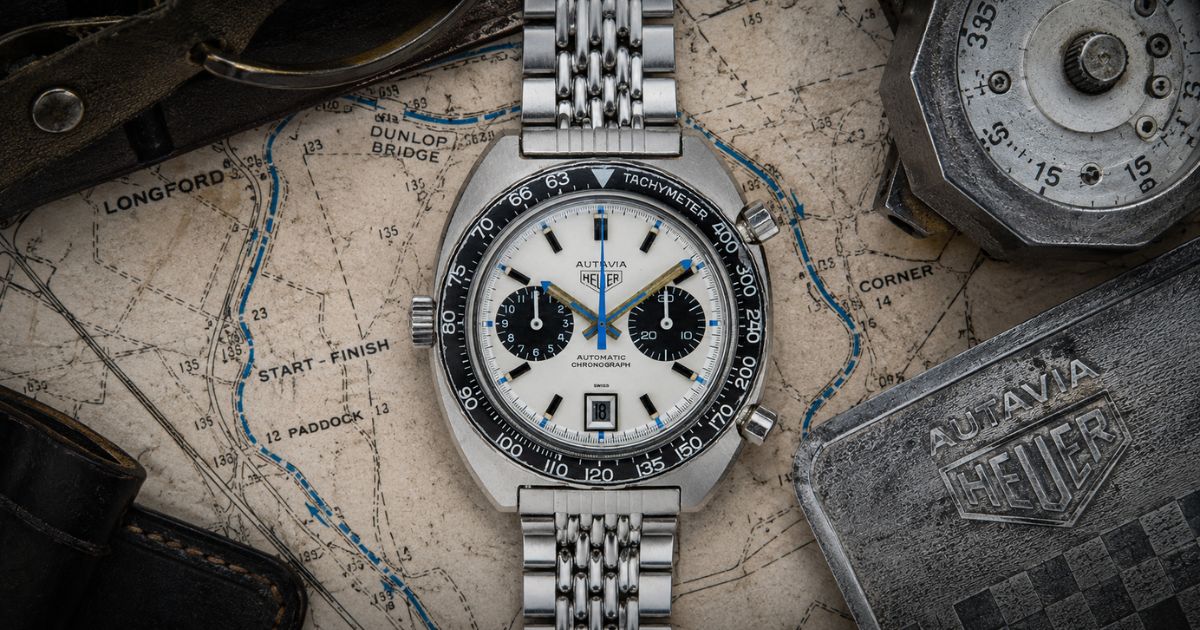
4. Heuer Autavia (1962)
The Pilot & The Driver
The name “Autavia” is a portmanteau of Automotive and Aviation. Jack Heuer created this line to serve both pilots and racers.
The Autavia is famous for the “Rotating Tachymeter Bezel”—a feature we now take for granted, but was revolutionary for the era. It allowed drivers to calculate average speeds without complex math. The vintage “Rindt” and “Siffert” references (named after racing legends) are some of the most sought-after pieces by collectors
Why it’s iconic: It represents the “Golden Era” of racing—the 60s—when drivers were rockstars and watches were mechanical beasts.
5. Breitling Navitimer (1952)
The Slide Rule Wizard
While the Navitimer is technically a pilot’s watch, its presence on the racing circuit is undeniable, specifically the “Top Time” and “Datora” variants. However, the Navitimer earns its spot because of the Top Time “Zorro” dial, famously worn by Jim Clark, a Formula 1 World Champion.
Breitling’s connection to speed comes from its obsession with complex calculations. The circular slide rule can do everything from averaging speed to converting fuel gallons.
Why it’s iconic: No other watch looks like it. The bezel is incredibly busy, yet somehow perfectly balanced. It is the thinking man’s racing watch.
6. Zenith El Primero (1969)
The High Beat
1969 was a big year. Zenith released the El Primero—Spanish for “The First”—boasting an integrated automatic chronograph movement that could beat at 36,000 vibrations per hour.
This high frequency allowed it to measure time to 1/10th of a second, a massive advantage in racing. The “A386” with its overlapping tri-color sub-dials is a masterpiece of 20th-century design.
Why it’s iconic: The engine. In fact, the movement was so good that in the 1980s, Rolex used it to power their early automatic Daytonas. Without the El Primero, the modern automatic Daytona might not exist.
7. Porsche Design Chronograph 1 (1972)
The Driver’s Watch
Ferdinand Alexander Porsche, the designer of the Porsche 911, founded his own design studio in 1972. His first product was the Chronograph 1.
It was the world’s first watch to feature a matte black case (made from titanium and coated). Why? To eliminate glare on the track. The design mirrors the dashboard of a 911—functional, stark, and brutally Teutonic.
Why it’s iconic: It invented the “All Black” stealth watch aesthetic that every brand from Hublot to Bamford copies today.
8. Chopard Mille Miglia (1988)
The Gentleman Racer
While F1 is about cutthroat competition, the Mille Miglia is about heritage. This annual classic car rally in Italy is the spiritual home of Chopard.
The Mille Miglia watch is famous for two things: (1) Vintage-inspired numerals and dials that look like classic car dashboards, and (2) The Rubber Strap. It was one of the first luxury watches to use rubber, specifically molded with a vintage tire tread pattern.
Why it’s iconic: It perfectly captures the romance of the open road rather than just raw speed.
9. Seiko Speedtimer (1969)
The Underdog
Europe dominated racing chronographs for decades, but Japan changed the game in 1969 with the Seiko Speedtimer—one of the world’s first automatic chronographs.
The Speedtimer is linked to the legendary Datsun 240Z, which won the brutal East African Safari Rally in 1971. It proved that a “Japanese watch” could be just as robust and precise as its Swiss rivals.
Why it’s iconic: It democratized the racing chronograph. It offers incredible design (check out the “Panda” 6139 model) without the scarcity of a Daytona.
10. IWC Ingenieur (1976)
The Anti-Ferromagnetic
The Ingenieur (German for “Engineer”) was designed by the legendary Gerald Genta (the father of the Royal Oak and Nautilus).
While not always a chronograph, the 1976 IWC Ingenieur SL is a racing watch because of its partnership with Mercedes-AMG. It features a soft-iron inner cage to protect the movement from magnetic fields (crucial for engine tuning). The “Jumbo” model with a five-minute intervals bezel and integrated bracelet screams 70s luxury speed.
Why it’s iconic: It is subtle. If the Daytona is a Ferrari, the IWC Ingenieur is an AMG Mercedes sedan—understated, but when you step on the gas, it leaves everything in the dust.
The Checkered Flag
The beauty of the racing watch is that it tells a story of human ambition. We want to go faster. We want to measure precisely.
From the Rolex Daytona’s crown to the Seiko Speedtimer’s underdog victory, these watches represent the apex of mechanical engineering. Whether you are a student of design or a future collector, these are the ten references you need to study.