
F.P. Journe at Auction: Record-Breaking Results and Why
If you have been following the high-stakes world of watch auctions lately, one name has consistently stolen the spotlight, shattered expectations, and left collectors in awe: F.P. Journe.
In an era where even the mighty Rolex and Patek Philippe markets have seen a “cooling off” from the 2022 peaks, the Geneva-based independent manufacture founded by François-Paul Journe seems to be operating in a different universe entirely. We are witnessing prices that defy gravity—most notably the $10,755,000 sale of the FFC Prototype in December 2025.
But why is this happening? Is F.P. Journe a bubble waiting to burst, or are we witnessing the final coronation of the greatest living watchmaker?
Today, we dissect the record-breaking results and uncover the specific factors driving the “Journe-mania” at auction houses like Phillips, Sotheby’s, and Christie’s.
The Numbers Don’t Lie: A Market on Fire
To understand the magnitude of this movement, we need to look at the raw data. In the last two years, F.P. Journe has consistently outperformed estimates by staggering margins.
Consider the recent Phillips New York Sessions Spring 2026 auction. It wasn’t a “Journe-only” sale, yet the independent brand dominated the top spots.
- Lot 1: F.P. Journe Centigraphe Souverain – Estimated at 80,000−160,000. Sold for: $355,600 (over double the high estimate).
- Lot 2: F.P. Journe Automatique Lune Havana – Estimated at 70,000−140,000. Sold for: $190,500.
The Tourbillon Souverain models are also absolute monsters. When F.P. Journe first started, a tourbillon was a rare sight. Today, specific references like the “Tourbillon Souverain T” routinely smash through the million-dollar barrier. In December 2025, a “T” model sold for $1,143,000, beating the estimate by a staggering 357%. Yes, you read that right: three-hundred and fifty-seven percent above expectations.
But the crowning jewel, the one that broke the internet, was the FFC Prototype sold for Francis Ford Coppola. It sold for USD 10.8 million in December 2025, making it the most expensive independent watch ever sold.
Why? The Three Pillars of Journe’s Auction Dominance
If you are new to luxury watch collecting, you might think, “It’s just a hype brand.” But that would be a dangerous misunderstanding. F.P. Journe is perhaps the most intellectually driven market in horology. Here is why they perform so well.
1. Extreme Scarcity (The “Real” Rarity)
Let’s talk supply and demand. Rolex produces over a million watches a year. Patek Philippe produces roughly 68,000. Even A. Lange & Söhne, a niche German brand, produces around 5,000.
F.P. Journe? They produce approximately 900 to 1,000 mechanical watches per year. That’s it. Furthermore, the brand does not have a vast catalog of 100 different models. They have a few core lines, and each watch is finished to a standard that rivals the holy trinity. Because the annual production is the equivalent of what Rolex makes in a single morning, the fundamental law of economics kicks in: Low supply + High demand = Rising prices.
2. “Invenit et Fecit” (I Invented and Make It)
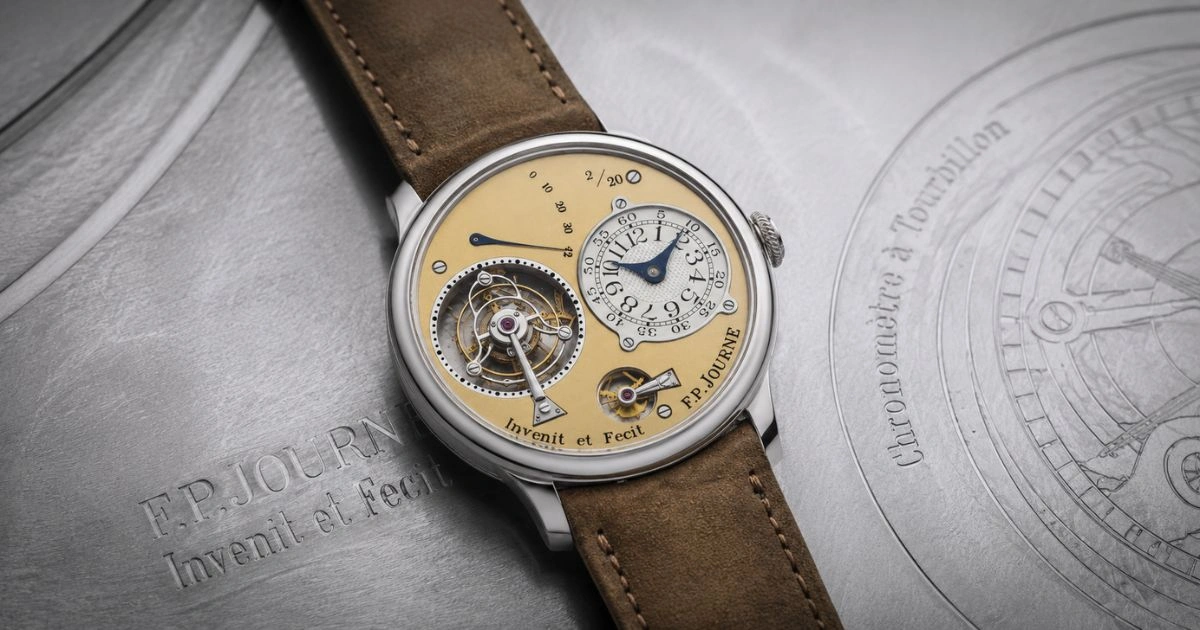
On every F.P. Journe dial, you see the Latin phrase Invenit et Fecit. This is not marketing fluff; it is a legal promise. It means Journe himself designed the movement, and his workshop built it from scratch.
In the world of high horology, many brands use “ébauches” (base movements) modified by specialists. Journe doesn’t. He solves mechanical problems that others ignore.
For example, the Chronomètre à Résonance is the only wristwatch in the world that uses the physical phenomenon of resonance (two balance wheels vibrating in sync) to achieve accuracy. The Centigraphe measures 1/100th of a second using a movement that doesn’t look like anything else on the market. The FFC tells time via a mechanical hand that looks like a prosthetic finger.
Collectors aren’t just buying gold and steel; they are buying intellectual property and mechanical genius. Auctions price innovation very highly.
3. The “Crossing the Chasm” Effect
For a long time, F.P. Journe was a secret among the ultra-wealthy “in-crowd.” But around 2019-2020, the brand crossed the chasm into mainstream collector consciousness.
We are currently in a phase where new millionaires are entering the hobby. They missed the boat on vintage Daytonas or Nautiluses, but they want the best. They research, and they inevitably land on Journe. The “Blue Dial” models (Chronomètre Bleu) and “Havana” dials have become status symbols for the intelligentsia of watch collecting.
Case Study: The Tourbillon Souverain
To truly learn the market, let’s zoom in on one specific model: the Tourbillon Souverain.
If you look at the historical data on EveryWatch, this model alone accounts for 12% of all Journe auction sales . It is the gateway to the high-end.
- The Record: An F.P. Journe Tourbillon Souverain “T” sold for a staggering $8,360,523 in 2024, proving that the Tourbillon is the crown jewel of the collection.
- The Average: Even “standard” examples in precious metals routinely sell for between 400,000and1.1 million depending on the metal and dial configuration.
Why does the Tourbillon do so well? Because it combines two of Journe’s obsessions: the Remontoire d’Égalité (constant force) and the Tourbillon. It is a double-whammy of chronometric precision that most brands can’t pull off.
The “Coppola Effect” and the FFC Prototype
The $10.8 million sale of the FFC Prototype deserves its own analysis. This watch was a prototype commissioned by film legend Francis Ford Coppola. It tells the time using a mechanical hand that extends and retracts fingers to indicate the hour.
This sale tells us three things about the current market:
- Provenance is King: A watch owned by (or made for) a cultural icon like Coppola adds a massive “romantic” premium.
- The “Fun” Factor: Serious collectors are tired of boring dials. The FFC is weird, whimsical, and brilliant. Uniqueness drives value.
- The Top End is Hot: While the 5k−20k market might be soft, the ultra-rare, seven-figure independent market is on fire.
Conclusion: Can You Still Get In?
For the learning collector, the F.P. Journe market is intimidating. The retail boutiques have waiting lists that are effectively closed to the public. If you walk in off the street, you will likely not be allocated a steel Chronomètre Bleu or a Resonance.
So, what do you do?
- Look at the “Second Tier”: Not every Journe model is a million-dollar watch. The Octa line or the Élégante (for ladies or small-wristed collectors) often trade for premiums above retail but are not yet in the stratospheric $500k+ range.
- Condition is Everything: In the auction world, originality matters. As noted in the Precision Watches journal, collectors care deeply about “originality, movement type, and production era.” A “brass movement” Journe (early models) is worth significantly more than a later one.
- Education over Speculation: Don’t buy a Journe just because the line is going up. Buy it because you understand why the Remontoire matters, or how the Resonance works. As the GQ analysis of the FFC auction wisely noted, the goal is to connect with the philosophy of the brand.
F.P. Journe at auction is no longer just about buying a watch. It is about acquiring a piece of 21st-century art. The records are falling, and for now, there is no ceiling in sight.