
The Bell & Ross Story: From Aviation Cockpits to Wristwear
In the vast universe of Swiss watchmaking, where heritage often spans centuries, it takes a special kind of boldness to disrupt the establishment. Enter Bell & Ross. Founded in 1994—which is relatively yesterday in horological terms—this Franco-Swiss brand managed to do what few others have: create an instantly recognizable silhouette in less than a decade.
For the luxury watch enthusiast looking to understand modern design language, Bell & Ross offers a fascinating case study. It proves that you don’t need 200 years of history to become an icon; you just need a damn good idea and the consistency to stick to it.
The idea? “From the cockpit to the wrist.”
The Genesis: A Friendship Forged in Design
To understand the watch, you must first understand the duo behind the curtain. Bell & Ross is the brainchild of Carlos Rosillo and Bruno Belamich. Childhood friends with a shared passion for aviation and industrial design, they noticed a gap in the market. While many brands made “pilot watches,” few were actually designed with the logic of an airplane.
In the early 90s, the pair set out to create a timepiece that adhered to the strict principles of aeronautical instrumentation: Legibility, Functionality, Precision, and Reliability.
Unlike traditional houses that evolved from pocket watches, Bell & Ross started with a blank sheet of paper—or rather, a blueprint of a fuselage. Their early collaboration with Chanel (which took a stake in the company) provided the financial backing to realize their vision, but the soul of the brand remained firmly in the hangar, not the boardroom.
2005: The BR-01 Revolution
If you are studying icon design, mark the year 2005 on your timeline. That was the year of the BR-01.
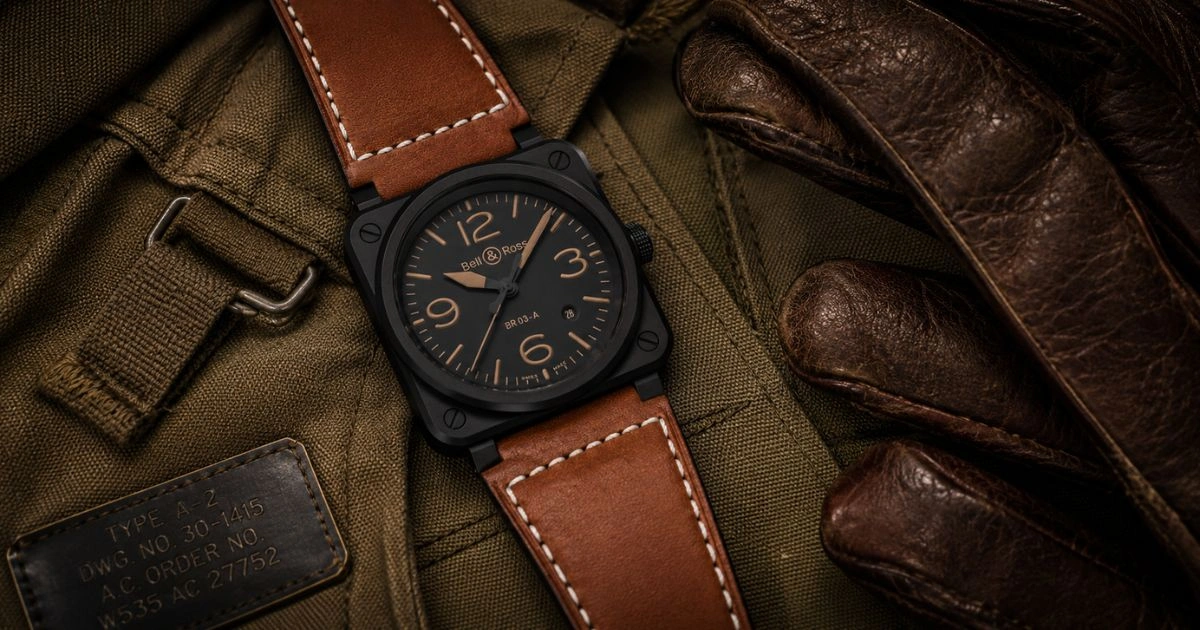
At the time, the watch world was dominated by round cases. Rolex, Omega, Patek—all round. Bell & Ross dropped a bomb with a 46mm square case, secured by four visible screws, housing a round dial. It looked like a clock ripped directly from a Airbus or Dassault fighter jet dashboard.
Why was this so revolutionary?
Size: 46mm was massive for 2005. But Bell & Ross wasn’t selling a watch; they were selling an instrument. They dared to be big, and the market followed.
The “Circle in a Square”: This geometry wasn’t just for looks. It solved a specific problem. Pilots need to read the time at a glance without hesitation. The stark contrast of the round dial against the square case creates a visual focus that mimics the cockpit environment.
The 4 Screws: In aviation, redundancy and security are key. Those four screws aren’t just decorative; they are a visual cue of industrial-grade ruggedness.
“Twenty years ago we created a shape that no longer needs any explanation. It’s as though we’ve been working towards this moment, where we don’t even have to put a name on the dial to be recognised.” — Carlos Rosillo
The Evolution: From Tool to Urban Icon
For the learner, it’s important to see how a brand evolves without losing its DNA. For the first decade, Bell &Ross was the darling of Special Forces and aviation geeks. They released the Phantom (all-black stealth look) and the Skull series, which became cult hits.
But a luxury brand cannot survive on niche military sales alone. In 2019, Bell & Ross executed a perfect pivot with the launch of the BR-05.
The BR-05 took the “circle in a square” but smoothed the edges. It introduced an integrated bracelet and a sleeker profile. This was “The City vs. The Sky.” Suddenly, the watch that looked at home in a cockpit looked equally stunning peeking out from under a dress shirt cuff in a boardroom.
Modern Mastery: The X-Series and Skeletonisation
Fast forward to 2024 and 2025, Bell & Ross is proving that they are more than a one-trick pony. While the BR-03 (the more manageable 42mm and 41mm descendant of the BR-01) remains the cornerstone, the brand is pushing into Haute Horlogerie.
1. The BR-X3 Series
According to recent reviews from Dubai Watch Week and industry experts, the BR-X3 represents the “most advanced level of sophistication.” It utilizes a multi-layer “sandwich” case construction, mixing titanium, steel, and anodized aluminum. It is lighter, more resistant, and visually complex.
2. The Skeleton Lum Ceramic
In a brilliant review by Time+Tide Watches, the BR-03 Skeleton Lum Ceramic was described as something that “looks like Star Wars.”
This watch ditches the purely functional tool-watch vibe for kinetic art. It features a skeletonized X-motif dial absolutely drenched in Super-LumiNova X1. When the lights go out, the watch doesn’t just glow; it radiates. As one reviewer noted, “reading the time isn’t really the top priority with this watch”—sometimes, jewelry is about the emotion, not the utility.
Why Collectors Respect Bell & Ross
If you are learning about watches, remember this: Consistency builds legacy.
Bell & Ross has stayed true to its “cockpit” roots while cleverly expanding into urban luxury. They have mastered the art of “themed” collections—from the Radar to the Horizon—without looking gimmicky.
They have also embraced the duality of modern watchmaking:
- The Instrument: BR-03 Diver, BR-03 Phantom.
- The Jewel: BR-X3 Tourbillon, BR-05 Skeleton.
As CEO Carlos Rosillo stated, the brand has moved “from off-road to urban, from rugged instrument to refined accessory.”
The Final Verdict
The Bell & Ross story is a masterclass in branding. They identified a visual gap (square aviation clocks), executed flawlessly (BR-01), and guarded that silhouette like a hawk. Now, as they celebrate 20 years of the BR-01, they are reaping the rewards of that patience.
For the luxury buyer, a Bell & Ross is a statement of mechanical literacy. It says you know your history, you appreciate industrial design, and you have the confidence to wear a square on your wrist.
The cockpit has never looked so chic.
What do you think about the evolution of Bell & Ross? Are you a fan of the brutalist BR-01 or the sleek BR-05? Let me know in the comments.