
A Beginner’s Guide to Starting a Patek Philippe Collection
There is very little that watch collectors agree on. Ask ten collectors which diver is the best, and you will get eleven arguments. However, if there is one universal truth in this hobby, it is the hallowed status of Patek Philippe.
For nearly two centuries, this Geneva-based Maison has been the benchmark for haute horlogerie. To say you collect Patek Philippe is not just about owning luxury goods; it is about becoming a custodian of history. The famous slogan, “You never actually own a Patek Philippe. You merely look after it for the next generation,” isn’t just marketing—it is the philosophy that governs serious collecting.
But where does a novice start? The catalogue is deep, the reference numbers are cryptic, and the landscape can seem intimidating. Having navigated these waters, I am here to tell you that starting a collection is less about the size of your safe and more about the size of your curiosity.
Here is your beginner’s guide to starting a Patek Philippe collection.
Step 1: Forget the Hype, Focus on the House
If you are a beginner, the worst thing you can do is chase the “hype cycle.” Yes, the Nautilus is iconic. Yes, the Aquanaut is ubiquitous on Instagram. But focusing solely on steel sports watches right now is like going to a Michelin-starred restaurant and only eating the breadsticks.
Before you buy a watch, buy the history. Patek Philippe has been operating since 1839. They navigated the shift from pocket watches to wristwatches and have been owned by the Stern family since the 1930s. Understanding this legacy is crucial.
A true collector respects the “Holy Trinity” (Patek, Audemars Piguet, Vacheron Constantin), but they specifically admire Patek for their commitment to the rare handcrafts—things like Grand Feu enamel, guilloché, and engraving that don’t often appear on the “trendy” models.
The Takeaway: Do your homework. Read about the history of the Calatrava. Learn why the Stern family saved the company. Knowledge is the first and most important investment.
Step 2: The Gateway Drug – The Dress Watch
If you are looking for your first Patek, you should look at the Calatrava.
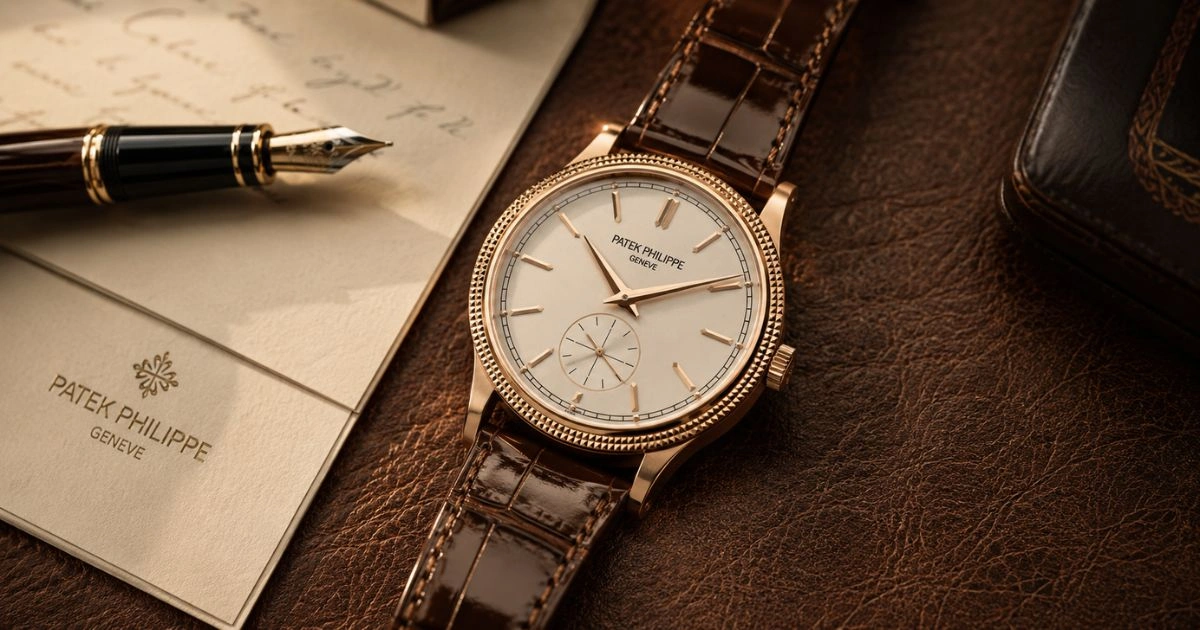
This is the purest expression of the brand. Launched in 1932, the Calatrava established the modern archetype of the elegant round wristwatch. It embodies the Bauhaus principle of “form follows function”. It is minimalist, timeless, and utterly refined.
Why is this the best start for a beginner?
- Purity: It distilled everything Patek knows about watchmaking into a simple hours/minutes/seconds display.
- Variety: You can find vintage pieces from the 1950s or neo-vintage pieces from the 1990s. Specific references like the Ref. 96 (the very first Calatrava) are the seeds from which the entire brand grew.
- The Details: Look at the Ref. 6119. Notice the “Clous de Paris” hobnail bezel. That texture isn’t just for looks; it is a signature of the brand’s finishing prowess.
Wearing a Calatrava doesn’t scream “money”; it whispers taste. For a beginner, learning to appreciate the curve of a polished bezel or the heat-treatment of a hand is far more valuable than flashing a steel sports watch.
Step 3: Understanding the Families (Beyond the Hype)
When moving past the Calatrava, you need to map out the landscape. You don’t have to memorize every reference number (though that will happen eventually), but you must understand the hierarchy.
The Sports Icons (Nautilus & Aquanaut)
Designed by Gérald Genta, the Nautilus (1976) broke the rules with a porthole-inspired case. It is the “grail” for many. For a more modern and accessible entry into Patek’s sporty side, look at the Aquanaut (1997). It shares DNA with the Nautilus but comes with a tropical rubber strap and a more contemporary, rugged feel.
The Disruptor (Cubitus)
Very recently, Patek introduced the Cubitus. This square-shaped, bold model is the first new line in 25 years. For a collector just starting today, the Cubitus represents the future. It is a statement piece that shows you are aware of the brand’s evolution, not just its past.
The Artistic Side (Golden Ellipse & Gondolo)
Don’t be afraid of the rectangles and ovals. The Golden Ellipse is mathematically perfect (based on the 1.618 golden ratio). The Gondolo brings Art Deco flair with its rectangular cases. These are often overlooked, which makes them incredibly smart buys for a collector seeking rarity.
Step 4: Navigating the “Scary” Part – Complications
Patek Philippe is the undisputed king of Complications (watches that do more than tell time). They invented the perpetual calendar for wristwatches.
As a beginner, you might look at a Grand Complication (Minute Repeaters, Tourbillons) and run for the hills. Don’t. Start small.
Look for an Annual Calendar (like the Ref. 5035). Unlike a perpetual calendar, it doesn’t account for leap years, but it only needs adjusting once a year (in February). It is high-intelligence watchmaking without the high-stress maintenance. It allows you to engage with the mechanics—setting the moon phase, watching the dates tick over—which is the entire joy of collecting.
Step 5: The Cardinal Ratio of Condition (Don’t “Fix” It)
You’ve bought a vintage Calatrava. The case has a small scratch. The dial is slightly discolored. Your instinct will be to send it to Geneva to be polished and “restored.”
Stop.
This is the most dangerous pitfall for a beginner. Aggressive polishing rounds off the sharp edges of the lugs, destroying the geometry of the watch. A refinish dial destroys the original patina.
As one expert notes, “original dials generally should not be refinished” because originality is the ultimate currency in vintage Patek collecting. A spot on a dial tells a story. A polished case hides the soul of the watch.
The Golden Rule: Service the movement to keep it running flawlessly for the next generation, but leave the case and dial alone.
Final Thoughts: Patience Over Haste
Starting a Patek Philippe collection is not a sprint; it is a marathon of passion. You will likely not walk into a boutique and buy a Nautilus tomorrow—and that is fine. The joy is in the hunt.
Look for the Ref. 5119 or 3919 with the hobnail bezel for classic elegance. Look for an Ellipse from the 1970s for quirky cool. Visit an authorized retailer, handle the metal, feel the weight of a white gold Calatrava.
Collecting Patek is about learning to see the difference between a machine-made watch and a hand-finished instrument. It is about respecting the legacy of the Stern family and the artisans who paint dials under a microscope.
Choose the watch that speaks to you, not the one the speculators are hunting. After all, you aren’t buying it for today. You are just looking after it for tomorrow.
Happy hunting.