
The Holy Trinity of Watchmaking: Patek Philippe, Audemars Piguet and Vacheron Constantin

In the echoing halls of Haute Horlogerie, few terms carry as much weight as “The Holy Trinity.” This isn’t a title given lightly, nor is it a marketing slogan you will see on official billboards. It is a distinction earned over centuries and bestowed by the most discerning collectors and historians.
Also known as the “Big Three,” the names Patek Philippe, Audemars Piguet, and Vacheron Constantin represent the absolute zenith of Swiss watchmaking.
But why these three? And why does Rolex—the most recognized name in the world—sit outside this exclusive club? Today, we are going to deconstruct the Divine Trio, exploring the unique identity, innovations, and iconic models that make them the undisputed rulers of the mechanical universe.
The Genesis of the “Trinity”
To understand the Trinity, we have to travel back to the 1970s. The Swiss watch industry was facing its darkest hour: The Quartz Crisis. Cheap, battery-powered Japanese watches were threatening to obliterate mechanical watchmaking forever.
In response to this existential threat, collectors and enthusiasts began to rally around the bastions of tradition. The term “Holy Trinity” emerged as a way to differentiate the artistic, hand-finished mechanical masterpieces from the mass-produced competition. While other brands adapted (or died), these three doubled down on their heritage, complexity, and exclusivity. They were the “untouchables” of the craft.
Here is the breakdown of the three kings.
Vacheron Constantin: The Elder Statesman (Est. 1755)
If the Trinity has a foundation, it is Vacheron Constantin. As the oldest continuously operating watch manufacturer in the world, Vacheron does not just make watches; it holds a living archive of 270 years of history.
The Philosophy:
Vacheron Constantin represents the “Academy” of watchmaking. They are the keepers of tradition. While they have modern lines (like the Overseas), their soul lies in classical aesthetics, ultra-thin movements, and the highest level of hand-finishing. They possess an unmatched savoir-faire in artistic crafts, known as Métiers d’Art.
The Defining Innovations:
The Reference 57260: Widely considered the most complicated mechanical watch ever made, featuring an astonishing 57 complications.
The First Complication: In 1790, they created the first watch movement with a complication, forever changing horology.
The Iconic Models:
- Overseas: The luxury sports watch competitor to the Nautilus and Royal Oak. Interestingly, unlike its siblings, the original “222” was not designed by Gérald Genta but by Jörg Hysek, giving it a distinct visual identity with a Maltese cross motif.
- Historiques American 1921: A driving watch with a diagonal dial, known for its quirky, “driver” orientation.
- Patrimony: The definition of “less is more,” representing the ultra-thin, elegant dress watch.
Learners Takeaway: If you want to understand the roots of Swiss luxury, start with Vacheron Constantin.
Patek Philippe: The Reigning Patriarch (Est. 1839)
If Vacheron Constantin is the father, Patek Philippe is the undisputed King. Headquartered in Geneva, Patek Philippe is the brand that most non-collectors associate with high-status heirlooms. Their slogan, “You never actually own a Patek Philippe. You merely look after it for the next generation,” isn’t just advertising; it is their engineering mandate.
The Philosophy:
Patek is obsessed with perfection. In 2009, they abandoned the prestigious Geneva Seal (Poinçon de Genève) to create their own, stricter Patek Philippe Seal. This seal evaluates the entire watch, not just the movement, ensuring chronometric precision and finishing that surpasses industry standards.
The Defining Innovations:
- The Winding Crown: They didn’t invent the stem-winding system, but Adrien Philippe perfected it, allowing watches to be wound without a separate key.
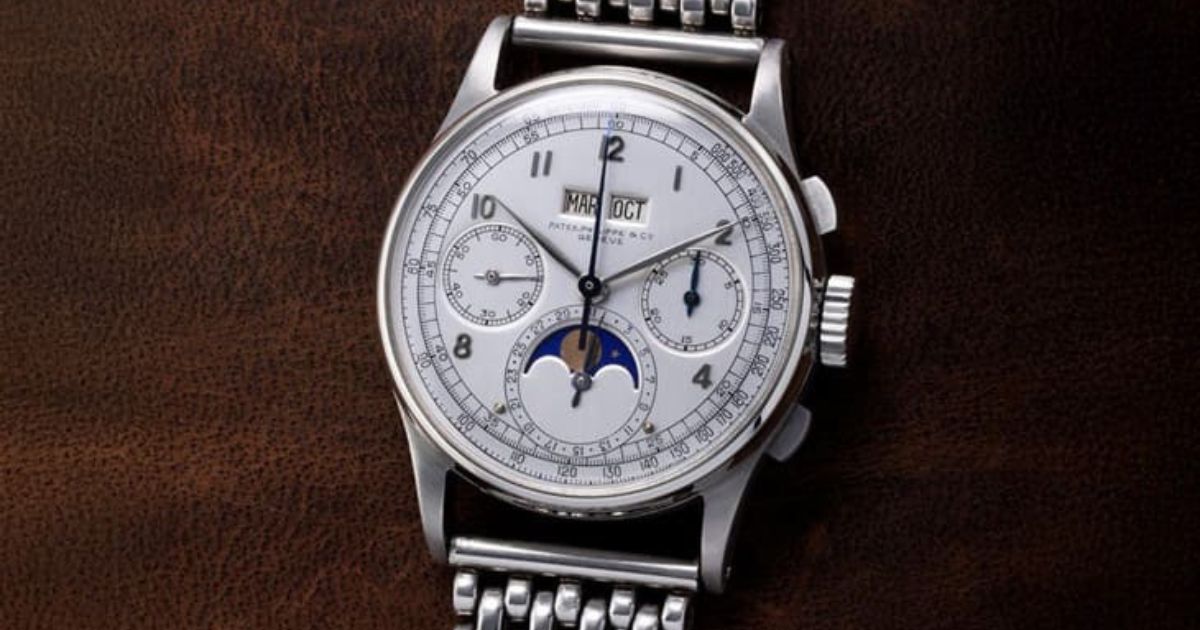
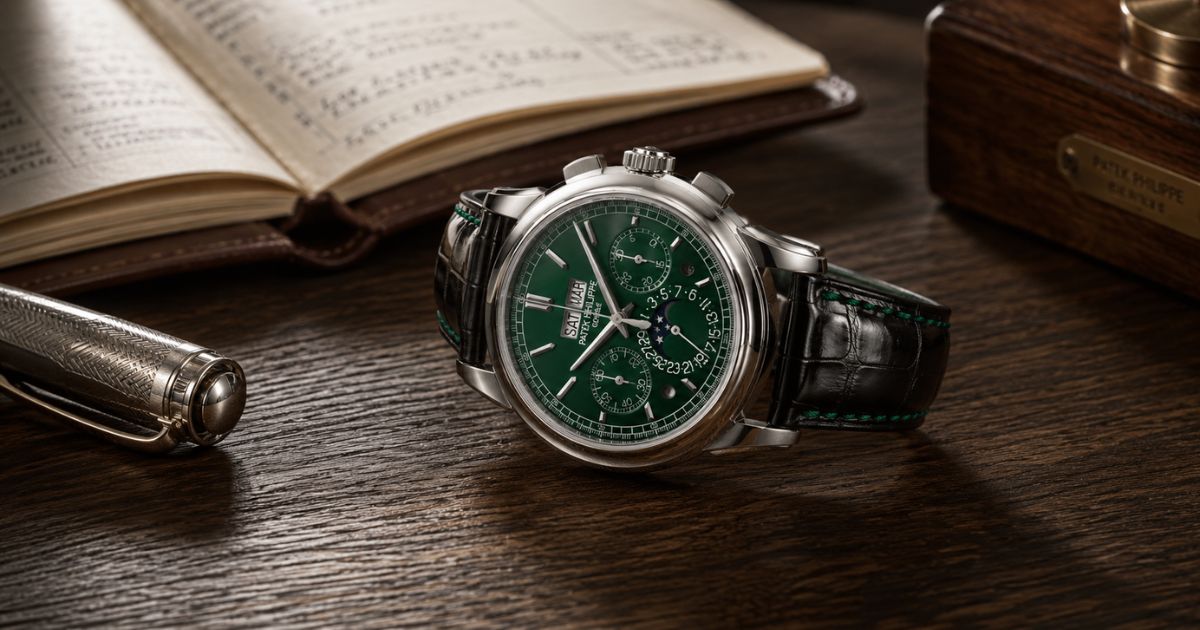
- The Perpetual Calendar Wristwatch: Patek Philippe created the first one in 1925.
The Iconic Models:
- Nautilus: Designed by Gérald Genta in 1976. The “Jumbo” (ref. 3700/1A) saved the brand during the quartz crisis by making stainless steel fashionable.
- Calatrava: The archetypal round dress watch, launched in 1932, featuring Bauhaus-inspired minimalism .
- Grandmaster Chime: The modern grail watch, featuring 20 complications including an alarm that strikes the time.
Learners Takeaway: Patek Philippe represents the pinnacle of investment and value retention in the mechanical world.
Audemars Piguet: The Disruptive Genius (Est. 1875)
Completing the trinity is Audemars Piguet. Hailing from the Vallée de Joux (the birthplace of complex watchmaking), Audemars Piguet is the “cool” uncle of the group. They took the centuries-old rules of the first two brands and threw them out the window.
The Philosophy:
Audemars Piguet is about audacity. While Vacheron Constantin and Patek Philippe were focused on elegant dress watches, Audemars Piguet realized that the future belonged to the integrated bracelet sports watch. They have arguably become the most relevant Trinity brand for the 21st century due to their risk-taking.
The Defining Innovations:
- The First Minute Repeater Wristwatch: In 1892, they created the first wristwatch with a minute repeater, shrinking complex chimes for the wrist.
- The First Skeleton Watch: They introduced the first skeletonized watch in 1934, revealing the movement’s architecture.
The Iconic Models:
- Royal Oak (1972): This is the big one. Designed by Gérald Genta overnight, it was the first luxury sports watch made of steel. With its octagonal bezel and exposed screws, it was considered ugly at launch, but it became the blueprint for every luxury sports watch that followed.
- Royal Oak Offshore: The “Beast” of the 1990s, a larger, chunkier, more masculine evolution of the Royal Oak.
- Code 11.59: A recent, controversial, but technically brilliant collection showcasing AP’s ability to innovate beyond the Royal Oak silhouette.
Learners Takeaway: AP proves that heritage does not have to mean “stuffy.” True mastery allows for disruption.
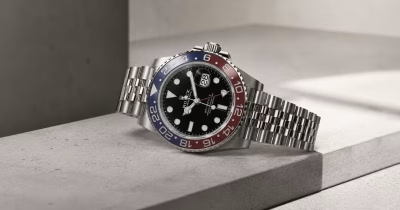
Why Isn’t Rolex in the Trinity?
This is the most common question from new learners. Rolex is the most famous tool watch brand in history.
The Trinity is not about fame or robustness; it is about high complications and hand-finishing.
Rolex excels at making incredibly durable, precise, and mass-produced mechanical movements (Oyster Perpetual, Daytona, Submariner). They manufacture over a million watches a year.
The Trinity, by contrast, produces low volumes with high manual labor. They specialize in haute couture complications like Tourbillons, Minute Repeaters, and Perpetual Calendars—things Rolex rarely touches. As the adage goes: Rolex is the king of sports; the Trinity is the god of art.
Conclusion
The Holy Trinity—Vacheron Constantin (The Tradition), Patek Philippe (The Perfection), and Audemars Piguet (The Disruption)—represent three distinct paths to the same summit.
For the learner, understanding the Trinity provides a roadmap to the rest of the watch world. Once you recognize the hand-finishing of a Vacheron Constantin, the engineering density of a Patek Philippe, or the avant-garde geometry of an Audemars Piguet, you begin to see time not as a number on a screen, but as a mechanical art form.
Which of the Big Three speaks to your soul? Is it the classical elegance of Vacheron Constantin, the patriarchal status of Patek Philippe, or the rebellious design of Audemars Piguet?