
The Classique Collection: The Essence of Breguet Style
If you ask a hundred people on the street to name the “Father of Modern Horology,” ninety-nine of them will likely shrug. But if you ask a watchmaker, they will whisper a single name: Abraham-Louis Breguet.
Born in Neuchâtel and flourishing in revolutionary Paris, Breguet didn’t just build clocks; he invented the vocabulary of luxury watchmaking. He gave us the tourbillon (to defeat gravity), the shock protection system (to save balance staffs), and the first self-winding mechanism.
But perhaps his greatest invention isn’t a technical one—it is an aesthetic. Today, that aesthetic lives and breathes in the Classique Collection.
In this deep dive, we will dissect the visual DNA of Breguet. We are not talking about prices or market trends. Instead, we will look at the Classique collection as a textbook for watch design. Whether you are a novice collector or a seasoned enthusiast, understanding the Classique is essential to understanding why we value mechanical art.
The Genesis of a Signature
To understand the Classique collection, we must travel back to 1786. Before Breguet, watch dials were chaotic. They were cluttered with Baroque embellishments, thick serif numerals, and heavy hands. It was the “roccoco” overload of the 18th century.
Then came Abraham-Louis.
He stripped the dial bare. He introduced a clean, white enamel or finely guillochéd silver surface. He prioritized legibility. This was radical. At the time, minimalism was not a trend; it was a risk.
The modern Breguet Classique is the direct descendant of those post-revolutionary masterpieces, specifically the famous “Subscription” watches and the legendary No. 5 pocket watch. Holding a modern Classique is like holding a page from a 200-year-old sketchbook.
The 5 Pillars of the Breguet Classqiue
When you look at a watch from the Classique line—be it a simple time-only 5177 or a grand complication 5327—you will notice a consistent set of features. These are the “Codes of Breguet,” and they are strictly enforced.
The Guilloché Dial (The Texture)
Abraham-Louis Breguet realized that bare precious metal was prone to scratches. To protect the surface and add visual interest, he introduced the guilloché engine-turning technique around 1786.
In the Classique collection, the dial is never flat. Look closely: you will see a “Parisian hobnail” (Clous de Paris) pattern covering the entire surface, or perhaps a basket-weave or sunburst motif. These patterns are cut by hand using antique rose engines—machines that are over a century old. They catch the light in a way that a stamped dial never can. It creates a private light show on your wrist.
The Breguet Hands (The Silhouette)
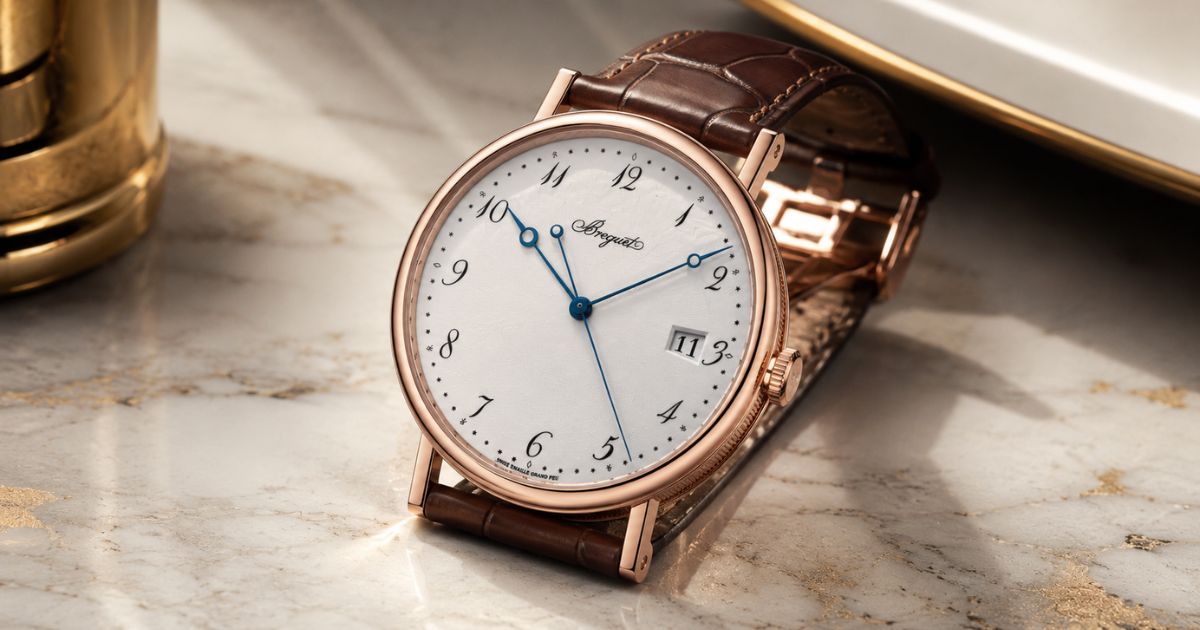
Perhaps the most copied feature in watchmaking is the Breguet hand. It is also known as the “open-tipped” or “hollow apple” (pomme) hand.
Look at the tip of the hour or minute hand. You will see an off-center circle (the eye) cut out of the metal. This is not just for decoration. In the 18th century, with poor candlelight, this cutout allowed the owner to see the numeral underneath the hand. Today, they are usually crafted in blued steel (heated to a specific temperature to turn that deep, midnight blue) or polished gold. The eccentric circle gives the watch a delicate, almost fragile grace that contrasts with the heavy engineering inside.
The Fluted Caseband (The Grip)
Most luxury watches have polished or brushed sides. Breguet uses a technique called “caning” or fluting. The case middle (the band) is decorated with fine, vertical grooves known as “Breguet fluting”.
This is a direct reference to the pocket watch era. The fluting made it easier to grip the smooth case to wind the watch. In a modern context, it is purely aesthetic, but it adds a massive amount of depth to the profile of the watch.
The Welded Lugs (The Connection)
In many high-end watches, lugs are integrated into the case or attached with modern machinery. Breguet does it the old way. The lugs are individually welded and soldered to the caseband by hand.
They are straight, tapered, and polished. They look fragile but are incredibly strong. This “hand-welded” aspect is a hallmark of the “Breguet style”—a subtle nod to the fact that a human artisan touched every part of this watch.
The Secret Signature
This is the ultimate “insider” detail. Since 1795, Breguet has used a secret signature on the dial. It is a tiny, engraved stamp of the Breguet name, usually placed near the 12 o’clock position or hidden within the guilloché pattern.
It is nearly invisible to the naked eye at a glance. You need a loupe or a specific angle of light to see it. Historically, this was an anti-counterfeiting measure. Today, it is a treasure hunt for the owner.
Case Study: The Classique 5177
If you want to buy one watch to understand the entire philosophy, look at the Classique 5177 .
It is the perfect archetype. It has a clean “Grand Feu” enamel dial (or guilloché), the blued Breguet hands, the welded lugs, and the fluted case. There is no “look at me” flash. Instead, it relies on perfect proportions—38mm is a classic, unisex size that fits under a cuff effortlessly.
It also houses the modern heart of Breguet: the silicon balance spring and escapement. This is where the magic happens. Breguet was the first to use silicon widely, which is immune to magnetism and needs no lubrication. It is a 21st-century material inside an 18th-century suit. That is the “Essence of Breguet”—the perpetual marriage of art and science.
The 250th Anniversary Evolution (2025)
Celebrating its 250th anniversary, Breguet reminded the world that “Classique” does not mean “Static.”
In 2025, they introduced the Classique Souscription 2025 . This model took the original 1797 “Subscription” single-hand watch and translated it into a modern wristwatch. It shocked purists in the best way possible. Why? Because they changed the rulebook slightly.
They introduced a new alloy: Breguet Gold (a pale, 18K gold mix with palladium for a unique blonde hue). They even altered the case ergonomics, curving the lugs more drastically for wrist comfort.
But they kept the soul: the immaculate white enamel dial and the single, blued steel hand. It won the GPHG “Aiguille d’Or” (Golden Hand) in 2025—the Oscars of watchmaking—proving that purity and restraint are still the ultimate luxury
Why This Matters for Learners
When you study the Breguet Classique, you are studying the Roots of the watch tree.
Modern watches often borrow from Breguet. The “Breguet numerals” (those whimsical Arabic numerals), the “Breguet overcoil” (the terminal curve of the hairspring), and the hands are copied by countless brands from Seiko to Patek Philippe.
But owning or even studying a true Classique is different. It is authentic. It is the source code. It teaches you that a watch doesn’t need a rubber strap or a skeletonized dial to be exceptional. It needs proportion, texture, and history.
The Classique Collection is not a product line. It is a portrait of Abraham-Louis Breguet himself: a revolutionary who believed that elegance is the most complicated complication of all.