
What is a GMT Watch? A Beginner’s Guide
If you have spent any time browsing the halls of luxury watch forums or window-shopping at high-end boutiques, you have probably heard the term “GMT.” It is one of those horological acronyms that gets thrown around a lot, often accompanied by images of pilots, jetsetting lifestyles, and some of the most iconic watches ever made (looking at you, Rolex).
But if you are new to the hobby, you might be asking yourself: What exactly is a GMT watch? Do I really need one? And how do you even read that weird extra hand?
As someone who loves the intersection of functionality and style, I am here to tell you that the GMT complication is not just a tool—it is a fantastic addition to any collection. Whether you are a world traveler or a homebody who just loves mechanical ingenuity, this guide will break down everything you need to know about GMT watches.
What Does “GMT” Actually Mean?
Let’s start with the basics. GMT stands for Greenwich Mean Time.
Back in 1884, an international conference decided that the Prime Meridian (zero degrees longitude) would be located at the Royal Observatory in Greenwich, London. The time at this specific line became the reference point for the entire world. So, when we say a time zone is “GMT +8,” we mean it is eight hours ahead of London.
In the watch world, a “GMT” watch is simply a timepiece that allows you to track two (or sometimes three) different time zones simultaneously. It is the ultimate nod to the golden age of aviation and global exploration.
A Quick Trip Through History
The story of the GMT watch is deeply tied to the dawn of the Jet Age. In the 1950s, air travel was becoming more accessible, and pilots flying long-haul routes for airlines like Pan Am faced a major headache: disorientation. They needed a watch that could show both the local time (where they were landing) and “home time” (Zulu time or their base time) simultaneously.
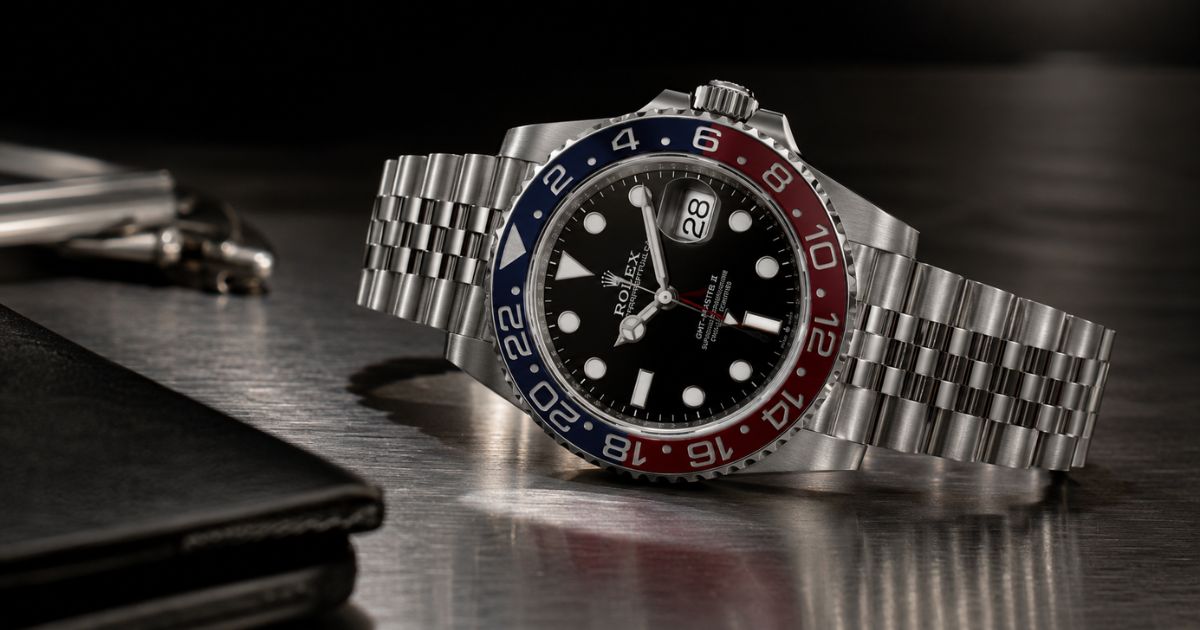
Pan Am approached Rolex to solve this problem. In 1955, the result changed watchmaking forever: the Rolex GMT-Master. It featured a fourth hand and a two-color bezel (the iconic blue and red “Pepsi”) to distinguish day from night in the 24-hour format.
While Rolex popularized it, Glycine also played a major role with the Airman around the same time. Regardless of who did it first, the “GMT” complication became the standard for pilots and frequent flyers.
How to Identify a GMT Watch
How can you spot a GMT watch on a wrist? Look for three distinct features:
1. The Fourth Hand
A standard watch has hour, minute, and seconds hands. A GMT watch has a fourth hand. This hand is often a different color (bright red, blue, or orange) and features an arrowhead or a distinct shape. This hand tracks the second time zone.
2. The 24-Hour Scale
Because the fourth hand only circles the dial once every 24 hours (instead of twice like the regular hour hand), it needs a 24-hour scale to read. You will find this scale in one of two places:
- On the Rehaut (Dial): Printed on the inside of the dial (like the Rolex Explorer II).
- On the Bezel: Most commonly, it is on a rotating bezel. This is my favorite look, as it adds a layer of “tool watch” aesthetic.
The Two Types of GMT Movements
When you start shopping, you will encounter two different “flavors” of GMT movements. Understanding this will save you a lot of confusion.
1. The “Caller” GMT (Office GMT)
This is the more common, entry-level style. Here, the local hour hand and the GMT hand are linked. You set the GMT hand to your home time, and then you stop setting the GMT hand. When you travel, you jump the local hour hand? You can’t (without stopping the watch). Instead, the GMT hand stays static, and you rotate the bezel to read a third time zone.
- Best for: People who don’t travel constantly but like tracking a second time zone (like a friend abroad).
2. The “Flyer” GMT (True GMT)
This is the luxury standard (found in watches like the Rolex GMT-Master II or Grand Seiko). In this movement, the local hour hand can be adjusted independently in one-hour increments without stopping the seconds or the GMT hand.
- Best for: Frequent travelers. You land in a new city, pull the crown out one notch, and click the local hour hand forward or backward to the new time. The GMT hand stays locked to your home time.
How to Read and Set a GMT Watch (The Simple Way)
If you just bought one or are trying one on, here is the easiest way to use it.
Scenario: You live in New York (GMT -5) but are traveling to London (GMT 0).
The Setup:
- Set the GMT hand to your Home Time (New York).
- Set the Main hour hand to your Local Time (London).
- Leave the 24-hour bezel at the neutral “12 o’clock” position.
How to Read it:
- Local Time: Look at the main hour hand. It reads 2:00 PM? That is the time in London.
- Home Time: Look at the colorful fourth hand. Where is it pointing on the 24-hour bezel? If it points to “10,” it is 10:00 AM back home in New York.
Pro Tip: Because the bezel uses 24 clicks, you instantly know if it is AM or PM back home (something a standard dual-time watch cannot tell you without a window).
GMT vs. Dual Time: What is the Difference?
You will see these terms used interchangeably, but there is a technical difference.
- Dual Time: Usually shows a second time zone on a sub-dial (a small clock within the main dial). It often uses a 12-hour scale, meaning it might not tell you if it’s day or night in that other zone unless it has an AM/PN indicator.
- GMT: Specifically uses a 24-hour hand and scale. It is designed to distinguish between day and night at a glance.
If you are a minimalist who just needs to know the hour for a conference call, Dual Time is fine. If you are a pilot or a traveler who needs to know if it is 3:00 AM (bad time to call home) or 3:00 PM (perfect time), you want the GMT.
Why You Should Add a GMT to Your Collection
You don’t need to be a pilot to love a GMT.
1. Unmatched Legibility
The 24-hour format removes all guesswork. If that fourth hand is pointing to the bottom of the dial (the 6 o’clock position, or 12 on the 24-hour scale), it is midnight. If it points to the top, it is noon. It is a very logical way to visualize a full day.
2. The “Three Time Zone” Trick
Here is the cool part. Because the bezel rotates, you can actually track a third time zone. Set your main hand to local time, your GMT hand to home time, then rotate the bezel. If you rotate the bezel to show the offset for Tokyo, the GMT hand will now point to the time in Tokyo on the bezel. It is a neat party trick and genuinely useful.
3. The Style Factor
Let’s be honest—watches are jewelry. The rotating 24-hour bezel adds a layer of complexity and visual interest to a dial that a standard datejust just doesn’t have. Whether it is the vintage charm of a “Pepsi” bezel or the stealth of a Ceramic “Batman,” GMTs are just cool.
Final Thoughts
The GMT watch is a perfect example of form following function. It was born out of a genuine need for pilots, but today it has evolved into a symbol of exploration and global connection.
If you are looking for your first “serious” luxury watch, a GMT is an excellent choice. It offers more utility than a simple three-hand watch but is much easier to read and use than a busy chronograph or a world timer.
So, go ahead. Set that fourth hand to your favorite place in the world. You might find that even when you are sitting at home, you start traveling in your mind.
Happy collecting