
How Does a World Time Watch Actually Work? The Complete Guide
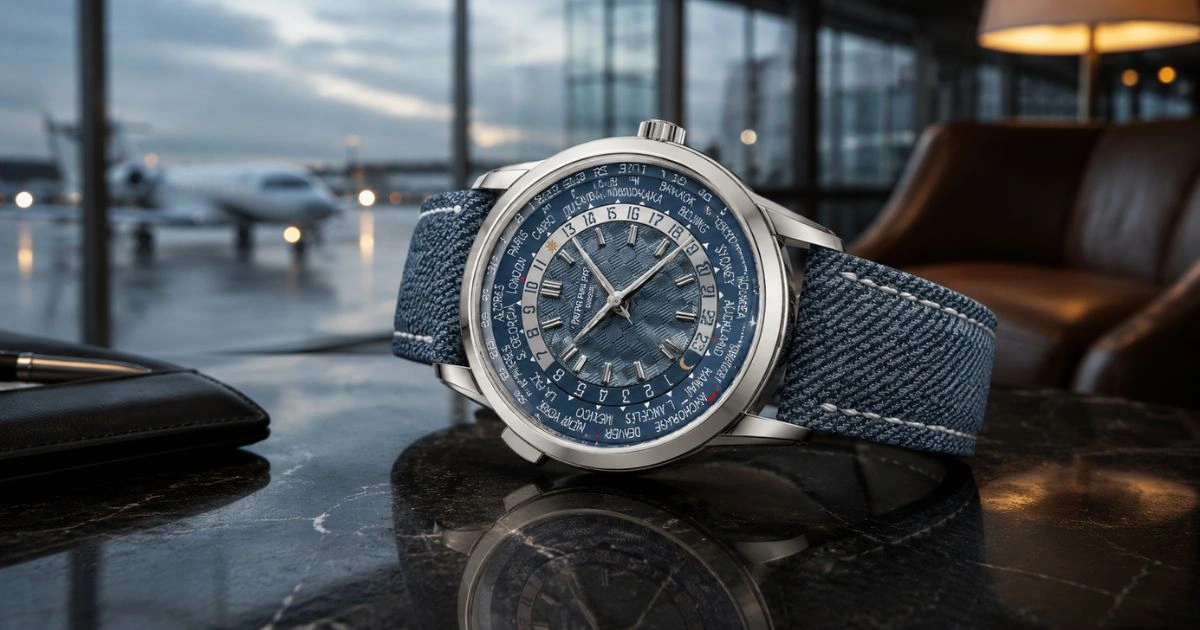
Imagine landing in London, and with a single press of a button, your watch knows you’ve crossed the Channel. The hour hand jumps forward. The date corrects itself. And on the dial, a ring of city names rotates in perfect sync with a 24-hour disc, instantly telling you that while you sip your Earl Grey at 10 AM, your colleague in Tokyo is already wrapping up his day at 6 PM.
This isn’t smartwatch technology. It is pure, unadulterated haute horlogerie.
The World Time complication—often referred to by its German name Weltzeit or the French Heures Universelles (HU)—is one of the most romantic and mechanically satisfying complications in luxury watchmaking. It effectively shrinks the globe onto your wrist.
But how does it actually work? Unlike a GMT, which tracks a second time zone, a true World Time watch allows you to read the time in all 24 time zones simultaneously without moving the bezel or doing math.
Let’s demystify the mechanics.
The Blueprint: The Two-Disc System
At its core, a mechanical world time watch relies on a simple, brilliant visual interaction between two rotating discs.
- The Cities Disc (Outer Ring): This features the names of 24 major cities, each representing a specific time zone (e.g., London, New York, Tokyo).
- The 24-Hour Disc (Inner Ring): Inside the city names, this ring is divided into 24 segments. It typically features a gradient—often dark for night-time and light for daytime—with numerals from 1 to 24.
The dial is completed by a standard set of central hour and minute hands.
How to read it:
The magic trick is that these two discs move in opposite directions. The inner 24-hour disc rotates counter-clockwise once every 24 hours, mimicking the Earth’s rotation.
You align the city representing your current location with the 12 o’clock marker. Now, look at the 24-hour disc. The hour number sitting next to any other city on the outer ring is the current time there.
For example, if it is 10:00 AM in London (at 12 o’clock), you look at the “Tokyo” city marker. If the 24-hour disc shows “18” next to Tokyo, it is 6:00 PM there.
The Genius of Louis Cottier
To understand the modern World Time watch, we must travel back to the 1930s. Before 1931, displaying multiple time zones on a wristwatch was clumsy. Enter Louis Cottier, a Genevan master watchmaker.
Cottier developed a revolutionary movement that linked the hour hand to the city and 24-hour discs. His system allowed the wearer to read all zones at a glance. Patek Philippe immediately recognized the genius of his invention, and their collaboration produced the first serially produced World Time watches in 1937.
For decades, adjusting these watches was a fiddly process involving two crowns—one for the hands and one to turn the city ring. If you traveled from New York to Los Angeles, you had to disengage gears manually.
The Modern Revolution: The “Push-Button” System
The true breakthrough for user experience came in the year 2000.
Patek Philippe released the legendary Ref. 5110, based on the Calibre 240 HU. This changed the game entirely. While the visual layout remained similar to Cottier’s design, the mechanism underneath was radically different.
Instead of a second crown, Patek Philippe placed a pusher at 10 o’clock.
This is where the mechanical poetry happens. When you land in a new time zone and press the pusher at 10 o’clock:
- The hour hand jumps forward by one hour.
- The City disc rotates counter-clockwise by one position (bringing your new location to 12 o’clock).
- The 24-hour disc also advances counter-clockwise.
Crucially, the minute hand never stops moving. This ensures the watch retains perfect accuracy. The mechanism uses a sophisticated clutch system with a 12-tooth starwheel that allows the hour hand to “jump” independently of the going train.
The Final Frontier: The Local Date
For decades, the World Time watch had one frustrating flaw: the date. Most mechanical watches have a date wheel that turns forward at midnight. But what happens if you fly backwards across the date line?
Traditionally, if you flew from Tokyo to Honolulu, you would have to manually spin the crown for hours to reverse the date. Or, worse, you risked breaking the movement by changing the date between 9 PM and 3 AM.
In 2023 (and released widely in 2024), Patek Philippe solved this with the Ref. 5330G-001.
How does it work? They introduced a patented central differential system with two concentric gears—one with 62 teeth, one with 31. The differential allows the date hand to “remember” its position.
- Move forward over the date line? The system adds a day.
- Move backward over the date line? The system subtracts a day.
When you press the pusher at 10 o’clock to change time zones, the date hand swings forward or backward automatically to stay synchronized with the local time. It is arguably the most practical evolution of the complication in 80 years.
GMT vs. World Timer: A Quick Clarification
Since this is a complete guide, it is essential to distinguish between two terms often used interchangeably but which are very different in practice.
- The GMT (Dual Time): Typically uses an extra hand (or a central skeletonized hand) to track a second time zone. You set it once for your “home” time, and it stays there. It is the pilot’s watch—lean, easy to read, and perfect for tracking just one other location.
- The World Timer: As described above, it tracks all zones. It is the explorer’s or diplomat’s watch. You don’t need to know the UTC offset of Singapore; you just look at the dial.
Summary: Why It Matters
A World Time watch is a testament to human ingenuity. It takes the rotation of the Earth (24 hours), the political division of time zones (the city ring), and mechanical memory (the differential) and displays them on your wrist.
The next time you see a watch with a globe or a city ring, look closer. The hands aren’t just telling you the time; they are simulating the steady, silent rotation of the planet beneath your feet. It is mechanical cartography at its finest.