
The Octo Finissimo: Redefining Ultra-Thin Watchmaking
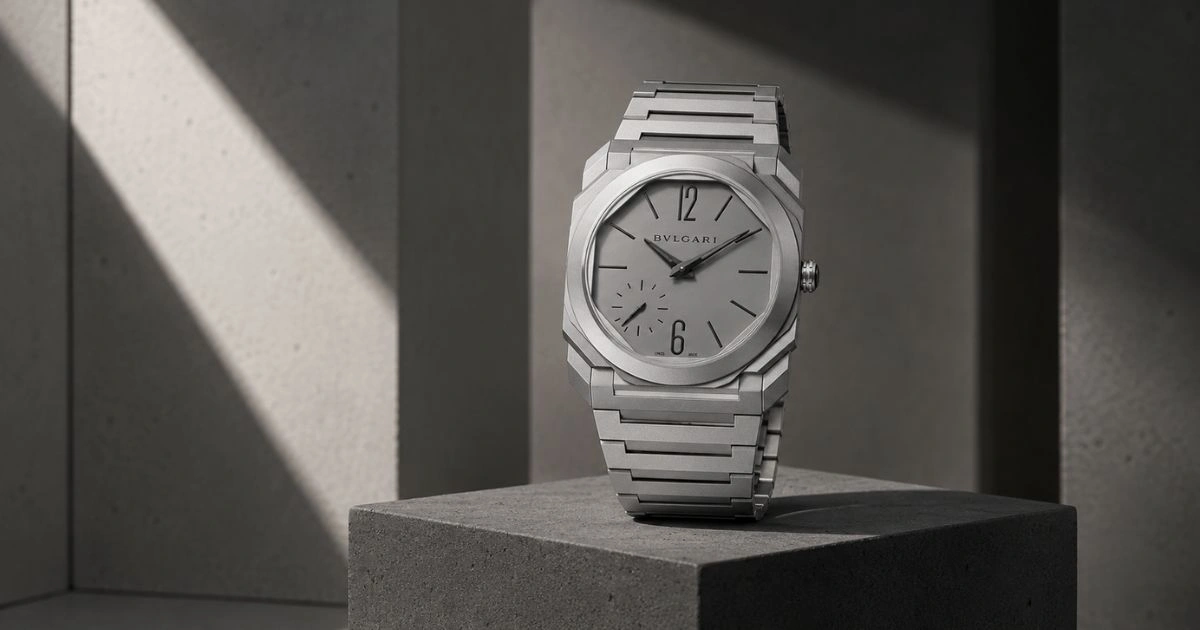
If you hold a typical mechanical watch in your hand, you feel the weight of history—the density of brass and steel, the chunky reassurance of the mainspring barrel. Now, imagine erasing that sensation. Imagine picking up a fully assembled mechanical watch and feeling… nothing. A ghost on the wrist.
That is the magic of the Bulgari Octo Finissimo.
For the past decade, the Octo Finissimo has not just participated in the race for thinness; it has hijacked it. From the moment it burst onto the scene, it rendered the competition obsolete, not merely by shaving off millimeters, but by rethinking the very grammar of watchmaking form and function.
Whether you are a student of industrial design or a collector looking to understand modern “Haute Horlogerie,” the Octo Finissimo is a mandatory study. Let’s break down why this Italian-designed, Swiss-made phenom is the undisputed king of thin.
The Geometry of Disruption (The Case)
Before we talk about the movement, we have to talk about the case. Most luxury watches rely on curves. The Octo Finissimo rejects them entirely.
The design, penned by Fabrizio Buonamassa Stigliani at Bulgari, is a love letter to Roman architecture. It is an exercise in radical geometry: a circle within an octagon within a square. While the Gerald Genta designs (like the Royal Oak or Nautilus) use screws and portholes to soften their look, the Octo goes full brutalist. It is sharp, angular, and uncompromising.
But here is the learning point for aspiring designers: Extreme proportions demand extreme finishing. Because the case is so flat (sometimes just 1.8mm thick), there is no room for error. If the polishing is off by a micron, the light won’t hit the facets correctly. The Finissimo uses a mix of satin brushing on the top surfaces and mirror polishing on the bevels. This contrast creates “light traps” that make the watch look like a piece of liquid metal sliding under a shirt cuff, even though it is only a few millimeters tall.
The Engine Room: Engineering the Impossible
Now, let’s get technical. The true genius of the Octo Finissimo lies in what is not there.
In traditional watchmaking, a movement has a base plate, bridges, and a mainplate stacked on top of each other. The Finissimo team looked at that and asked: “What if we got rid of the floor?”
The Micro-Rotor Revolution
To achieve thinness, you cannot have a large oscillating weight swinging over the top of the movement. That would add 1mm all by itself. Instead, Bulgari pioneered the use of a peripheral micro-rotor.
- The BVL 138: In the standard 40mm models, this movement is just 2.23mm thick.
- The BVF 100 (2026): In the new 37mm models, Bulgari had to shrink the diameter. Logic says a smaller watch should be thinner. Bulgari actually made the movement slightly taller (2.35mm) to keep it robust, but reduced the volume by 20%. They prioritized wearability over a meaningless millimeter statistic.
The “No-Baseplate” Approach
For their record-breaking pieces, like the Octo Finissimo Ultra Tourbillon, Bulgari took a radical step: they eliminated the baseplate entirely. The caseback becomes the mainplate.
Furthermore, they moved the winding and setting mechanisms to the edge of the movement rather than stacking them on top. The crowns are actually geared wheels that sit flush against the side. When you wind the watch, you aren’t turning a stem; you are turning a gear train directly.
As one review noted, looking at these movements feels “surreal”. You see the mainspring barrel and the gears immediately, without layers of brass obscuring the view.
The “Small” Revolution: Why 37mm Matters
If you have been following the watch world in 2026, you know the big news: The Octo Finissimo 37mm.
For years, some collectors found the 40mm Finissimo too wide for its height—like a piece of paper stretched too far. At Watches and Wonders 2026, Bulgari answered with a complete redesign.
- The New Calibre BVF 100: It was not enough to just shrink the case. Bulgari spent three years developing a new movement specifically for this size.
- The Trade-Off: The new watch is 6.45mm thick (vs. the 40mm’s 5.15mm). Wait, did they go backward? No. They added a millimeter of height to gain 12 hours of power reserve (now 72 hours) and a much better fit for smaller wrists.
This move teaches an important lesson: Thinness for the sake of a number is useless if the watch wears poorly. The 37mm is an evolution of ergonomics, not just a record-chaser.
The Artistic Canvas: More Than Just Tech
The Octo Finissimo has become the ultimate canvas for artistic expression. Because the case is so flat and the dial so wide, it acts like a blank slate.
Bulgari has collaborated with artists like Lee Ufan to create pieces that are as much sculpture as timekeeper. In the Lee Ufan edition, the bracelet is violently scratched to look like raw stone, contrasting with a mirror-polished dial. Fabrizio Buonamassa famously took a prototype bracelet and “destroyed it” to replicate the texture of a rock.
This is a vital takeaway for learners: Ultra-thin is a complication. Just like a tourbillon or a minute repeater, making a watch this flat requires solving impossible physics problems. Bulgari has earned ten world records because they treat thinness not as a byproduct, but as the main event.
Final Thoughts: The Icon of Our Era
Is the Octo Finissimo comfortable? Unbelievably so. The bracelet is so flexible it folds like paper. The clasp is integrated into the links so there is no bulky lump under your wrist.
But more importantly, the Octo Finissimo has changed how we look at watches. Before 2014, “thin” meant “dress watch”—small, round, and fragile. The Octo Finissimo proved that an ultra-thin watch could be sporty, angular, and aggressive.
It doesn’t just tell time. It defines space.
Key Takeaways for the Collector
- Look at the materials: Titanium is the metal of choice here because it is rigid enough to be this thin without bending.
- Check the clasp: The folding clasp on the Finissimo is unlike any other; it sinks into the bracelet, not above it.
- Don’t fear the 40mm: The wide, flat lugs make the 40mm wear like a bracelet, not a dinner plate. Try both the 40mm and the new 37mm to see which geometry speaks to your wrist.
The Octo Finissimo is not just a watch; it is a manifesto. And it is the standard by which all modern integrated bracelet watches are judged.