
The Explorer and Explorer II: Built for Adventure
In the pantheon of luxury sports watches, there are icons born in boardrooms, and then there are legends forged in the grit of the Earth’s extremes. The Rolex Explorer and Explorer II belong strictly to the latter category.
While the Submariner conquers the deep and the Daytona rules the racetrack, the Explorer collection has always served a purer, perhaps more romantic purpose: to be the tool on the wrist of those who push human boundaries.
As a collector, it is easy to get lost in polished chamfers and ceramic bezels. But today, I want to take you back to the raw essence of horology. We are going to dissect the ultimate adventure duo. Why does the simple, time-only Explorer I remain the quintessential “under-the-radar” grail, and why has the “underdog” Explorer II become the smart traveler’s best friend?
Let’s strap in.
The Genesis: The Summit
To understand the Explorer, we have to travel back to 1953. Before the watch had a name, it was simply the Oyster Perpetual worn by Sir Edmund Hillary and Tenzing Norgay as they stepped onto the summit of Mount Everest.
Rolex didn’t just release a watch to celebrate that; they released a philosophy. The Rolex Explorer (ref. 6350, later 1016) was a watch built for the harshest conditions on earth. But here is the fascinating part that many learners miss: the original Explorer is almost tragically simple.
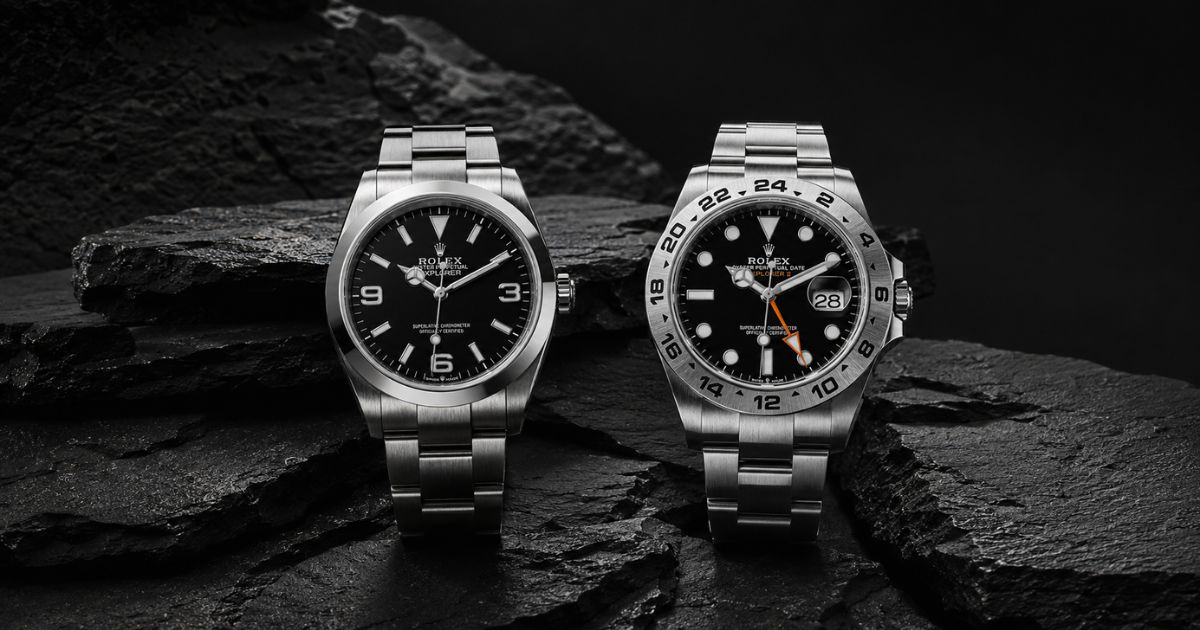
In an era of dive timers and flyback chronographs, the Explorer I is just a time-only watch. It features a clean, highly legible dial with large 3, 6, and 9 numerals. That’s it.
- The Magic: The absence of clutter is its superpower.
- The Durability: It houses the robust Oyster case, shielding the movement from dust, moisture, and shock.
The Explorer I teaches us a vital lesson in luxury: Absolute toughness often wears a very discreet face. It is the watch for the climber who needs reliability, not distractions. It is stealth wealth at its most functional.
The Problem of Darkness: Enter the Explorer II
By 1971, the original Explorer was a classic, but the needs of explorers had evolved. Speleologists (cave explorers) and polar expedition leaders faced a unique problem: when you spend days in darkness or weeks of Arctic midnight sun, you lose track of AM vs. PM.
Thus, Rolex introduced the Explorer II Ref. 1655. And initially, it was a commercial flop. But in horology, failure today often means legend tomorrow.
The Ref. 1655, now nicknamed the “Steve McQueen” (though he never actually wore it), looked radical. It featured a fixed 24-hour graduated bezel and a bright orange, arrow-tipped 24-hour hand.
- The Function: Unlike the GMT Master, the first Explorer II’s 24-hour hand was not independently adjustable. It was locked to the main hour hand.
- The Purpose: It wasn’t for tracking a second time zone (yet). It was a pure day/night indicator. If the orange hand was on the “6” (18:00) side of the dial, it was evening.
This distinction is crucial for the learner to understand. The first Explorer II was not a traveler’s watch; it was a survival tool for the underworld.
The Evolution: Becoming the Travel Icon
The modern Explorer II we know and love didn’t really hit its stride until 1985 with the Ref. 16550. This is where the plot thickens and the watch becomes a “GMT.”
Rolex introduced two major changes:
- The “Polar” Dial: A stark, brilliant white dial that offered unparalleled legibility and has since become the collector’s favorite.
- True GMT Function: With the Calibre 3085, the 24-hour hand became independently adjustable.
Suddenly, the Explorer II wasn’t just for caves. It was for jetsetters. You could now keep your home time on the 24-hour hand (pointing to the fixed bezel) while jumping the main hour hand to local time. It offered the functionality of the GMT Master II but with a much tougher, more utilitarian aesthetic.
The Ref. 16570 (1989-2011) refined this further, shrinking the lug holes and updating movements, but the soul was set.
The Modern Titans: 216570 & 226570
In 2011, Rolex celebrated the Explorer II’s 40th birthday with the Ref. 216570. They supersized it to 42mm (up from 40mm) and, in a move that thrilled purists, brought back the iconic “Freccione” (big arrow) —the massive orange 24-hour hand of the 1655.
The current generation, Ref. 226570, houses the powerful Calibre 3285.
- Power Reserve: 70 hours (take it off on Friday, it’s still running Monday).
- Chronergy Escapement: Highly efficient and resistant to magnetic fields.
Today, choosing between the Explorer I and Explorer II is a fascinating decision for any collector.
Side-by-Side: The Choice
Wear the Explorer I (36mm or 39mm) when:
- You value symmetry and understatement.
- You want a watch that works with a tuxedo as well as a hiking boot.
- You believe that “less is more.” The Explorer I is the thinking person’s Rolex. It has no date, no cyclops, just pure symmetry.
Wear the Explorer II (42mm) when:
- You have an affinity for “tool watch” aesthetics—chunky, functional, and bold.
- You travel frequently or work with multiple time zones.
- You want the legibility of the “Polar” white dial (a must-have in my opinion) or the high-contrast black dial.
- You appreciate a watch with a “failed” past that turned into a cult icon.
Final Thoughts
The Explorer duo is Rolex at its most honest. Without the polished flash of the Datejust or the intimidating mass of the Deepsea, the Explorers are simply ready.
For the learner entering the world of luxury watches, do not overlook these models for the hyped steel sports models. The Explorer is the quiet companion for a lifetime of daily adventures. The Explorer II is the robust companion for crossing borders and time zones.
They aren’t just watches. They are instruments, designed not to be looked at, but to be relied upon when the road ends and the wilderness begins.
What is your take? Are you Team Polar (Explorer II) or Team Classic (Explorer I)? Let me know in the comments below.