
GMT vs. World Time: What’s the Difference and Which is Right for You?
As lovers of haute horlogerie, we often find ourselves drawn to complications not just for their mechanical complexity, but for the story they tell about our lives.
For the global citizen, few complications are as visually arresting or genuinely useful as the ones tracking our planet’s hours. Yet, there is a persistent confusion at the boutique counter and among collectors: What exactly is the difference between a GMT and a World Timer?
At first glance, they seem to serve the same purpose—keeping you connected to distant time zones. But in practice, these two complications are philosophically different beasts. One is a lean, mean, cross-continental machine; the other is a sweeping atlas of human civilization.
Let’s dissect the mechanics, the history, and the lifestyle behind each, so you can decide which complication deserves a spot in your rotation.
The GMT: The Pilot’s Trusted Co-Pilot
What is it?
GMT stands for Greenwich Mean Time. Historically, this was the global time standard based on the Prime Meridian in London. In watchmaking, a GMT complication allows you to track two time zones simultaneously.
How to Spot It?
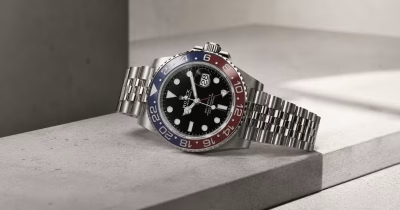
Look at the center of the dial. You will see the standard hour and minute hands, but there is a third hand—often distinguished by an arrowhead and a contrasting color (like bright red or blue). This is the GMT hand. It completes one full rotation of the dial every 24 hours, rather than every 12.
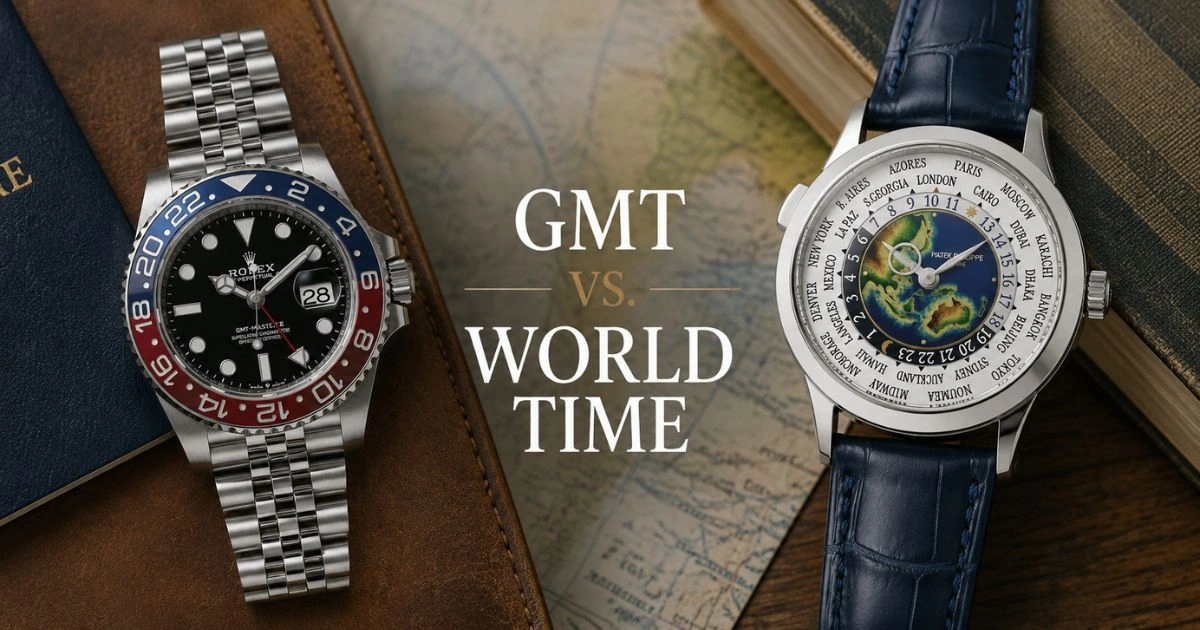
To read it, you reference a 24-hour scale. This scale might be printed on the rehaut (inner ring) or, most iconically, on a bi-directional rotating bezel (think the “Pepsi” or “Batman” Rolex GMT-Master II).
The Mechanics: “Caller” vs. “Traveler”
Not all GMTs are created equal. There is a crucial mechanical distinction that dictates how you live with the watch:
- The “Caller” GMT (Office GMT): This is the more common, entry-level mechanism. The main hour hand and the GMT hand are linked. You set the GMT hand to your “home” time, and then you jump the main hour hand in one-hour increments to your “local” time. This is great if you sit in an office in New York and need to know the time in London, but you never actually change time zones yourself.
- The “Traveler” GMT (True GMT): This is the grail for the jet-setter. When you pull the crown, you jump the local hour hand forward or backward without stopping the seconds or disturbing the minute hand. The GMT hand stays locked onto your home time. This allows you to land in Singapore, pull the crown, flick the hour hand forward six hours, and go—all while maintaining perfect accuracy.
The Verdict: The GMT is for the business traveler. It is a tool of action. It prioritizes legibility and speed. It tells you exactly where you are and exactly where home is, with one glance. It is rugged, specific, and highly functional.
The World Timer: The Continental Command Center
What is it?
If the GMT is a scalpel, the World Time watch is a map. A true World Timer does not need to be adjusted when you land; it shows you the current time in all 24 time zones at the same time.
How to Spot It
These watches are theatrical. The dial is usually busier, featuring a world map in the center or a ring of city names (frequently referred to as the “City Ring”) around the periphery. You will see a 24-hour ring, often split into day (light) and night (dark) halves.
The Magic Behind It
Most modern World Timers owe their design to the genius of Louis Cottier, who developed the system for Patek Philippe in the 1930s.
The function is brilliant in its simplicity:
- You set your local time via the central hands.
- You align the city representing your current location (e.g., “LONDON” or “NYC”) with the 12 o’clock position or the 24-hour mark.
- Instantly, you can look around the ring. If it is 10 AM in Geneva, you can see that it is 5 PM in Hong Kong, and 1 AM in Los Angeles.
The Lifestyle Fit: The World Timer is not necessarily designed to be changed every time you cross a border (though you can reset the city ring). It is designed for awareness. It is for the CEO who has teams on three continents, or the collector who simply loves the poetry of watching the world spin on their wrist.
Head-to-Head: The Comparative Analysis
For the luxury blog reader looking to make a decision, the choice comes down to Identity vs. Utility.
| Feature | GMT (Greenwich Mean Time) | World Timer (Worldtime) |
|---|---|---|
| Primary Function | Tracks one secondary time zone (Home) plus Local. | Tracks all 24 time zones simultaneously. |
| Dial Aesthetic | Clean, tool-ish, sporty. Usually features an extra hand. | Complex, artistic, map-centric. Looks like an instrument panel. |
| Adjustment | Highly interactive (the “Traveler” GMT allows quick local jumps). | Set it and forget it. You observe the world ring, rather than adjust it. |
| Best For | The pilot, the weekly globetrotter, the diver who needs a second zone. | The diplomat, the remote manager, the romantic who loves geography. |
| Readability | Instant: You know “Home” and “Here” in a second. | Broad: You see the whole picture, but must focus to find a specific zone. |
The “Grey Area”: Dual Time
Before we conclude, we must mention the Dual Time. Brands often use this term loosely. Generally, a Dual Time watch is a simpler version of a GMT. It usually lacks the 24-hour hand. Instead, it offers a small sub-dial (often running on a 12-hour or 24-hour scale) or even a second digital display. It is “two times” but without the full 24-hour day/night indicator that makes GMTs so user-friendly.
Which One is Right for You?
Ask yourself: How do you move through the world?
You should buy a GMT if:
- You are on a plane every week.
- You need to know “Is it too late to call home?” instantly.
- You prefer a sporty aesthetic (think steel bezels, oyster cases, integrated bracelets).
- You value the tactile pleasure of adjusting the watch to a new reality every time you land.
You should buy a World Timer if:
- You manage a global team or have family scattered across the globe.
- You view your watch as a piece of art and engineering as much as a tool.
- You rarely change time zones yourself, but you want to visualize the rhythm of the world.
- You appreciate a dressier or more complex dial (enamel maps, engraved cities)
In the end, comparing a GMT to a World Timer isn’t about which is “better.” It is about whether you want a window looking out at one specific destination, or a panorama of the entire sky. Either way, you are wearing a mastery of time—and that is the ultimate luxury.