
Battle of the Icons: Cartier Tank vs. Jaeger-LeCoultre Reverso
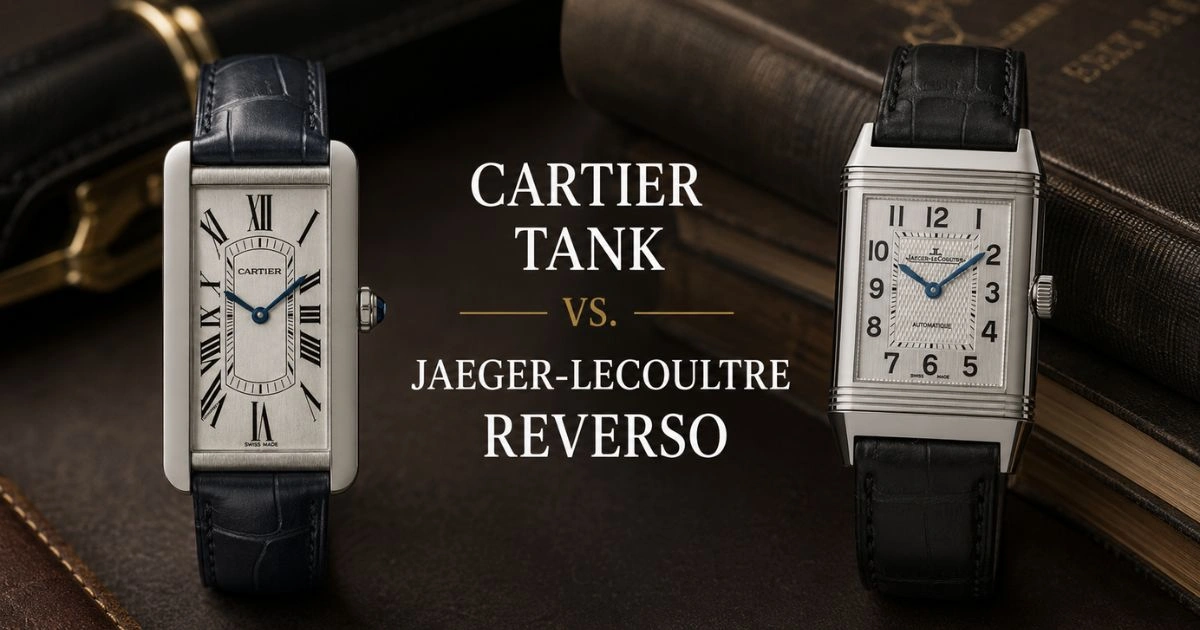
In the pantheon of luxury watchmaking, few rivalries are as enduring—or as elegantly contested—as that between the Cartier Tank and the Jaeger-LeCoultre Reverso. Both are rectangular. Both are icons. Both have graced the wrists of cultural legends, from Princess Diana to Andy Warhol. But beyond their geometric kinship, these two timepieces represent profoundly different philosophies. One is a triumph of Parisian design; the other is Swiss engineering elevated to an art form. This is a battle of style versus substance—or perhaps, as you’ll see, it’s a battle of whose style and substance speaks more clearly to you.
Common Ground: The Art Deco Legacy
Before we draw battle lines, let’s acknowledge the shared DNA. Both watches were born in the crucible of the early 20th century, a time when wristwatches were transitioning from novelty to necessity. The Cartier Tank, first prototyped in 1917 and released to the public in 1919, drew inspiration from the aerial view of the Renault FT-17 tank—its parallel brancards evoking military treads. The Jaeger-LeCoultre Reverso, arriving in 1931, was a direct response to a problem: British officers in India were damaging their watch crystals during polo matches, necessitating a case that could slide and flip to protect the dial.
Both watches are sculptural. They are not merely rectangles but case studies in proportion, where every line and angle is intentional. And while both are considered dress watches today, their versatility is legendary. They look just as at home with a tuxedo as they do with jeans and a t-shirt.
Design & Philosophy: Parisian Elegance vs. Functional Form
At their core, the Tank and the Reverso diverge on a fundamental question: Is the watch a piece of jewelry, or is it an instrument?
The Cartier Tank is design-first. It is stripped back, minimalist, and undeniably elegant. The classic Tank features a silvered dial, Roman numerals, and sword-shaped hands, all framed by the instantly recognizable brancard case. It is a watch that hasn’t changed much since 1917, and that’s precisely the point. It didn’t just ride the wave of wristwatches; it defined the category. As one collector noted, “The Tank is effortless. It’s what Jackie Kennedy wore to the White House… It’s as timeless as it gets”. It is the “white tee of horology: sleek and adaptable”.
The Jaeger-LeCoultre Reverso is function turned into form. Its case isn’t just a case; it’s a mechanism. Designed to flip over to protect the dial, this feature gives the Reverso a structural, almost engineered aesthetic. The look is unmistakably JLC: sharp, structured, and quietly bold, with horizontal gadroons inspired by Art Deco vocabulary. The Reverso isn’t just about telling time; it’s about the idea of watchmaking. It whispers instead of waves.
Wearability: Under the Cuff
How these philosophies translate to the wrist is telling. The Cartier Tank is famously thin. It slides under a shirt cuff with ease and flatters smaller wrists. The Reverso, due to its flipping mechanism, wears a bit taller and often has a longer lug-to-lug distance. While both are unisex, the Tank is generally considered easier to wear for those with slimmer wrists, whereas the Reverso’s presence can feel more substantial.
Movement & Craftsmanship: The Watchmaker vs. The Designer
This is perhaps the most significant divide. Cartier started as a jeweler and designer. For much of its history, the movements inside the Tank were outsourced—some even from Jaeger-LeCoultre themselves. That approach is changing. Today, higher-end Tanks like the Tank Louis are fitted with Cartier’s in-house 1847 MC automatic movement, a reliable and solid caliber.
Jaeger-LeCoultre, however, has always been the “watchmaker’s watchmaker.” They are synonymous with in-house movement production, having supplied calibers to Patek Philippe and Audemars Piguet for decades. Inside the Reverso, you find the brand’s horological soul. Whether it’s the manual-wind Calibre 822 or the automatic Calibre 968A, these movements are built and finished in the Vallée de Joux with a level of detail that makes collectors smile. If you’re interested in pure horology, the Reverso is the purist’s choice.
Variety: Quartz to Complications
Both watches offer immense variety. The Cartier Tank family includes the quartz Tank Must (a fuss-free daily wearer), the mechanical Tank Louis, the sleek Tank Américaine, and the sportier Tank Française. The entry point to a mechanical Tank is significantly lower than that of a mechanical Reverso.
The Reverso, meanwhile, ranges from the monoface Classic to the mind-bending Duoface models that offer two time zones in one watch. It is also available in a dizzying array of complications, including moon phases, chronographs, and tourbillons. This technical variety is a major part of its appeal. However, if you are looking for a specific complication, the Reverso offers a far deeper well to draw from than the Tank.
The Verdict: Which Icon is for You?
So, after all that, which one wins? The answer, as with most great debates, is personal.
Choose the Cartier Tank if:
- You prioritize style and iconography.
- You want a watch that is instantly recognizable and universally admired.
- You prefer a slim, versatile watch that can be dressed up or down.
- You want a classic piece, and perhaps an easier entry point into mechanical luxury.
As one collector put it, “Wearing a Tank says you’ve got taste and you don’t need to prove it”. It’s for those who have arrived.
Choose the Jaeger-LeCoultre Reverso if:
- You value horological substance and engineering.
- You appreciate the craftsmanship and history of in-house movements.
- You want a conversation starter that flies under the radar.
- You are fascinated by the duality of the watch—the ability to flip it and reveal another face or a blank canvas for engraving.
“Wearing a Reverso is a different energy,” one expert notes. “It says you’ve done your homework. You appreciate the mechanics, the history, the engineering”. It’s for the insider, the connoisseur.
The Cartier Tank is style. The Jaeger-LeCoultre Reverso is substance with flair. One is the icon you see everywhere; the other makes you look twice. In the end, both are legends that deserve a place in any well-curated collection. Perhaps, as one forum member wisely stated, you just have to be prepared to own both eventually.