
Flyback vs. Rattrapante: Complicated Chronographs Explained
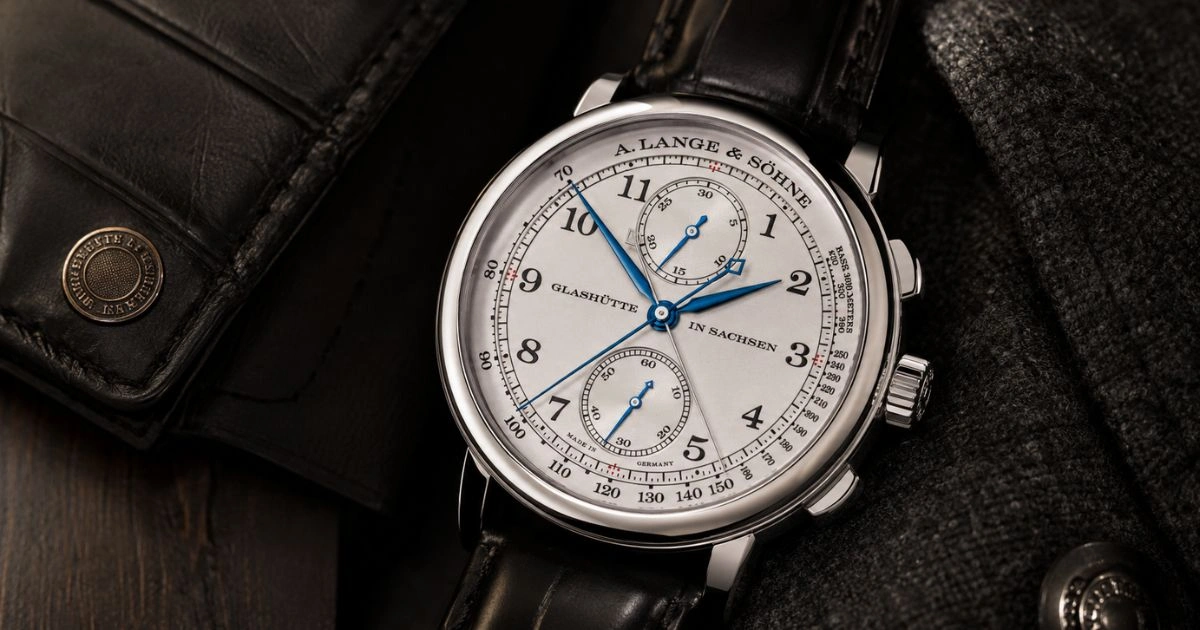
In the world of horology, the chronograph is perhaps the most useful and celebrated complication. It measures the quantifiable passage of time against the mechanical poetry of gears and levers. But once you move beyond the standard “start-stop-reset” push-pieces, things get delightfully complicated.
We enter the realm of the “Complicated Chronograph”—watches that do more than just time a single event. On one side, we have the Flyback (or Retour-en-Vol), the pilot’s best friend. On the other, the Rattrapante (or Split-Seconds), the maestro of interval timing.
At a glance, they can look similar. Both often feature two extra pushers on the case. However, the mathematics they perform are fundamentally different.
Here is your deep-dive guide to understanding, using, and appreciating these two titans of timing.
The Baseline – The Standard Chronograph
Before comparing the advanced players, let us look at the standard “workhorse.” A normal chronograph (like the Valjoux 7750 or an Omega 3861) operates on a three-step sequence:
- Press (A) to Start.
- Press (A) to Stop.
- Press (B) to Reset to Zero.
This is fine if you are timing a single steak on the grill. But if you are navigating a fighter jet in the 1930s or timing a Formula 1 driver’s lap splits, those three steps are too slow.
The Flyback (Retour-en-Vol)
The Concept
In French, Retour-en-Vol translates to “Return in Flight.” In English, “Flyback” describes exactly what the second hand does: it flies back to zero without being asked to stop first.
The Flyback function solves a specific problem: Resetting instantly to time the next leg of a journey.
How It Works
Imagine you are timing a relay race or a flight path with multiple waypoints. On a standard chronograph, to start the next segment you must: Stop -> Reset -> Start. That is three pushes and a second or two of lost time.
On a Flyback chronograph, you simply press the Bottom Pusher (at 4 o’clock) while the timer is still running.
In a single, instantaneous motion, the following happens mechanically:
- The seconds hand stops.
- The heart-shaped cam resets the hand to zero.
- The clutch re-engages to start the hand moving again.
It compresses three actions into one seamless sweep.
The Historical Context
The Flyback was born in the 1930s for aviators. Early pilots, like Wiley Post, navigated by timing their flight between physical landmarks (rivers, mountains). If you were flying at 200 km/h and had to stop, reset, and restart your chronograph manually, you would overshoot your mark by hundreds of meters. The Flyback allowed pilots to press a single pusher at the exact moment they passed a waypoint, getting an immediate, accurate reading for the next leg.
Technical Tell-Tale Signs
- Pushers: Usually has a Start/Stop at 2 o’clock and a Flyback/Reset at 4 o’clock.
- Action: The chronograph hand resets to zero and starts again without pausing.
- Dial Text: Often branded with the word Flyback or Retour-en-Vol.
The Learning Moment: If you see a watch where you can hit the reset button while the chronograph is running without breaking the movement, it is a Flyback. Standard movements lock the reset function to prevent damage; Flybacks do not.
The Rattrapante (Split-Seconds)
The Concept
While the Flyback cares about speed of resetting, the Rattrapante cares about simultaneity. The word Rattrapante comes from the French rattraper, meaning “to catch up”.
The Rattrapante answers the question: “What time did the first-place runner finish, and what time did the second-place runner finish… even though they started at the exact same second?”
How It Works
This complication requires a second set of hands—literally. Look closely at the center of the dial. You will see two overlapping seconds hands (one is usually the “main” hand, the other is the “rattrapante” hand).
Here is the sequence:
- Start: Both hands move together, stacked perfectly on top of each other.
- Split: You press the Split Pusher (usually at 10 o’clock or 8 o’clock) . The bottom hand (rattrapante) stops dead, while the top hand (chronograph) continues running.
- Record: You read the intermediate time off the stopped hand.
- Catch-up: You press the split pusher again. The stopped hand instantly “flies” forward (or rattrapes) to catch up to the running hand. They now move together again until you press the split pusher once more.
The Mechanical Magic
The mechanism is visually stunning. Under the dial, a pair of tiny steel “pincers” (or a brake) clamps down on a wheel to stop the rattrapante hand while allowing the main wheel to keep spinning. When released, a heart-shaped cam and a spring-loaded arm force the stopped hand to snap back into perfect alignment with the moving hand.
Technical Tell-Tale Signs
- Pushers: Three pushers. (Start/Stop; Split/Reset; Reset-to-Zero).
- Visual: Two central seconds hands. One often has a different colored tip or a “lollipop” counterweight to distinguish it.
- Terminology: Look for “Split-Seconds,” “Double Chronograph,” “Doppelchronograph” (German), or the IWC term “Rattrapante”.
The Learning Moment: The Rattrapante is about measuring a lap or a competitor. The Flyback is about measuring consecutive segments.
Head-to-Head Comparison
To truly understand the difference, let us look at two specific real-world scenarios.
| Feature | Flyback Chronograph | Rattrapante (Split-Seconds) |
|---|---|---|
| Primary Goal | Speed of resetting | Measuring multiple simultaneous durations |
| Best For | Navigation, racing laps, cooking | Horse racing, running splits, competitor analysis |
| Hands | Single central seconds hand | Two central seconds hands (stacked) |
| The Action | Resets to zero and starts over | Stops one hand; keeps other running |
| Complexity | Moderate (adds levers to reset cam) | High (requires pincer mechanism, extra wheel train) |
The Rare Hybrid (The Holy Grail)
Can a watch do both? Yes.
You will occasionally encounter the “Flyback Rattrapante” (or Chronographe Flyback à Rattrapante). Brands like Blancpain have manufactured these marvels.
These movements combine the “Catch-up” mechanism of the Split-Seconds with the “Instant Reset” of the Flyback. They are exceptionally rare because stuffing two separate complication layers (the column wheel for the split and the levers for the flyback) into a tiny watch case pushes the boundaries of physics.
If a standard chronograph requires 100 parts, a Rattrapante requires 200, and a Flyback Rattrapante might require 300+ parts.
Final Thoughts
As you browse the catalogues of IWC, Patek Philippe, Longines, or Breitling, look closely at the pushers.
- Do you see a single extra pusher at 4 o’clock? That is a Flyback. It is a tool for pilots and speed demons. It values efficiency.
- Do you see a third pusher integrated into the crown or at 10 o’clock? That is a Rattrapante. It is a tool for strategists and statisticians. It values data.
Both represent the pinnacle of mechanical engineering. The Flyback is about the “Zero” moment—returning to the start. The Rattrapante is about the “Catch-up”—ensuring you never miss the finish.
Which one suits your wrist? That depends entirely on how you measure your minutes.