
The Patek Philippe Perpetual Calendar: A Deep Dive for Collectors
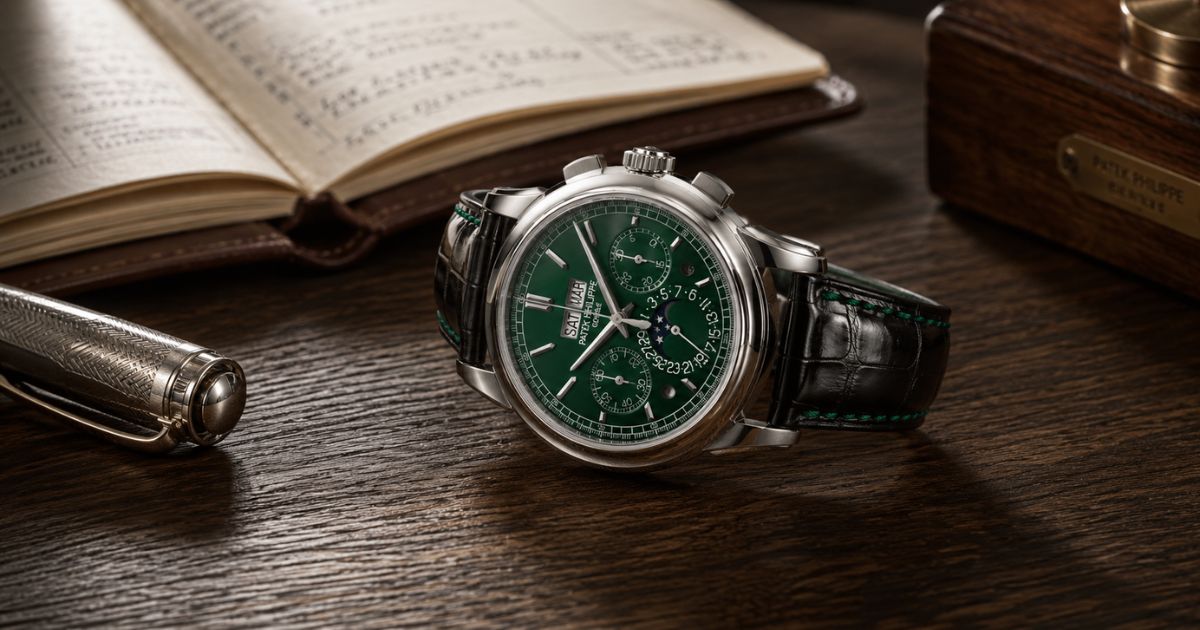
In the pantheon of haute horlogerie, few names command the reverence reserved for Patek Philippe. The Geneva-based manufacture has, since 1839, represented the zenith of watchmaking artistry, blending technical innovation with an aesthetic restraint that borders on the spiritual. For the discerning collector, a Patek Philippe is never merely a timepiece; it is an heirloom, a tangible link to a legacy of uncompromising craftsmanship.
And at the very heart of that legacy lies the perpetual calendar—the complication most synonymous with Patek Philippe’s genius. This is not just a watch function; it is a mechanical memory, an intricate dance of wheels and levers programmed to respect the rules of the Gregorian calendar for a century at a time.
In this deep dive, we will explore the technical mastery, the rich history, and the iconic references that define the Patek Philippe perpetual calendar, offering a comprehensive guide for the novice enthusiast and the seasoned collector alike.
The Mechanical “Memory”: How a Perpetual Calendar Works
Before examining the icons, we must understand the engine. A perpetual calendar is the most sophisticated of all calendar complications. Unlike a simple date wheel or even an annual calendar (which requires adjustment once a year at the end of February), a perpetual calendar automatically accounts for the varying lengths of months and the occurrence of leap years .
It is a mechanical computer designed to “remember” a four-year cycle. This is achieved not through digital code, but through the physical geometry of a cam. This 48-month cam is the brain of the operation, rotating once every four years . Its circumference is divided into 48 segments, each with a specific depth that corresponds to the length of each month. The deepest notch belongs to February. A grand lever probes this contour with a finger-piece. At the end of each month, the lever “catches” a cam, forcing the date change. The depth of the notch dictates whether the wheel advances 30, 29, or 28 days, leaping correctly to the 1st of the next month without manual intervention .
This mechanism, first mastered by Patek Philippe in the 19th century for pocket watches, is the bedrock of their most legendary wristwatches .
The Genesis of a Legend: The First Wristwatches
Patek Philippe’s journey with the perpetual calendar wristwatch began in 1925 with the Reference 97975, the world’s first perpetual calendar wristwatch. This pioneering piece used a movement originally designed in 1898 for a women’s pendant watch, ingeniously repurposed for the wrist .
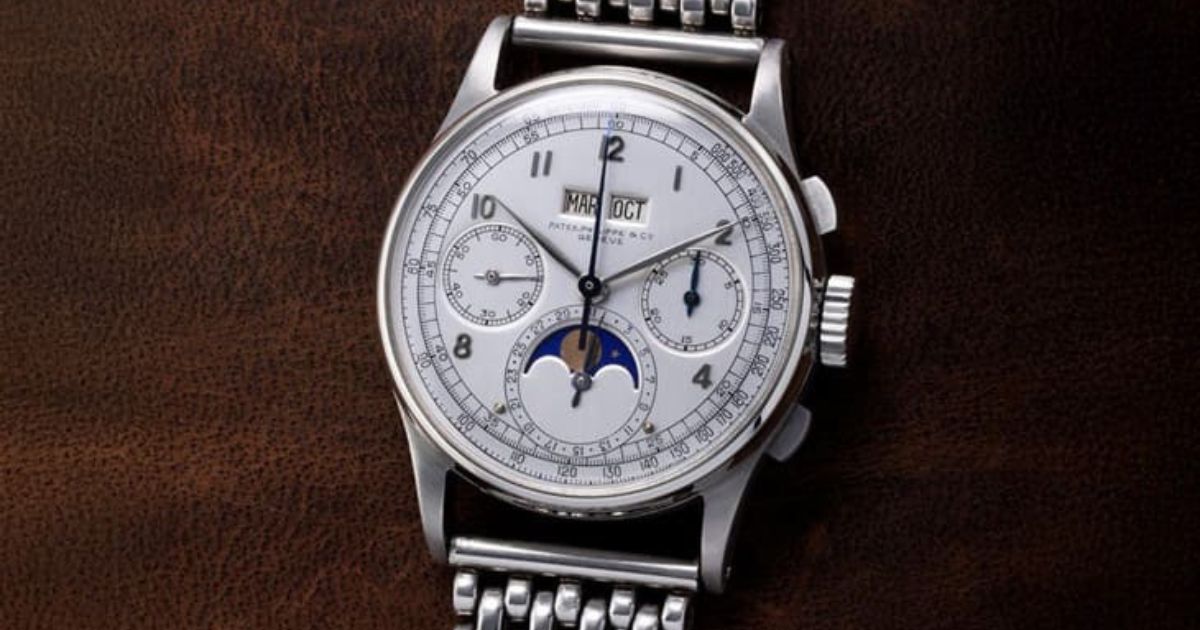
The true watershed moment, however, arrived in 1941 with the launch of the Reference 1518. This was a breakthrough of seismic proportions: the world’s first serially produced perpetual calendar chronograph wristwatch . It established a design language—the harmonious layout of counters, the pulsometer scale, and the elegant, restrained case—that would define the brand’s grand complications for generations to come.
The Reference 1518 was a masterstroke, and its influence is still felt today. Patek Philippe would hold a virtual monopoly on this particular combination for decades, cementing its reputation as the maker of the world’s most coveted complicated watches .
The Iconic Lineage: A Journey Through the Classics
To speak of collecting Patek Philippe perpetual calendars is to recount a continuous thread of evolution, where each reference builds upon its predecessor.
The Golden Era: From 1518 to 3970
The 1518 was succeeded in 1951 by the legendary Reference 2499. Produced across four series for over three decades, the ref. 2499 is often considered the quintessential vintage Patek Philippe. It retained the perpetual calendar chronograph complication but in a more robust, masculine case with a distinctive stepped bezel . Many collectors consider it the ultimate “grail.”
In 1986, at a time when mechanical watches were fighting for survival against the quartz tide, Patek Philippe introduced the Reference 3970. This modern interpretation featured a slightly smaller 36mm case and was powered by a heavily modified Lemania-based movement, the caliber CH 27-70 Q, which would become the heart of many great watches to come .
The Neo-Vintage Marvel: Reference 5970
For many collectors, the Reference 5970 represents the perfect synthesis of modern wearability and classical design. Launched in 2004, it succeeded the 3970 with a larger 40mm case that offers a commanding presence on the wrist, yet retains the elegant proportions of its ancestors .
Crucially, the 5970 was the final perpetual calendar chronograph to use a non-in-house movement—the legendary caliber CH 27-70 Q based on a Nouvelle Lemania ébauche . It is a masterclass in finishing and robustness, and its short, six-year production run adds to its allure. The dial is a study in perfect symmetry: day/month apertures at 12 o’clock, a 30-minute counter and leap year at 3 o’clock, small seconds and day/night indication at 9 o’clock, and a moon phase with date hand at 6 o’clock. Its leaf-shaped hands (feuille) are a direct nod to the 1518 and 2499, creating a powerful link to the brand’s storied past .
The Modern Epoch: Reference 5270
In 2011, the 5970 was replaced by the Reference 5270—the first perpetual calendar chronograph to house an entirely in-house movement, the caliber CH 29-535 PS Q . This is the modern era’s flagship grand complication. The 41mm case is sharply executed, and the movement boasts six patented innovations, including an optimized chronograph mechanism. The 5270 is a statement of Patek Philippe’s enduring technical independence and a worthy heir to the 1518’s throne .
A Legacy Forged in Ultra-Thinness: The Caliber 240 Q
The perpetual calendar chronographs may dominate the headlines, but Patek Philippe has also mastered the art of the classic, ultra-thin perpetual calendar. This is the domain of the automatic Caliber 240 Q. With a thickness of a mere 3.88mm and a 22k gold off-center mini-rotor, it is one of the world’s thinnest and most elegant self-winding perpetual calendar movements .
This movement powers several of the brand’s most refined dress watches:
- Reference 3940: A legend in its own right, celebrated for its clean dial and legendary comfort. It is rumored to have been the personal favorite of former CEO Philippe Stern .
- Reference 5327: A modern classic, this 39mm Calatrava-style model showcases the 240 Q movement through a sapphire caseback, often featuring breathtakingly beautiful dials like the sunburst blue with Breguet numerals .
- Twenty~4 Ref. 7340: Bringing the complication to the Twenty~4 collection, this model proves that high complications are not the sole preserve of men’s watches, offering a shantung-silk-patterned dial within a 36mm case .
The Ultimate Expressions: Beyond the Calendar
For collectors who seek the absolute pinnacle, Patek Philippe also offers the perpetual calendar in increasingly complex configurations.
- Reference 5004: This neo-vintage icon was the first serially produced Patek Philippe to feature a perpetual calendar with a split-seconds chronograph, a highly complex mechanism that allows for the timing of two events simultaneously .
- Reference 5208R: A modern grail, this watch combines a minute repeater, a monopusher chronograph, and a perpetual calendar. It is one of the most complicated watches ever made by Patek Philippe .
- Reference 5236P: The “In-line” perpetual calendar is a radical departure, placing the day, date, and month in a single, horizontal aperture at 12 o’clock, a feat of engineering that reimagines the entire display .
The New Horizon: Cubitus and the Skeletonized Future
In a bold move for 2026, Patek Philippe has introduced the first grand complication in its sporty Cubitus collection: the Reference 5840P-001. This is a square-shaped, skeletonized perpetual calendar, showcasing the new caliber 28-28 Q SQU .
It is a departure from the classical round cases, offering a modern, assertive aesthetic. The openworked movement is a monochrome marvel, with only touches of blue on the screws, revealing the entire 313-part mechanism . This watch represents the brand’s willingness to innovate not just in function, but in form, bringing its most vaunted complication into a new, contemporary light.
Collecting with Confidence
For the collector, choosing a Patek Philippe perpetual calendar is a deeply personal decision. Some will gravitate towards the historical purity of a 1518 or 2499. Others will be drawn to the wearability and mechanical heritage of the 5970. For those seeking the ultimate in modern craftsmanship, the 5270 and its ilk represent the state of the art.
However, one must be mindful of the technical details. While the 48-month cam is standard for triple-counter displays, there are also 12-month cam configurations for some models . Furthermore, the manner in which the date jumps varies. Most “drag” over a few minutes, but the most complex models feature an “instantaneous jumping” mechanism, a large 15-part yoke that advances day, date, month, and leap year at the exact stroke of midnight .
Ultimately, to own a Patek Philippe perpetual calendar is to join a centuries-old tradition. It is a testament to the collector’s appreciation for the highest form of mechanical art—a piece of history on the wrist, a promise of precision, and a legacy that will endure for generations. It is, quite simply, the measure of a collector.