
What is a Perpetual Calendar Watch? The Ultimate Guide
Welcome, watch enthusiasts and curious minds. If you have spent any time in the world of haute horlogerie, you have heard the term whispered with a certain reverence. The Perpetual Calendar. It sits at the “Holy Trinity” of watch complications, alongside the Tourbillon and the Minute Repeater.
But unlike a Tourbillon, which fights gravity, or a Minute Repeater, which chimes the time, the Perpetual Calendar is arguably the most useful of the high-end complications. It is a bridge between human engineering and cosmic order.
In this guide, we are going to strip away the intimidation factor. We will look at how they work, why they are so special, and the history behind the magic. Let’s dive in.
The Basics: More Than Just a Date
At its simplest, a wristwatch tells the time. A calendar watch tells you the date. A Perpetual Calendar tells you the correct date, every single day, seemingly forever.
To understand why this is impressive, consider the mess that is the Gregorian calendar. Some months have 30 days, some have 31, and February is a wildcard with 28, or 29 during Leap Year.
- A standard date watch simply assumes every month has 31 days. You have to manually adjust it five times a year to fix the 30-day months and February.
- An Annual Calendar is smarter. It knows the difference between 30 and 31-day months. It stays correct all year, needing only one correction at the end of February.
- A Perpetual Calendar is the genius. It has a mechanical “memory” that accounts for 30 and 31-day months, AND it tracks the four-year leap year cycle.
Put simply: If you wind your perpetual calendar watch and wear it continuously, you should not have to manually correct the date until the year 2100.
The “2100” Exception: Why Not Truly Forever?
You will often hear collectors mention the “2100 bug” for perpetual calendars. If the watch is so smart, why does it fail in 2100?
This isn’t a flaw in the watch; it is a flaw in our calendar system. The Gregorian calendar has a specific rule: While most years divisible by 4 are leap years, century years (like 1900, 2100, 2200) are not leap years unless they are divisible by 400.
The year 2100 is divisible by 4, but it is a century year not divisible by 400. Therefore, it has no February 29th. Most mechanical perpetual calendar movements are programmed to simply follow the 4-year cycle. They think the year 2100 is a leap year because they cannot compute the “century rule.”
Therefore, on February 28th, 2100, your watch will try to click over to February 29th. It will need a manual correction to March 1st. That is the one time in the next 75 years (and the last time in the 20th century) you will have to touch the crown for a date correction.
A Brief History: From London to Geneva
The story of the perpetual calendar begins not in Switzerland, but in England.
The Inventor
The credit for the first perpetual calendar mechanism usually goes to Thomas Mudge. An 18th-century English watchmaker (famous for inventing the lever escapement), Mudge created a pocket watch around 1762 that could track month lengths. You can actually see it today at the British Museum.
The Patents
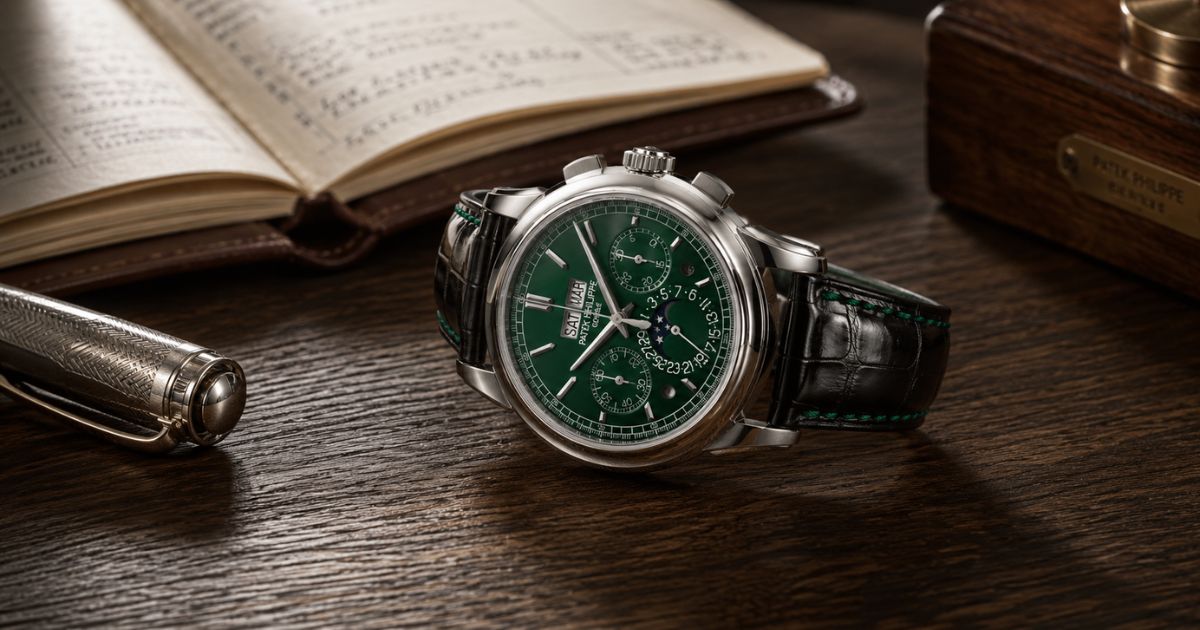
Fast forward to the industrial revolution. In 1889, Patek Philippe secured a patent for a perpetual calendar mechanism for pocket watches. This solidified their reputation as the masters of complexity.
The First Wristwatch
The year is 1925. The Roaring Twenties. Patek Philippe takes a movement from a 1898 ladies’ pendant watch and places it into a wristwatch case. This creates history: The first perpetual calendar wristwatch.
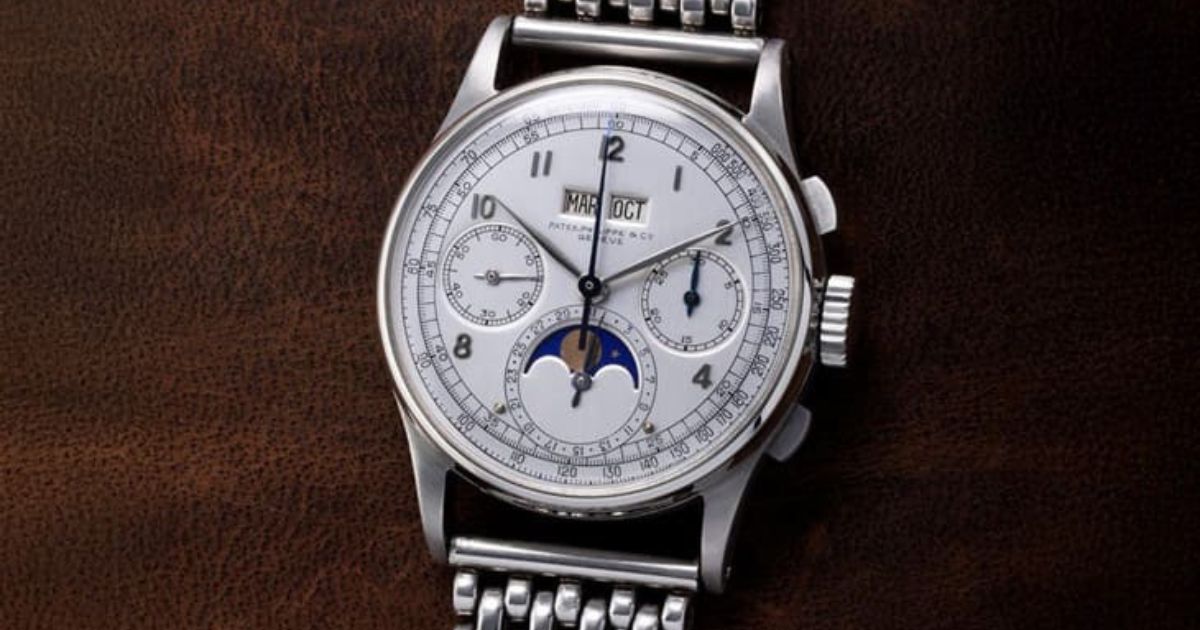
However, these were rare, bespoke items. The true democratization (relatively speaking) came in 1941 with the launch of the Patek Philippe Ref. 1526. It was the first serially produced perpetual calendar wristwatch, setting the design standard with twin day/month windows and a sub-dial for the date and moon phase.
The Design & Layout: How to Read One
While brands have their own unique codes, the “Patek Philippe layout” from the 1941 Ref. 1526 is the industry standard.
When you look at a classic perpetual calendar dial, you are usually looking at this configuration:
- 12 o’clock: Two apertures side-by-side showing the Day (Monday) and Month (April).
- 6 o’clock: A sub-dial. This usually handles double duty. A hand points to the Date (1-31), and inside that dial is a smaller window for the Moonphase (New Moon, Full Moon).
- Somewhere on the dial (often 3 or 9): A small Leap Year indicator. It cycles through numbers 1, 2, 3, and 4. When the hand is on “4” (or “L” for Leap), it is a leap year.
Quartz vs. Mechanical: A Cautionary Note
Here is a vital distinction for learners. You will see “Perpetual Calendar” watches at the mall for a few hundred dollars. How is that possible?
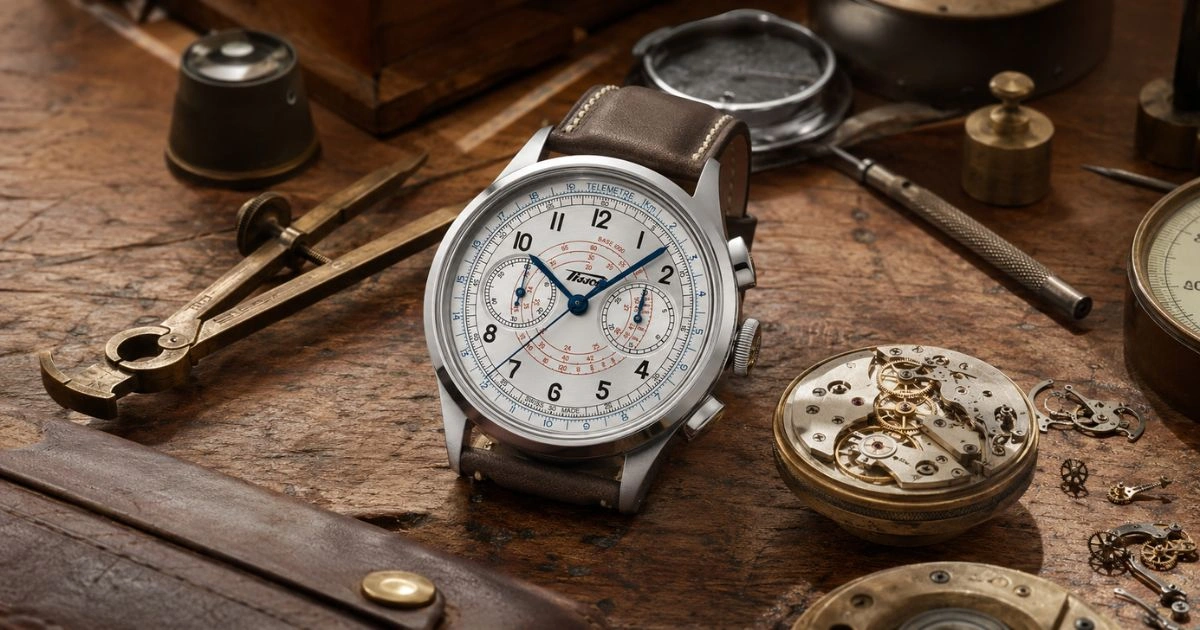
- The Quartz Version: Brands like Tissot use quartz movements (like the G15) that compute the date using a microchip. They are accurate, cheap, and run on batteries. They are digitally smart.
- The Mechanical Version: Brands like Patek Philippe, IWC, or A. Lange & Söhne use hundreds of tiny gears, levers, and “finger” cogs. These physically “feel” the length of the month. This is the “Holy Grail” complication.
For the luxury collector, we are concerned with the latter. It is the mechanical “memory” that holds the value.
The “Idiot Proof” Revolution (IWC & Modern Era)
For decades, setting a perpetual calendar was a nightmare. If your watch stopped, you needed a tiny tool (a stylus) to press recessed buttons on the side of the case to move the day, date, and month forward individually. If you changed it during the “danger zone” (8 PM to 3 AM), you could break the movement.
Everything changed in 1985. During the Quartz Crisis, a legendary engineer at IWC named Kurt Klaus had a breakthrough. He developed a perpetual calendar module that was fully adjustable via the crown.
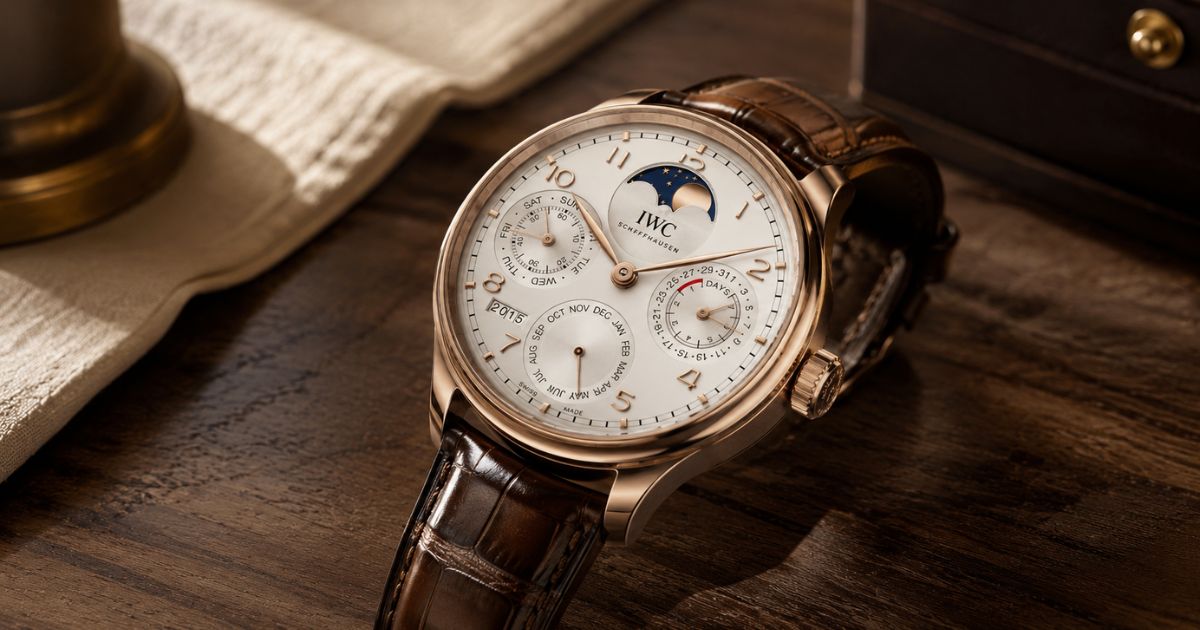
You simply pull the crown out and turn it. The day, date, month, and moonphase all move forward in sync. Suddenly, the complication became user-friendly. The IWC Da Vinci (and later the Portuguese) brought high-complication engineering to a slightly wider audience, proving that mechanical watches were still relevant.
How to “Mistreat” Your Perpetual Calendar
To own one is a joy, but to understand it is a responsibility. Here are the rules to live by:
1. Never set it backwards.
Always move the hands forward. The sequence of levers is designed to move one way. Going backwards can destroy the delicate mechanism.
2. Avoid the “Danger Zone.”
Never use the quick-set features or adjust the date when the watch thinks the time is between 8:00 PM and 3:00 AM. At this time, the gears are engaged to change the date. Interrupting this can strip gears. Set the time to 6:00 AM (safe zone) first, then change the date.
3. Keep it running.
The “perpetual” accuracy is reliant on the watch having power. If you take it off for a weekend and it stops, the calendar will not advance. If it stops for a month, you have to manually reset everything. This is why watch winders are essential for perpetual calendar owners. As long as the watch is moving, the calendar stays perfect.
Conclusion
The Perpetual Calendar is often called the most romantic of the grand complications. A Tourbillon fights for precision; a Chronograph measures speed. But a Perpetual Calendar simulates human intelligence. It is a computer made of brass and steel, programmed to understand the stars.
It captures the irregular rhythm of our human years—the long months, the short months, the rare bonus day in February—and compresses it into a tiny box on your wrist. That is engineering poetry.
Whether it is a vintage Patek Philippe Ref. 1526 or a modern IWC Portugieser, the perpetual calendar remains the ultimate accessory for the thinker, the collector, and the romantic.