- A. Lange & Söhne Watches
- Audemars Piguet Watches
- Bell & Ross Watches
- Blancpain Watches
- Breguet Watches
- Breitling Watches
- Bvlgari Watches
- Cartier Watches
- Chopard Watches
- F.P.Journe Watches
- Franck Muller Watches
- Girard Perregaux Watches
- Glashütte Original Watches
- Hamilton Watches
- Hublot Watches
- IWC Watches
- Jaeger-LeCoultre Watches
- Longines Watches
- Mido Watches
- Nomos Watches
- Omega Watches
- Oris Watches
- Panerai Watches
- Patek Philppe Watches
- Piaget Watches
- Richard Mille Watches
- Roger Dubuis Watches
- Rolex Watches
- Seiko Watches
- Tag Heuer Watches
- Tissot Watches
- Tudor Watches
- Ulysse Nardin Watches
- Vacheron Constantin Watches
- Zenith Watches

Aquanaut vs. Nautilus: Which Patek Philippe Sports Watch is Right for You?
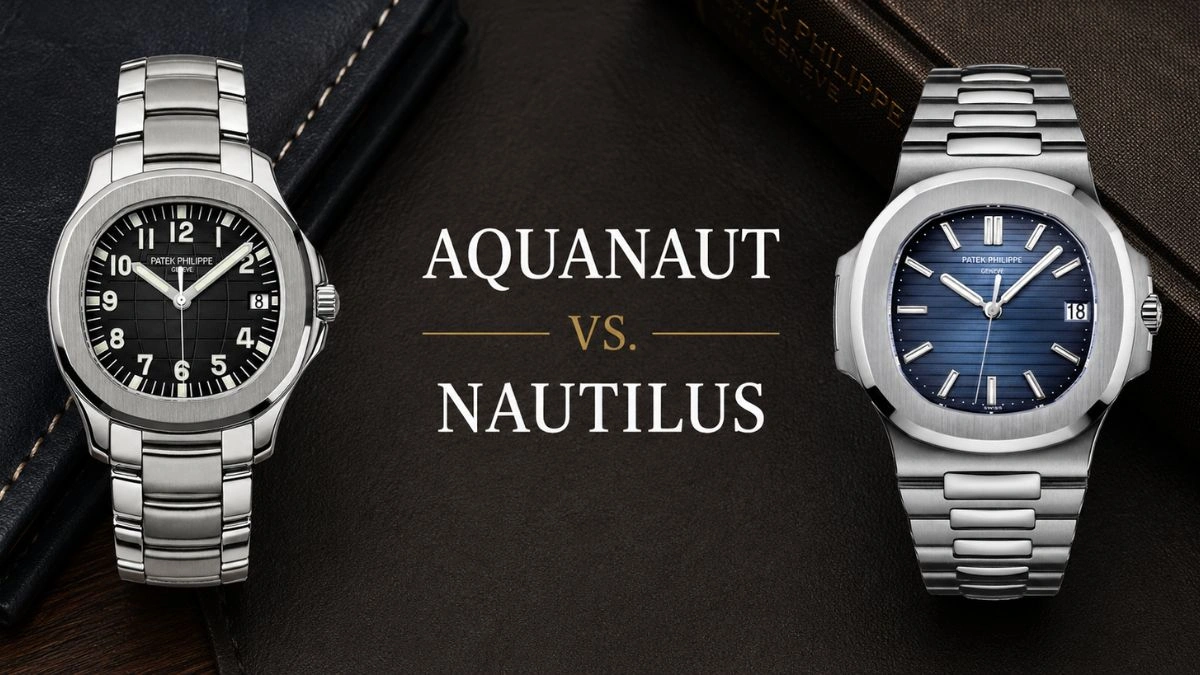
Two icons. One legacy. The question of whether to choose a Patek Philippe Nautilus or Aquanaut is one of the most debated in luxury watch collecting. Both sit at the pinnacle of sports-luxury watchmaking. Both embody the brand’s uncompromising standards. Yet they serve different purposes, appeal to different collectors, and project entirely different statements on the wrist.
So which one is right for you? Let’s break it down.
The Origins: A Story of Two Eras
The Nautilus arrived first—in 1976, designed by the legendary Gérald Genta. It was Patek Philippe’s first stainless steel sports watch, a bold departure for a brand famous for precious metals. The original advertising slogan—”One of the world’s costliest watches is made of steel”—created immediate intrigue. With its porthole-inspired case, integrated bracelet, and horizontally embossed dial, the Nautilus challenged conventions and eventually became one of the most recognisable watches in the world.
The Aquanaut followed two decades later, in 1997. Patek Philippe designed it to appeal to a younger, more contemporary audience while maintaining the brand’s exacting standards. It kept the rounded-octagonal case idea but moved toward a cleaner, sportier look. The reaction? Shock from the market. Never before had Patek Philippe offered a watch on a rubber strap. But the strategy worked—the initially underestimated Aquanaut has achieved cult status in recent years.
Design and Aesthetics: Two Philosophies
The Nautilus: Architectural Refinement
The Nautilus is defined by its octagonal bezel with sharp, defined edges and prominent lateral “ears” that resemble porthole hinges. It has an angular, architectural appearance—elaborate, fine, and elegant. The integrated stainless steel bracelet features brushed and polished finishing that feels architectural and refined. The dial is defined by horizontal embossed grooves, lending a sporty yet elegant texture. It’s a design that effortlessly transitions from casual to formal.
The Aquanaut: Modern Sportiness
The Aquanaut maintains a rounded octagonal case similar to the Nautilus but with a smoother, more modern silhouette. It has much softer lines and fewer angles and edges. The defining feature is its “Tropical” composite rubber strap—durable, resistant to UV rays, salt water, and abrasion, reinforcing its identity as an everyday, adventure-ready sports watch. The dial features an embossed checkerboard pattern that some enthusiasts nickname the “chocolate bar” dial. It’s bolder, more youthful, and designed for an active lifestyle.
Dial Textures: The Devil in the Details
The dial is where these watches truly differentiate themselves visually. The Nautilus’s horizontal grooves create a maritime texture that is refined and elegant. The Aquanaut’s checkerboard pattern is sometimes compared to a grenade or a globe—it adds depth and dynamism, with Arabic numeral hour markers providing excellent legibility. Everything about the Aquanaut’s dial is larger, more pronounced, more aggressive. Even the “Patek Philippe Geneve” print is significantly larger on the Aquanaut than on the Nautilus.
The Strap vs. Bracelet Question
The Nautilus has always featured an integrated bracelet—a signature element of its design DNA. The Aquanaut, by contrast, introduced Patek Philippe’s first rubber strap, a groundbreaking choice for a haute horlogerie brand. Today, Patek Philippe also offers bracelet options for the Aquanaut, but the rubber strap remains its defining characteristic.
Movement and Complications: Shared Excellence, Different Focus
Both watches house in-house automatic movements that are accurate, reliable, and built to last. Both are water-resistant to 120 metres.
Where they differ is in complexity. The Nautilus collection offers more complicated models—moonphase, annual calendar, chronograph versions. The Aquanaut keeps it simpler: mostly time, date, and sometimes dual time (Travel Time references). This isn’t a compromise—it’s a reflection of each watch’s philosophy. The Nautilus is about mechanical complexity and refinement. The Aquanaut is about robust utility and everyday wearability.
Which One Is Right for You?
Choose the Nautilus if you’re drawn to the original icon with a deep historical narrative. You appreciate understated luxury and exclusivity. You want a watch that looks equally at home with a suit or casualwear—one that embodies refined taste and horological history. The Nautilus is for collectors who value heritage, iconic design, and substantial long-term collectibility.
Choose the Aquanaut if you prefer a bolder, more contemporary aesthetic with enhanced comfort and sporty appeal for everyday adventures. You have an active lifestyle or work in a casual environment. You want a Patek Philippe that combines cutting-edge design with exceptional comfort and durability. The Aquanaut is for the modern collector who wants something lighter and easier to wear every day.
The Final Word
Both watches embody Patek Philippe’s uncompromising quality. Both are highly sought-after and incredibly exclusive. The Nautilus is a style-defining icon that has proven its worth over nearly five decades. The Aquanaut is a modern classic that has earned its cult status through bold design and everyday versatility.
The question isn’t which is better—it’s which is better for you. One is a statement of refined tradition. The other is a statement of contemporary spirit. Both are unmistakably Patek Philippe.
Choose accordingly.




Related posts

Aquanaut vs. Nautilus: Which Patek Philippe Sports Watch is Right for You?
Two icons. One legacy. The que...

Datejust vs. Oyster Perpetual: Choosing Your Classic Rolex
There's a moment every watch e...
The Octo Finissimo: Redefining Ultra-Thin Watchmaking
If you hold a typical mechanic...
The Tribute to Fifty Fathoms MIL-SPEC: A Nod to History
In the vast, often murky depth...

GMT vs. World Time: What’s the Difference and Which is Right for You?
As lovers of haute horlogerie,...