
Speedmaster: How a Watch Went to the Moon
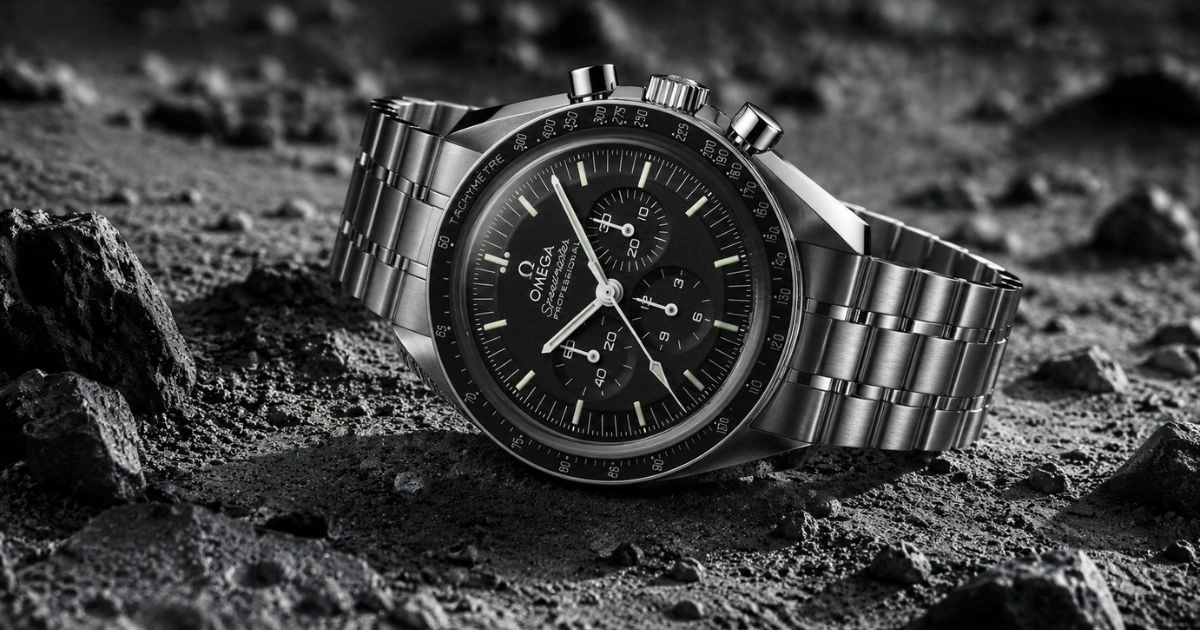
It is a story that has become the very fabric of horological legend, a tale so deeply embedded in watch culture that it feels almost mythical. Yet, the journey of the Omega Speedmaster from a racing chronograph to the “Moonwatch” is not a work of fiction. It is a documented, thrilling narrative of precision engineering, accidental heroism, and a race against time. This is the story of how a simple, manual-wind chronograph, designed for the race track, became an indispensable tool for humanity’s greatest adventure.
A Chronograph for the Track
To understand its lunar destiny, we must first look at its origins. The Speedmaster was born in 1957, a time when the world was captivated by speed and motorsport. Omega, already the official timekeeper for the Olympic Games, introduced the Speedmaster as a sports and racing chronograph. Its defining feature, and a revolutionary one at the time, was the placement of the tachymeter scale on the bezel rather than the dial. This allowed drivers to read their average speed without their gaze leaving the road for too long. With its high-contrast dial, domed Plexiglas crystal, and the legendary manually-wound Calibre 321 movement, the Speedmaster was built for precision and durability on Earth. No one involved in its creation could have predicted it would become the ultimate tool for a vastly more demanding environment.
A Secret Mission for NASA
The story takes a pivotal turn in the early 1960s. As the United States raced to fulfill President John F. Kennedy’s pledge to land a man on the Moon, NASA began planning for the Gemini and Apollo missions. The agency needed a reliable, accurate timepiece for its astronauts—a backup timing device in case the spacecraft’s electronic systems failed. Crucially, it had to be manually wound, as an automatic movement was not trusted to function reliably in zero gravity.
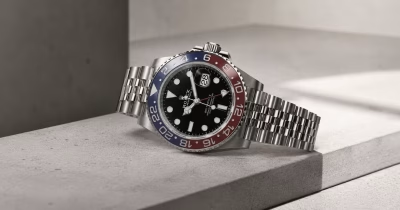
In 1964, NASA’s Director of Flight Crew Operations, Deke Slayton, issued a request for “high-quality chronographs” from several watch manufacturers. However, they didn’t seek a custom-built solution. Instead, NASA wanted off-the-shelf watches, believing a bespoke design would be too time-consuming and costly. Ten brands were invited to submit proposals, but only four responded with timepieces that met the basic specifications: Omega, Rolex, Longines-Wittnauer, and Hamilton. Hamilton was quickly disqualified for submitting a pocket watch, leaving three contenders: the Rolex 6238 “pre-Daytona,” the Longines-Wittnauer 242T, and the Omega Speedmaster.
The Tests That Forged a Legend
The watches were handed to NASA engineer James Ragan, whose task was to subject them to an “extreme” testing program designed more for spacecraft hardware than a wristwatch. The goal was not just to find the best watch, but to see if any watch could survive at all. Over the course of multiple trials, the timepieces were subjected to a series of eleven brutal tests that simulated the harsh conditions of space.
The list of tests reads like a torture manual, a gauntlet designed to break even the most robust instruments:
- Extreme Temperatures: The watches endured 48 hours at 70°C (158°F), followed by 30 minutes at a scorching 93°C (200°F) in a partial vacuum. They were then frozen for four hours at -18°C (0°F). The Speedmaster was the only watch to survive the high-temperature tests.
- Humidity and Corrosion: They were placed in a chamber with 95% humidity for ten 24-hour cycles and then exposed to an atmosphere of pure oxygen at high temperatures for 48 hours.
- Shock and Acceleration: The watches were subjected to six 40 G shocks from different directions. They were also placed on a centrifuge and accelerated to a peak of 16 G for 30 seconds.
- Pressure and Vibration: They were exposed to near-vacuum and high-pressure environments and vibrated intensely to simulate the conditions of a rocket launch.
- Acoustic Noise: Finally, they were subjected to 130 decibels of noise for 30 minutes, a sound level that would be physically painful to a human ear.
The Sole Survivor
On March 1, 1965, the results were in. The Rolex had stopped running and failed a temperature test. The Longines-Wittnauer also failed a temperature test and the decompression test. The Omega Speedmaster, while not without its own minor issues (it gained and lost some time during the acceleration and decompression tests), had passed them all. It was officially declared “Flight Qualified for all Manned Space Missions”. The Speedmaster had not just won; it had been the only one to survive.
Even James Ragan was surprised by the outcome. “It was the most extreme testing you could do to a piece of hardware,” he later recalled.
The Moonwatch
The Speedmaster’s journey to the Moon began just weeks after its certification. On March 23, 1965, it was worn by Gus Grissom and John Young on the Gemini 3 mission. Soon after, Ed White wore his Speedmaster strapped to the outside of his spacesuit during America’s first spacewalk on Gemini 4. The watch was now a staple of the space program.
Then came the defining moment. On July 20, 1969, the Apollo 11 mission landed on the lunar surface. Neil Armstrong became the first man to set foot on the Moon, but he chose to leave his Speedmaster in the Lunar Module as a backup after a malfunction with the on-board timer. It was Buzz Aldrin who stepped onto the lunar surface wearing his Omega Speedmaster reference ST 105.012. At that moment, the Speedmaster became the first watch on the Moon, earning its immortal nickname: the “Moonwatch”.
A Legacy Beyond the Moon
The Speedmaster’s role in space history did not end with Apollo 11. It was worn on all subsequent Apollo missions, including the ill-fated Apollo 13. When the mission was crippled by an explosion, the crew relied on the precise timing of Jack Swigert’s Speedmaster to execute the critical 14-second engine burn that was essential for a safe re-entry to Earth. For this, Omega was awarded the “Silver Snoopy Award,” NASA’s highest honor, cementing the watch’s legendary status.
The Speedmaster’s story is far more than just a marketing triumph. It is a testament to the power of simple, robust engineering. A watch that began its life measuring speed on a race track ended up measuring time on the Moon, proving that good design, reliability, and the spirit of exploration are a timeless combination. It remains, to this day, one of the most iconic and inspiring timepieces ever created, a reminder that sometimes, the greatest adventures begin with a single, steady tick.