
The Art of Fusion: What Makes Hublot Truly Unqiue
In the pantheon of Swiss watchmaking, where centuries of tradition often serve as the primary currency of value, Hublot stands as a deliberate and proud anomaly. Founded in 1980, it is a relative newcomer compared to the hallowed houses of the 18th and 19th centuries. Yet, in its short existence, Hublot has carved out a niche that is entirely its own, defined not by a reverence for the past, but by a relentless pursuit of the future. This is the essence of “The Art of Fusion,” a philosophy that is more than a marketing slogan; it is the very DNA of the manufacture. This concept, which guides all its actions, innovations, and partnerships, is the key to understanding what makes Hublot truly unique in the world of luxury watches.
The Genesis of a Philosophy
The story of Hublot begins with a bold and unprecedented move. In 1980, founder Carlo Crocco created the first watch to pair a precious gold case with a natural rubber strap. This simple yet radical act, a fusion of luxury and sport, of tradition and modernity, was the spark that ignited the “Art of Fusion”. It was a statement that Hublot would not be bound by the conventional rules of high horology. This philosophy was later formalized and propelled to global prominence by Jean-Claude Biver, who took the helm in 2004 and described the concept as a “philosophy” as simple as it was powerful. For Biver, the “Art of Fusion” was about creating new codes, a “subtle blend of science, alchemy, and playful boldness”.
The Fusion of Materials: A Laboratory on the Wrist
Where Hublot truly distinguishes itself is in its mastery and relentless innovation of materials. The brand operates like a high-tech research laboratory, constantly pushing the boundaries of what is possible. This is not merely an aesthetic pursuit; it’s a philosophy focused on providing concrete functional benefits to the wearer.
The manufacture’s in-house R&D team, a dedicated group of engineers, chemists, and watchmakers, is the engine behind these advancements. They are responsible for a stunning array of world-firsts. One of the most significant is Magic Gold, an 18-karat gold alloy that is scratch-resistant, a property previously unheard of in gold cases. This is achieved by fusing gold with a high-tech ceramic, creating a material that is both noble and exceptionally durable.
Beyond gold, Hublot has become a leader in the development of colored ceramics and sapphire. For over a decade, it has been at the vanguard of producing vibrantly colored ceramics in-house, a feat few other manufactures can claim. This expertise culminated in 2025 with the announcement of the world’s first multi-colored ceramic, dubbed “Magic Ceramic,” a patent-pending innovation that demonstrates Hublot’s alchemical ability to control color at the molecular level. Similarly, Hublot has become synonymous with colored sapphire, producing cases in a rainbow of hues that are just as hard and scratch-resistant as traditional sapphire crystal. This mastery extends even to more unconventional materials, such as carbon fibre, which was integrated into movements as early as 2007, and even concrete, showcasing the brand’s willingness to experiment without limits.
The Fusion of Mechanics: Reimagining the Movement
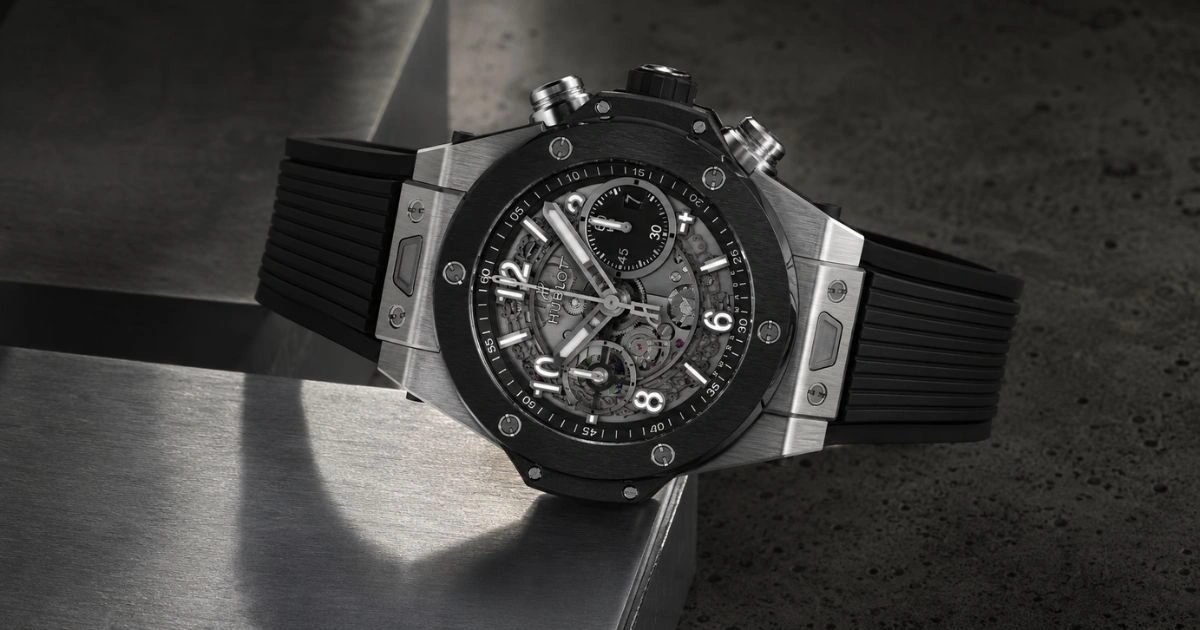
The “Art of Fusion” is not limited to the case and strap; it extends to the very heart of the watch. Hublot’s in-house movements are a testament to its commitment to technical innovation and architectural design. The Unico, the manufacture’s first automatic chronograph movement, is a prime example of this philosophy in action. It features a unique clutch system visible from the dial side, a design choice that prioritizes both performance and spectacle.
Another masterpiece is the Meca-10, a manual-winding skeleton movement that is a marvel of micromechanical engineering. Inspired by Meccano construction systems, its architecture is laid bare, with bridges and gears creating a dynamic, three-dimensional choreography. Its most striking feature is its 10-day power reserve, indicated by a unique rack-and-pinion system that displays the remaining energy in a digital-style format, a blend of mechanical complexity and modern readability. The movement was recently re-engineered to fit a more compact 42mm case, showcasing Hublot’s commitment to refining its innovations. As CEO Julien Tornare notes, the Unico and Meca-10 are multi-patented mechanisms with real technical depth, yet the brand sometimes doesn’t get the credit it deserves for its horological substance.
The Fusion of Worlds: Beyond Watchmaking
The “Art of Fusion” is also a philosophy of connection, extending beyond the physical product to encompass a diverse ecosystem of partnerships. Hublot actively collaborates with athletes, chefs, and artists, creating a community of “Hublotistas” and blurring the lines between watchmaking and other creative fields. Its role as the Official Timekeeper of the FIFA World Cup is a prominent example of its connection to the world of sports.
This fusion is perhaps most evident in its collaborations with contemporary artists. In 2025, the brand unveiled the MP-17 Arsham Splash, a wearable sculpture created in partnership with artist Daniel Arsham. This piece, with its organic, flowing lines sculpted in titanium and sapphire, is a testament to Hublot’s ability to merge art, technology, and watchmaking into a single, disruptive object. This outward-looking approach solidifies the idea that “fusion” is a living, breathing concept at Hublot, one that is constantly evolving and seeking new expressions.
Conclusion
Hublot’s uniqueness lies in its unwavering commitment to the “Art of Fusion.” It is a brand that refuses to be defined by the past, preferring instead to invent the future of watchmaking. From the bold pairing of gold and rubber to the alchemy of creating scratch-proof gold and multi-colored ceramic, from the architectural audacity of its in-house movements to the cultural energy of its collaborations, Hublot embodies a philosophy of innovation that is both disruptive and profoundly original. It is not just a watch brand; it is a modern concept of luxury, one that finds its value not in tradition alone, but in the bold fusion of art, science, and a fearless spirit of creativity.