
The Ultimate Guide to the Rolex Daytona
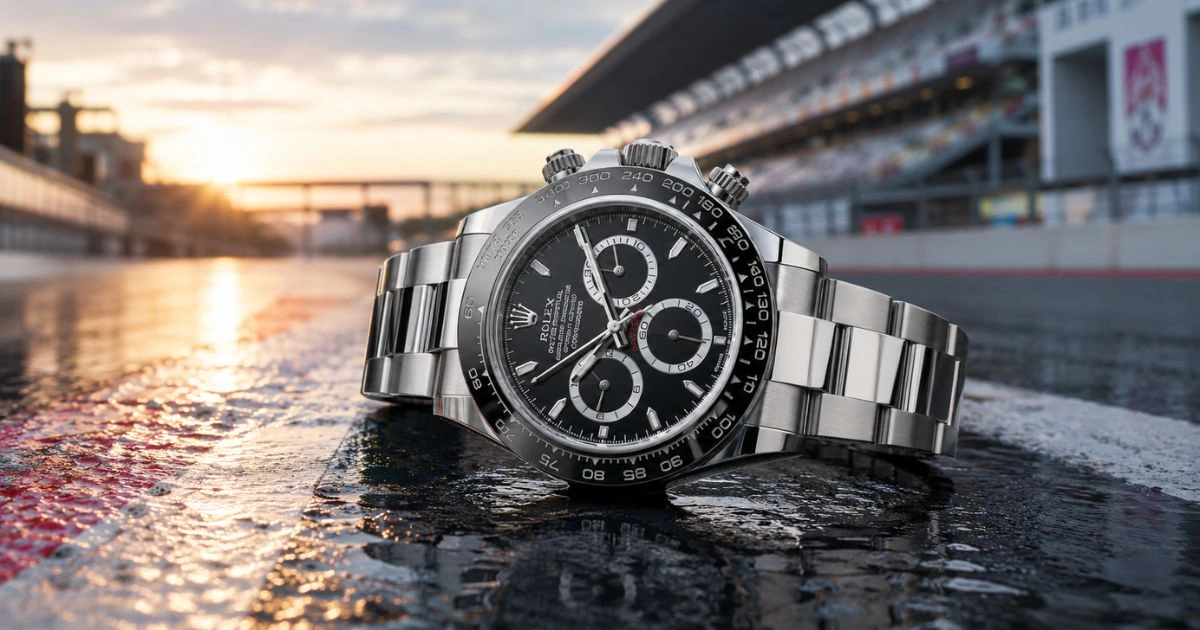
Few names in horology carry the weight and mystique of the Rolex Daytona. It’s a watch that has transcended its original purpose as a tool for racing drivers to become a cultural icon and a grail for collectors worldwide. This guide is designed to be your comprehensive introduction to this legendary timepiece, covering its storied history, the technical marvels within, and the key models that define its legacy.
The Birth of an Icon: From Cosmograph to Daytona
The story of the Daytona begins not in the winner’s circle, but on the drawing board. The first Cosmograph, as it was initially called, was introduced around 1963. It was the successor to earlier Rolex chronographs like the ref. 6238 but featured a key innovation: the tachymeter scale was moved from the dial to the bezel, giving the watch a cleaner, more purposeful look.
Despite its now-classic design, the early Daytona was not an immediate success. It was powered by a manual-wind Valjoux movement, a reliable but unremarkable choice at a time when automatic chronographs were gaining popularity. To boost its appeal, Rolex sought a powerful marketing connection, eventually settling on the name “Daytona” after the famous Daytona International Speedway in Florida, where Rolex was the official timekeeper.
The “Paul Newman” Phenomenon
The Daytona’s true ascent to legendary status began decades after its launch, fueled by a cult following, particularly among style-conscious Italian collectors. This fervor was ignited by actor and racing enthusiast Paul Newman, who was often seen wearing his own exotic-dial Daytona. This specific dial variation, with its distinctive square markers on the sub-dials, became inseparable from Newman’s image and is now one of the most sought-after and valuable vintage watches in existence. In 2017, Newman’s personal Daytona sold for a staggering $17.8 million, setting a world record for a wristwatch and cementing the model’s legendary status.
The Technical Evolution: The Heart of the Matter
The Daytona’s journey through history is marked by three distinct movement eras, each representing a significant leap in technology.
The Valjoux Era (1963-1988)
The original Daytonas were powered by manual-winding Valjoux calibers, specifically the Cal. 72 (in its variations: 72B, 722, 722-1, and 727). These reliable movements used a horizontal clutch and a column wheel for the chronograph function. The Cal. 722-1, for example, was a 13-ligne (30mm) movement with a frequency of 18,000 beats per hour. While robust, these movements were considered dated by the 1970s and 1980s, as the industry shifted towards automatic chronographs.
The Zenith Era (1988-2000)
A pivotal moment for the Daytona came in 1988 when Rolex introduced the reference 16520. For the first time, the Daytona was an automatic chronograph, housing a heavily modified version of Zenith’s legendary El Primero movement, which Rolex designated as the Caliber 4030. The El Primero was one of the first automatic chronograph movements ever made and was known for its high frequency. Rolex modified it, lowering its frequency to 28,800 beats per hour, to improve robustness and serviceability. These “Zenith Daytona” models are highly collectible today, representing a unique and fascinating chapter in the model’s history.
The In-House Era (2000-Present)
The year 2000 marked a watershed moment for the Daytona with the introduction of the reference 116520 and the Caliber 4130—Rolex’s first entirely in-house, self-winding chronograph movement. The Cal. 4130 was a masterpiece of engineering. It featured a vertical clutch, which allowed for more precise starts and stops without the hand-jumping commonly associated with lateral clutches. This was a game-changer in terms of robustness and timekeeping accuracy.
The movement’s architecture was also designed for efficiency and serviceability. It integrated the hour and minute counters into a single unit, freeing up space for a larger mainspring barrel and a power reserve of 72 hours. It used significantly fewer parts than its predecessor, simplifying maintenance. This movement set a new benchmark for industrial chronographs. In 2023, the Caliber 4130 was succeeded by the Caliber 4131, which includes incremental upgrades like the Chronergy escapement and an improved, more decorated finishing. A special variant, the Cal. 4132, was developed for the “Le Mans” edition to track 24 hours, using a clever differential gearset.
Key Model Generations
Understanding the differences between model generations is crucial for any collector or enthusiast.
4-Digit References (1963-1988)
These are the original, vintage Daytonas. They are manual-wind watches with 37mm cases. Key references include the 6239 (the first, with a steel bezel), 6241 (with a black acrylic bezel), 6263, and 6265. Collectors often focus on details like “pump” pushers vs. screw-down pushers, with the latter being introduced to improve water resistance.
5-Digit References (1988-2000)
This generation includes the automatic Zenith-powered models like the 16520. These watches have a 40mm case and crown guards, giving them a more robust and modern feel. Their slimmer cases are often preferred by collectors who value a more classic wrist presence.
6-Digit References (2000-Present)
The modern era of the Daytona began with the 116520, the first in-house model. This generation is known for its thicker, more solid cases and the introduction of the ceramic (Cerachrom) bezel with the 116500LN in 2016. The current model is the 126500LN, which refines the formula with a slimmer profile and the updated Caliber 4131 movement. The platinum version (ref. 126506) stands out with its ice-blue dial and chestnut brown Cerachrom bezel, and was notably the first sports Rolex to feature an exhibition caseback.
Dial Nicknames and Notable Special Editions
Part of the Daytona’s charm lies in the rich vocabulary of nicknames used by collectors to describe its various dials and special editions.
“Panda” and “Reverse Panda”
The “Panda” dial is a white dial with contrasting black sub-dials. The “Reverse Panda,” naturally, is a black dial with white sub-dials. These are among the most iconic and desirable configurations for both vintage and modern Daytonas.
The “Rainbow”
The Rainbow Daytona is a model of dazzling extravagance. Introduced in 2012, it features a bezel set with 36 baguette-cut sapphires arranged in a gradient of colors, mimicking a rainbow. Available in yellow, white, and Everose gold, it is a favorite among celebrities and a testament to Rolex’s ability to blend horology with high jewelry.
The “Le Mans”
To celebrate the centenary of the 24 Hours of Le Mans race in 2023, Rolex released a special “Le Mans” model. This watch is powered by the exclusive Caliber 4132, which allows it to time events up to 24 hours. It also features a reverse-panda dial with sub-dials styled after the vintage “exotic” Paul Newman dials, a perfect blend of modern technology and vintage aesthetics.
How to Choose Your Daytona
Choosing a Daytona is a deeply personal decision. For a first-time buyer, a modern steel reference with a ceramic bezel and a classic “Panda” or black dial is a versatile and solid choice that holds its value exceptionally well. If you are drawn to vintage proportions and collector character, a 5-digit “Zenith” Daytona offers a more accessible entry into the world of neo-vintage collecting. Ultimately, whether you seek the precision of a modern Caliber 4131, the historical significance of a manual-wind Valjoux, or the striking beauty of a gem-set piece, the Rolex Daytona is more than a watch; it is a piece of history, a masterpiece of engineering, and an enduring symbol of excellence.