
The Tribute to Fifty Fathoms MIL-SPEC: A Nod to History
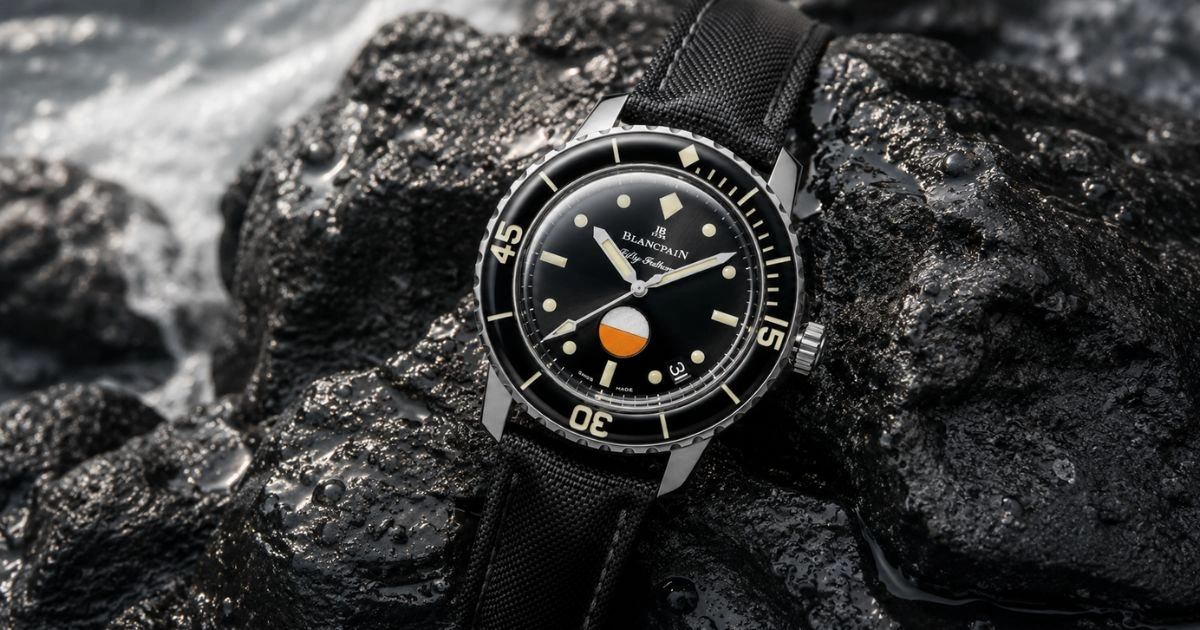
There are certain watches that transcend their function as timekeeping instruments. They become artifacts of human endeavor—witnesses to exploration, survival, and the relentless pursuit of precision. The Blancpain Fifty Fathoms MIL-SPEC is one such watch. And in 2017, Blancpain gave us something extraordinary: the Tribute to Fifty Fathoms MIL-SPEC, a faithful reinterpretation of one of the most significant dive watches ever created.
Today, we are going to explore what makes this watch not just a collector’s piece, but a genuine lesson in horological history.
The Birth of an Icon
The story begins not in a boardroom, but beneath the waves. In 1952, French Navy officers Bob Maloubier and Claude Riffaud were tasked with equipping their elite combat divers with a reliable underwater timepiece. The watches they tested were disappointing—unreliable, difficult to read, and ultimately, a matter of life and death.
Then they met Jean-Jacques Fiechter, the CEO of Blancpain from 1950 to 1980, and an avid diver himself. Fiechter understood the challenge intimately—he had once run out of air while diving and was forced to make an emergency ascent, an experience that drove him to create a watch that could prevent such dangerous miscalculations.
The result was the Fifty Fathoms, introduced in 1953. Its name came from the English measurement of depth: fifty fathoms equalling 91.44 meters. It was the first automatic diving watch, the first with a rotating bezel for timing, and it featured innovations that we now take for granted—a double-sealed crown and a unidirectional rotating bezel. Before Rolex launched the Submariner or Omega the Seamaster 300, Blancpain had already set the standard.
The MIL-SPEC: Military Precision
In 1957, the United States Navy published a fifteen-page specification for what they called a “Submersible Wrist Watch”. The document was exhaustive—detailing steel composition, radiation levels for luminous material, crystal strength (requiring a steel ball dropped from 40 inches), bezel robustness (tested by hammer), and an astonishing array of other requirements.
Blancpain’s Fifty Fathoms, already proven with the French Navy, was perfectly positioned. When the Navy tested watches from various manufacturers, only the Fifty Fathoms was rated “satisfactory in all categories”. The MIL-SPEC 1 was formally introduced in 1957-1958, and roughly 1,000 watches were issued to the U.S. Navy in the early 1960s.
What set the MIL-SPEC apart? Most notably, a humidity indicator on the dial—a small circle that would change color from white to red if moisture penetrated the case. For a diver whose life depended on their equipment, this was not a gimmick; it was a vital safety feature. Other requirements included antimagnetic protection, a hacking movement for synchronizing with dive teams, and exceptional legibility.
The Modern Tribute
Fast forward to Baselworld 2017. Blancpain unveiled the Tribute to Fifty Fathoms MIL-SPEC—a limited edition of 500 pieces that captured the essence of the 1957 original while embracing modern watchmaking excellence.
The Case and Dimensions
The watch features a 40mm stainless steel case, measuring 13.2mm in thickness. It sits comfortably on the wrist—substantial enough to feel robust, yet refined enough to slip under a shirt cuff. As one reviewer noted, “At 40mm, it is just the right size – not too small, but definitely not too big either”.
Water resistance is rated at 300 meters (30 bar), ensuring that the humidity indicator—a faithful reproduction of the original—will likely never need to serve its intended purpose. The bezel features a sapphire insert with a fully luminescent scale, a modern material upgrade from the original’s bakelite.
The Dial
The matte black dial is a study in purposeful minimalism. Large, contrasting indices. Chunky, legible hands. Strong lume. And there, at 6 o’clock, the pièce de résistance: the functioning moisture indicator. A small circle that remains white when the case is sealed, but would turn red if water ever found its way inside.
It is, as Hodinkee described it, “period-correct and oh-so-adventurous”. The indicator gives the dial a distinctive character—a flash of personality that sets the MIL-SPEC apart from every other dive watch on the market.
The Movement
Beneath the sapphire case back beats the caliber 1151, Blancpain’s in-house automatic movement. It comprises 210 components, including two series-coupled mainspring barrels that deliver a four-day power reserve. The movement features a silicon balance spring, providing superior antimagnetic and shock resistance. The solid gold winding rotor, coated with NAC (a ruthenium-based alloy), is visible through the exhibition case back—a beautiful reminder of the craftsmanship within.
The Faithful Homage, Not a Slavish Copy
The Tribute to Fifty Fathoms MIL-SPEC is not a straight re-issue. It builds on its heritage while embracing modern materials and techniques. The sapphire bezel insert offers scratch resistance that the original’s bakelite could never match. The movement incorporates cutting-edge silicon technology. The finishing is more refined, the overall package more elegant.
Yet it never loses sight of its origins. The design language remains true to the 1957 original—the dial layout, the hands, the bezel proportions, and most importantly, that iconic moisture indicator. It is, in the words of aBlogtoWatch, “such an iconic and historic watch that’s faithfully redone”. It is “the kind of sleeper-hit that watch nerds obsess about for a very, very long time”.
Why This Watch Matters
For the student of horology, the Tribute to Fifty Fathoms MIL-SPEC offers several important lessons.
First, it teaches us about origins. The modern dive watch—with its rotating bezel, high legibility, and robust construction—did not emerge fully formed. It was designed, piece by piece, by people who understood the demands of the deep. Blancpain’s innovations in the 1950s established the template that every dive watch since has followed.
Second, it teaches us about purpose. Every element of the MIL-SPEC serves a function. The humidity indicator was not decorative; it was a safety device. The bezel was not a style choice; it was a timing tool. The legibility was not an aesthetic preference; it was a necessity when every second counted. This is design at its most honest.
Third, it teaches us about continuity. When a brand revisits its archives, it is not merely exploiting nostalgia. It is acknowledging that some designs achieve a kind of perfection—a harmony of form and function that transcends the era in which they were created. The Tribute to Fifty Fathoms MIL-SPEC demonstrates that great design endures.
Final Thoughts
There is a reason the MIL-SPEC has become one of the most coveted vintage Fifty Fathoms models. It represents a moment when horology and military necessity intersected to create something genuinely extraordinary. The Tribute to Fifty Fathoms MIL-SPEC honors that moment without being trapped by it.
It is, as Revolution Watch declared, “a subtle incarnation of a legendary timepiece — a piece of diving history on your wrist”. It does not scream for attention. It does not need to. For those who know what they are looking at, it speaks volumes.
The Fifty Fathoms was born from a simple need: a watch that would not fail when lives depended on it. The MIL-SPEC refined that vision into something even more focused. And the Tribute to Fifty Fathoms MIL-SPEC ensures that this legacy—this remarkable chapter in the history of diving and watchmaking—will not be forgotten.
Some watches tell time. This one tells a story.