
The Atmos: The Clock That Lives on Air
There is a peculiar magic in the mechanical universe that we, as enthusiasts, chase every day. We chase the perfect sweep of a second hand, the crisp snap of a chronograph reset, or the harmonious chime of a minute repeater.
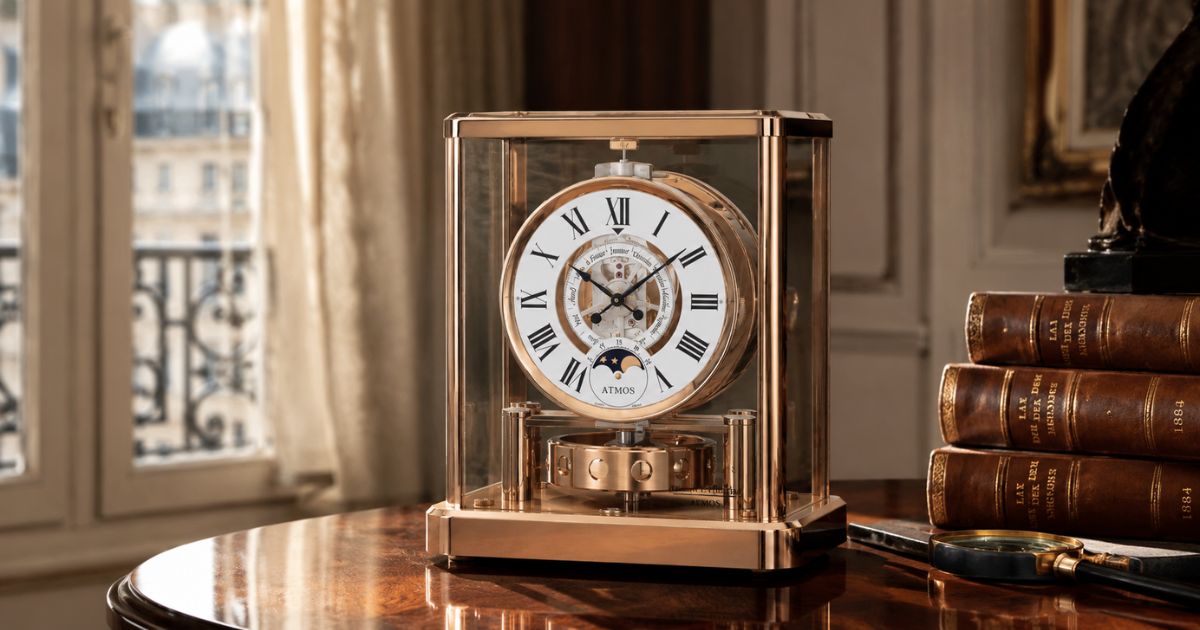
But every so often, we encounter a piece that breaks the mold so completely that it ceases to feel like a machine and starts to feel like a living, breathing organism. The Jaeger-LeCoultre Atmos is that anomaly.
In a world of high-beat movements and constant human interaction, the Atmos sits silently on a shelf, asking for nothing. It is the “clock that lives on air,” a paradox of engineering that powers itself solely by the silent breathing of the planet.
Today, we are diving deep into the history, the hypnotic mechanics, and the artistic grandeur of horology’s most self-sufficient masterpiece.
The Impossible Dream of Perpetual Motion
The story of the Atmos begins not with a watchmaker, but with an obsession. In 1928, a Swiss engineer named Jean-Léon Reutter was fixated on a concept that had eluded inventors for centuries: a clock that never required manual winding.
While others tried magnets or gravity, Reutter looked at the weather. His prototype was a marvel of barometric sensitivity. He created a hermetically sealed capsule filled with mercury. As the air pressure or temperature rose and fell, the mercury would expand and contract, physically pumping a mainspring. It was a brilliant concept, but Reutter was an engineer, not a horologist. His prototype worked in theory, but it was temperamental and unreliable for daily life.
Enter the watchmakers of the Vallée de Joux. In 1936, the firm of LeCoultre (later Jaeger-LeCoultre) acquired the patent. They understood that for the clock to survive the test of domestic life, mercury—which was volatile and later banned—had to go.
They replaced it with a gas that would become the secret ingredient to the Atmos’s soul: ethyl chloride.
The Secret Inside the Bellows
To understand the Atmos, you must forget everything you know about winding a watch.
There is no crown to twist. There is no rotor to swing. Instead, look inside the glass case. You will see a transparent, accordion-like capsule. This is the thermal bellows.
Here is the science, simplified for our collector’s mindset. Inside that sealed capsule is a mixture of ethyl chloride gas and liquid. Ethyl chloride is highly sensitive to temperature; it boils at just 12.27 degrees Celsius (about 54 degrees Fahrenheit). Imagine that—the very air in the room is boiling this liquid.
- When the temperature rises, the liquid evaporates into gas.
- When the temperature drops, the gas condenses back into liquid.
This expansion and contraction is so powerful, yet so gentle, that it constantly contracts and expands the bellows. That motion pulls on a mainspring. That mainspring runs the clock. A single degree of temperature change—the kind that happens when a cloud passes the sun or when you turn on a reading lamp—generates enough energy to power the clock for two full days.
Jaeger-LeCoultre loves to point out a staggering fact to put this efficiency into perspective: It would take 60 million Atmos clocks to consume the same amount of energy as a single 15-watt light bulb. If you boil an egg, the thermal energy released would run an Atmos for nearly 40,000 years.
The Zen of Timekeeping (Calibre 582)
Of course, harvesting energy is only half the battle. You have to regulate it. Standard watches tick at 28,800 vibrations per hour. It is a flurry of frantic activity. The Atmos takes a different path: meditation.
Most Atmos clocks utilize a torsion pendulum. Look closely at the dial. You will see a large, spinning wheel (the balance) oscillating back and forth. But it moves incredibly slowly. It oscillates only twice per minute.
Because the balance is suspended on a thin wire (made of the alloy Elinvar to resist temperature changes), it essentially floats, using almost zero friction. There are no oiled pivots to gum up over time. The gear trains run dry. This is why the Atmos is often described as “near perpetual.” As long as the earth keeps turning and the temperature keeps fluctuating, the clock can theoretically run for centuries without a service (though Jaeger-LeCoultre does recommend a check-up every 20 years).
A Canvas for the Gods (Artistry)
While the engineering is stunning, the Atmos has also served as a three-dimensional canvas for the highest form of decorative arts. Because the clock does not need to be opened to be wound, it can be sealed within the most exquisite crystal boxes.
The Atmos has graced the Oval Office. The Swiss government famously gifted these clocks to world leaders, including President John F. Kennedy, Winston Churchill, and Pope John Paul II. But beyond the politics, there is the art.
In 2026, Jaeger-LeCoultre has pushed this further than ever. To celebrate Milan Design Week, the Maison unveiled the Atmos Régulateur Enamel Colibris (Limited to 3 pieces). This is not a clock; it is an heirloom of the distant future. The dials and side panels feature miniature-painted hummingbirds and blossoms.
The process is a testament to pain. The artisans used the Grand Feu enameling technique, applying 15 layers of enamel to the panels alone. Each firing at 800°C carries the risk of explosion or cracking. If one dust particle lands on the wet enamel, the panel is ruined, and the master must start over from the first coat of metal. The result is a three-dimensional, glossy painting that will outlast us all.
Equally stunning is the collaboration with industrial designer Marc Newson. His recent Atmos Designer 568 reimagines the clock for the 21st century, suspended in a solid block of Baccarat crystal. The crystal is mouth-blown and so perfectly transparent that the movement appears to be floating in mid-air, defying gravity just as the mechanism defies entropy. It includes complications like the Equation of Time and a moon phase so accurate it would take 4,087 years to be off by a single day.
Lessons for the Watch Lover
So, why should a collector obsessed with wristwatches care about a mantel clock?
Because the Atmos teaches a lesson in efficiency. In our hobby, we often equate “bigger” and “faster” with “better.” We want 100-hour power reserves and high-frequency movements.
The Atmos is the antithesis of that. It celebrates slowness. It thrives on the microscopic. It respects the fact that the most powerful engine in horology is not a heavy metal rotor, but the invisible thermal dance of the universe.
It is a reminder that less is more. There is no date corrector to fumble with, no battery to change, no crown to strip. It exists in a state of perfect equilibrium with its environment.
Owning an Atmos is not about controlling time. It is about watching it, passively, gracefully, as it flows through a piece of kinetic sculpture that lives on air.