
The Big Bang: Deconstructing an Iconic Design
It isn’t every day that a single wristwatch fundamentally alters the trajectory of modern watchmaking. In fact, for most of the 20th century, evolution in Swiss horology was measured in millimeters and subtle movements—slowly refining the dress watch or perfecting the steel sports watch.
Then came 2005.
When Jean-Claude Biver took the helm at Hublot and unveiled the Big Bang at Baselworld, the industry didn’t just take notice; it felt the shockwaves. To understand modern luxury aesthetics—the rise of the “supercar” watch, the obsession with exotic materials, and the high-end rubber strap—you must first understand the Big Bang.
Today, we are deconstructing this icon. We aren’t talking about market value; we are talking about design value. Why does this watch, which turns 20 this year, still look like it belongs to the future?
The Porthole: A Nautical Rebellion
To understand the Big Bang, we have to rewind to 1980. Carlo Crocco founded Hublot (French for “porthole”) based on a single visual cue: a circular window with rubber seals. The original Classic Fusion was elegant, but it was quiet.
The Big Bang took that porthole and turned up the volume to 11.
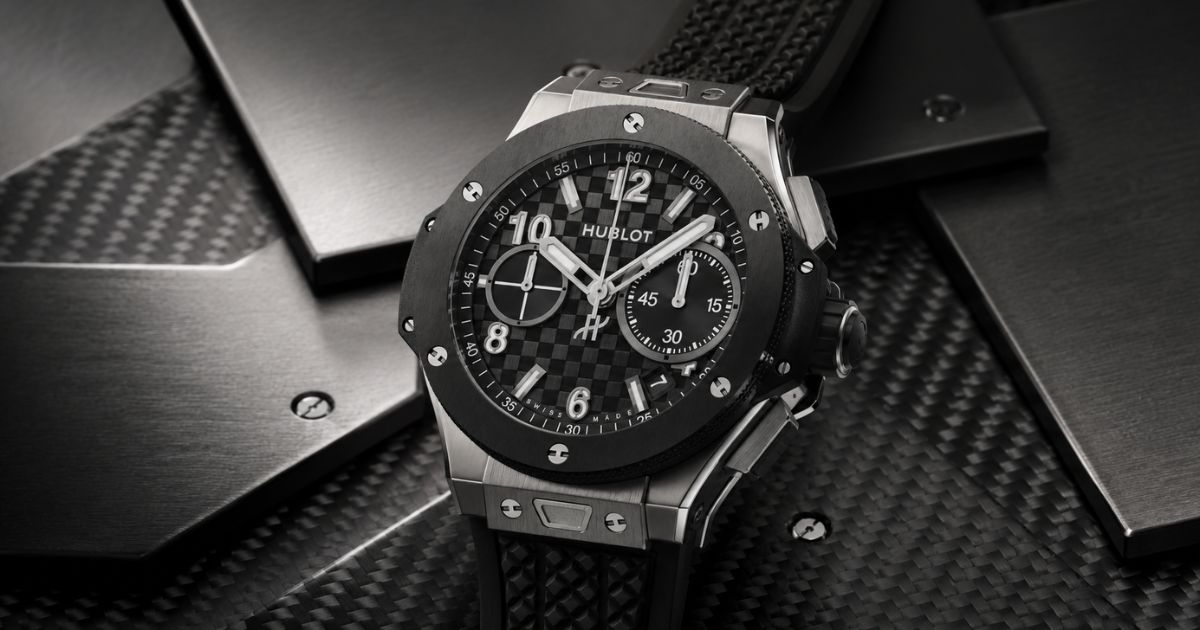
Look closely at the bezel. It isn’t just round; it is a complex sandwich of materials. The six iconic H-shaped screws don’t just hold the bezel in place—they are the jewelry. In 2005, visible screws were often hidden or polished away to maintain a “clean” look. Hublot did the opposite. They made the screws a feature, creating an industrial, architectural aesthetic that mimicked the exposed rivets of a skyscraper or the bolts on a racing bike.
The Learning Point: Design isn’t always about hiding the mechanics. Sometimes, exposing the “connective tissue” of a watch—the screws, the gaskets, the joints—creates honesty and visual tension.
The “Art of Fusion” (More Than a Tagline)
Most brands use marketing slogans. Hublot lives by one: The Art of Fusion. Before 2005, the Swiss industry was siloed. You had gold dress watches, steel tool watches, and plastic Swatches. You rarely mixed gold with rubber.
The Big Bang shattered that glass ceiling. The original model combined a polished steel or rose gold case with a black rubber strap. This was sacrilege to purists—yet it was irresistible to a new generation of collectors who wanted luxury that could survive a rainy commute or a weekend in jeans.
But “Fusion” goes deeper than rubber and gold. Look at the chronograph pushers. They feature rubber inserts. The crown is gripped with rubber. The bezel might be ceramic, while the case is titanium. Hublot didn’t just use materials; they juxtaposed them. Hard meets soft. Polished meets satin. Cold metal meets warm, tactile rubber.
The Learning Point: When designing a collection, consider contrast. The most successful modern watches are those that refuse to be one thing. The Big Bang is simultaneously a dress watch (in its finishing) and a sports watch (in its construction).
The Sandwich Case Architecture
Take the Big Bang off the wrist and look at its profile. You will see layers. This isn’t a simple two-piece case back and bezel. The Big Bang is a complex mille-feuille of components.
This “layered” look gives the watch its incredible depth. The sapphire crystal often has an anti-reflective coating that makes the dial disappear, allowing you to see the movement. But the case itself is sculptural. The lugs are not simply welded on; they are part of a modular system that allows for Hublot’s “One Click” strap changes—another innovation that is now copied across the industry.
This architecture serves a dual purpose:
- Aesthetics: It looks like a high-performance engine.
- Ergonomics: Despite often being 44mm or 45mm, the watch wears comfortably because the layered lugs curve downward, hugging the wrist.
The Dial: Skeletonization as Art
In its 20-year evolution, the Big Bang dial has become a masterclass in transparency. With the introduction of the in-house Unico movement in 2009 (and subsequent versions), Hublot moved away from simple dials toward full skeletonization.
Why is this important for deconstruction?
The Big Bang is one of the first watches to successfully use the dial as a “stage” rather than a “cover.”
- The Chronograph: In a Unico movement, the column wheel (the brain of the chronograph) is visible from the dial side at 6 o’clock. Usually, this is hidden away under a solid caseback.
- The Date: Often integrated into the bezel ring or the sub-dial periphery, it doesn’t interrupt the symmetry.
The dial is a playground of texture. Look for the “checkerboard” or carbon-fiber weave patterns on the newer 20th Anniversary models. This adds a tactile, fabric-like feel to the visual experience.
The “Invisible Visibility’ Revolution (The All Black)
In 2006, just one year after the launch, Hublot did something insane. They released the Big Bang All Black.
The concept was called “Invisible Visibility.” They created a watch where the case, the dial, the hands, and the indices were all varying shades of matte and glossy black. You couldn’t read the time instantly; you had to look twice. Critics said it was illegible. Collectors bought it in droves.
The All Black taught the watch industry a vital lesson: A watch is no longer just a time-reading tool; it is a piece of aesthetic architecture. It is a mood. The All Black wasn’t about practicality; it was about exclusivity and stealth wealth long before “stealth wealth” became a trend.
The Learning Point: Sometimes, removing functionality (legibility) enhances desirability. It creates a secret handshake for the wearer.
The Material Scientist: Ceramics & Sapphire
Finally, we cannot deconstruct this icon without looking at what it is made of today. Over 20 years, the Big Bang has served as a testbed for impossible materials.
- Magic Gold: The world’s first scratch-resistant 18K gold. Hublot figured out how to fuse ceramic particles into gold, creating a material so hard it can only be polished with diamonds.
- Colored Ceramics: While other brands struggle to make a blue bezel, Hublot produces vivid reds, yellows, and mint greens that never fade.
- Sapphire Cases: The ultimate expression of the Big Bang’s transparency fetish. A fully transparent case (in blue, pink, or clear) requires hundreds of hours of machining because sapphire is nearly as hard as diamond.
Final Thoughts: The Legacy
When the Big Bang first landed, traditionalists dismissed it as a fad. “It is too big.” “The screws are ugly.” “Rubber has no place next to gold.”
Twenty years later, the Big Bang is the blueprint. It legitimized the idea that a luxury watch can be a statement of avant-garde engineering rather than a relic of heritage. It opened the door for every other brand to experiment with materials, size, and color.
For the learning collector, the Big Bang is a perfect case study in cohesive disruption. Every element—the screw, the rubber strap, the layered case, the skeleton dial—serves the “Art of Fusion.” Nothing is accidental.
Whether it is your style or not, the horological universe today exists in the crater left by the Big Bang.