
Omega Speedmaster vs. TAG Heuer Carrera
If you are deep enough into the horology rabbit hole to be reading a dedicated luxury watch blog, you are likely familiar with the “heavyweight” debates: Rolex vs. Omega, Steel vs. Gold, New vs. Vintage.
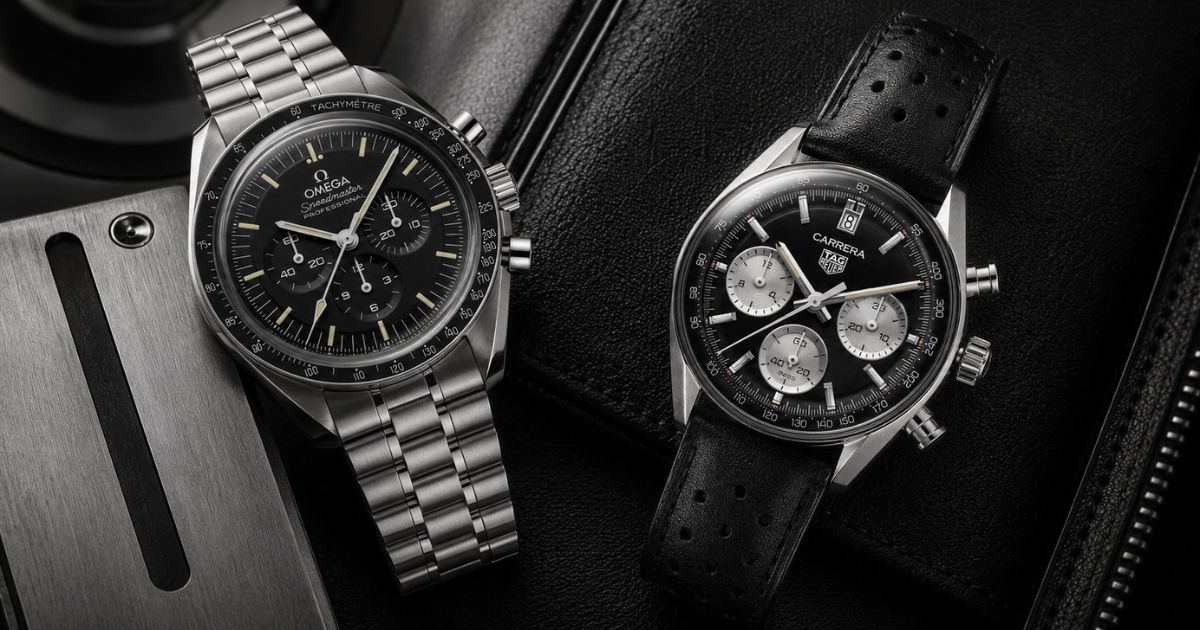
But there is a quieter, more nuanced rivalry happening on enthusiasts’ wrists. It is the battle of the racing chronographs. On one side, we have the icon of the space age: the Omega Speedmaster. On the other, the essence of the golden era of motorsport: the TAG Heuer Carrera.
At first glance, they serve the same function: a steel sports chronograph with a tachymeter bezel. But in practice, these two watches could not be more different. Having worn iterations of both extensively, I want to break down the Speedmaster and Carrera not as spec sheets, but as experiences.
Whether you are filling your first watch box or your tenth, here is a deep dive into two of Switzerland’s finest.
The DNA: Space Dust vs. Gasoline Fumes
Understanding why these watches feel different starts with their origins.
The Omega Speedmaster was not born in a vacuum—literally. Launched in 1957, it was originally designed for motorsport and industry. However, its destiny was rewritten by NASA. The Speedmaster Professional, specifically the reference ST 105.012, became the “Moonwatch” in 1969.
Wearing a Speedmaster feels like wearing a piece of human achievement. It is utilitarian, robust, and slightly rugged. It is a tool watch in the truest sense—a piece of equipment designed to survive the vacuum of space, extreme temperatures, and high G-forces.
The TAG Heuer Carrera, on the other hand, is pure asphalt. Launched in 1963 by Jack Heuer, it was named after the grueling Carrera Panamericana road race in Mexico. The design brief was radical for its time: maximum legibility.
While the Speedmaster went to the moon, the Carrera stayed on the wrist of Formula 1 drivers. It is the watch of Steve McQueen (though he famously wore the Monaco, the Carrera shares that cinematic cool), pit crews, and the glamour of Le Mans. It is less about surviving extremes and more about the art of speed.
The Dial Side: Readability vs. Character
Placing a current Speedmaster Moonwatch next to a Carrera Glassbox reveals two very different philosophies regarding what a chronograph should look like.
The Speedmaster Professional (Ref. 310.30.42.50.01.001) is a masterclass in “if it ain’t broke, don’t fix it.” The design has remained virtually unchanged since the late 1960s. You get the classic asymmetrical case, the step dial, and the distinctive alpha or baton hands.
From a learning perspective, the Speedmaster is the benchmark for balance. The three subdials (running seconds at 9, 30-minute at 3, and 12-hour at 6) are perfectly weighted. In low light, the legibility is outstanding due to the high contrast. However, the current model has a “dot over 90” on the bezel—a tiny detail that vintage nerds obsess over, but one that adds to the narrative.
The TAG Heuer Carrera (specifically the 39mm Glassbox) takes a different approach. Jack Heuer’s original vision was to remove any clutter that distracted the driver. The modern “Glassbox” interpretation features a domed sapphire crystal that curves over the edge of the dial, effectively absorbing the tachymeter scale.
The result is a much cleaner, more “open” dial. The Carrera feels dressier than the Speedmaster. Where the Omega looks like a soldier, the Carrera looks like a racing driver in a tailored suit. The recent Glassbox iterations have phenomenal depth, utilizing “azuré” (concentric circle) finishes on the subdials that catch the light in a way the flat black paint of the Speedy does not.
The Blogger’s Take: The Speedmaster has the superior legacy; the Carrera has the superior finishing on the dial at this tier. If you love historical re-issues, go Omega. If you love light play and architectural depth, go TAG Heuer.
The Movement: Manual Devotion vs. Automatic Ease
This is where the decision often gets made in the showroom.
Omega Speedmaster Professional: It is manual wind. Full stop. The Caliber 3861 is a sight to behold (especially the sapphire sandwich version with the display caseback). It is a Master Chronometer certified by METAS, meaning it is resistant to magnetic fields up to 15,000 gauss and runs at 0 to +5 seconds per day.
However, you have to wind it. Every morning. For a collector, this is a ritual—a moment to connect with the machine. For someone who just wants to grab and go, it is a chore.
TAG Heuer Carrera: Most modern Carreras, particularly the new TH20-00 and TH20-02 movements, are automatic with a bidirectional rotor. They offer an impressive 80-hour power reserve. You can take the Carrera off on a Friday night, and it will still be running Monday morning.
The TH20 series also utilizes a vertical clutch and column wheel, resulting in a very smooth chronograph start/stop action with minimal “jitter” of the chronograph hand.
The Blogger’s Take: If you want the pure connection to horology and don’t mind the daily wind, the Speedmaster wins. But purely on technical convenience and modern architecture, the Carrera’s TH20-00 is a superior daily driver.
The Wrist Feel: 42mm vs 39mm
Numbers on a screen lie. You must try these on.
The Speedmaster is listed at 42mm. However, because it measures the entire asymmetrical case (including the crown guards), it actually wears like a 40mm to 40.5mm watch. The lug-to-lug is a short 47mm, meaning it hugs the wrist well. It has presence, but it is not a dinner plate. The new 3861 models also have much better taper on the bracelet compared to the old 1861 models.
The Carrera (standard production models) usually sits at 39mm. It is sleek, low-profile, and slides under a cuff effortlessly. The Glassbox models have a bit of height due to the crystal, but the case back sits flat against the skin. For smaller wrists (under 6.5 inches), the Carrera is the easy winner here.
Which One Belongs in Your Collection?
As a blogger who sees thousands of watch photos a week, here is my honest advice for the learner:
Buy the Omega Speedmaster Professional if:
- You love history (Apollo missions, NASA, Snoopy awards).
- You enjoy a manual wind ritual.
- You want a watch that holds its value exceptionally well (The Moonwatch is a staple).
- You want “the watch” that non-watch people also recognize as cool.
Buy the TAG Heuer Carrera if:
- You are a motorsport fanatic (F1, endurance racing, vintage Porsche).
- You prefer automatic convenience with a long power reserve.
- You want a vintage aesthetic but with modern, bold finishing (like the Glassbox).
- You want a chronograph that feels elegant, not tactical.
The Final Verdict
You cannot go wrong. The Speedmaster is arguably the better watch in terms of raw build quality and historical gravity. It feels like a tank. The Carrera is the smarter watch for the modern collector who values wearability and automatic movements.
If I had to keep only one? I keep the Speedmaster. But the Carrera is the one I would pick to wear with a leather jacket on a weekend drive.