
5 Things to Know Before Buying Your First Grand Seiko
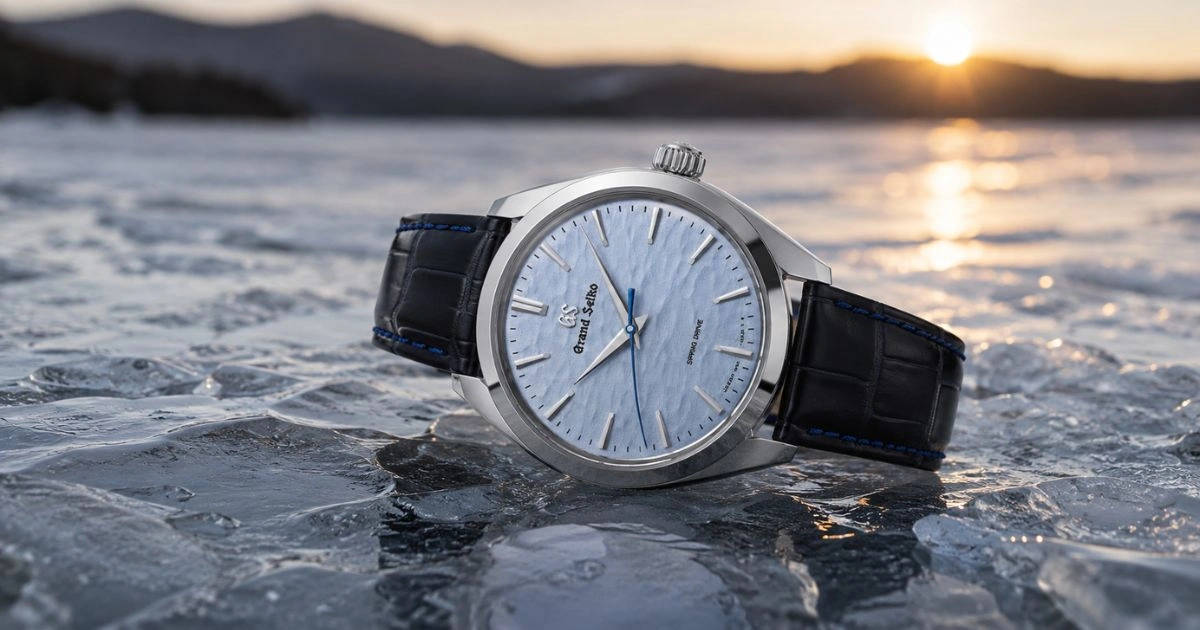
There is a specific moment every watch collector experiences when they first encounter a Grand Seiko. It usually happens in natural light.
You lean over a display case, expecting to see just another luxury watch. But then, the light catches the indices. They aren’t just applied markers; they are razor-sharp shards of light, polished so perfectly they look like liquid mercury. The hands glide across the dial without the mechanical stutter of a traditional tick. Suddenly, the Swiss prices on the tags next to it seem a little… hard to justify.
If you are reading this, you have likely had that moment. You are ready to stop lurking on the forums and actually pull the trigger. But buying your first Grand Seiko is different from buying a Swiss diver or a German pilot’s watch. The rules are different. The history is different. And the technology is unlike anything else.
Here are the five essential truths you need to know before you buy your first Grand Seiko.
You Are Buying Three Different “Brands” (Choose Your Flavor)
Here is the first trap new buyers fall into: treating Grand Seiko as a monolith. In reality, the brand offers three distinct “heartbeats,” and your experience with the watch will be radically different depending on which one you choose.
The Mechanical (9S): If you love the romance of traditional watchmaking, this is for you. The 9S mechanical movements are assembled by hand in the Shizukuishi Watch Studio. They boast a 72-hour power reserve and are regulated to a standard of -3 to +5 seconds per day—a standard that competes directly with the Swiss COSC chronometer specifications but is actually stricter in real-world testing. However, you buy this for the finishing; the striped bridges and blued screws visible through the caseback are a nod to tradition, but with a distinctly Japanese, almost austere precision.
The Quartz (9F): Do not scroll past this section just because you see the “Q-word.” The 9F Quartz is the only quartz movement in the world that deserves a spot in a luxury blog. This is not the $50 battery-powered movement from the mall. The 9F is hermetically sealed, uses a twin-pulse motor to move the hands with serious torque (no stuttering), and has a “backlash auto-adjust” mechanism to ensure the second hand hits the marker dead-on every single time. With an accuracy of ±10 seconds per year, it is technically superior to almost every mechanical watch on the planet.
The Spring Drive (9R): This is the unicorn. Conceived in 1977 but not perfected until 1999, Spring Drive is the reason many collectors cross over to Grand Seiko. It is a hybrid. You wind it like a mechanical watch (mainspring power), but it regulates time using a quartz oscillator and an electromagnetic brake. The result? The second hand glides in a single, continuous, silent sweep across the dial—a perfect representation of the “natural flow of time.” Modern Spring Drive movements, like the new U.F.A. (Ultra Fine Accuracy), now achieve accuracy of ±20 seconds per year while maintaining that silky sweep.
The Verdict: Do you want heritage? Go Mechanical. Do you want brutalist engineering perfection? Go Quartz. Do you want magic? Go Spring Drive.
The “Zaratsu” Shine Comes at a Cost
You will hear the word “Zaratsu” (or Sallaz) repeated ad nauseam in reviews. It is the specific, almost spiritual method of polishing the watch case. Unlike Swiss polishing, which often softens the lines of a case, Zaratsu polishing uses a spinning metal disc to create perfectly flat, distortion-free mirror surfaces.
When you hold a Grand Seiko, you will notice the contrast: the mirror-finished, sharp bevels of the lugs sit directly next to the silky, hairline brushed finishes on top. This interplay of light creates the “brilliance” that Grand Seiko is famous for.
Here is what you need to know: This beauty is fragile.
Those razor-sharp edges are polished to such a high degree that they act as light guides. However, they are also scratch magnets. A minor brush against a door frame that would vanish on a brushed steel Rolex will leave a glaring, visible mark on a Zaratsu-polished Grand Seiko. Be prepared to accept wear and tear—or invest in a polishing cloth and accept that it tells your story.
The Design Language is Prescriptive (But the Dials are Poetry)
n the 1960s, Grand Seiko established the “Grand Seiko Style” – a strict set of design rules (9 specific elements) that dictated everything from the distortion-free surfaces to the specific angle of the bezel and the double-width index at 12 o’clock.
This means that unlike other brands that redesign their entire lineup every decade, a Grand Seiko from 1967 looks unmistakably like a Grand Seiko from 2024. You are buying into a consistent, evolving lineage.
Where that rigidity breaks into total freedom is the dial. This is where Japanese culture explodes onto the wrist. You don’t just buy a “blue watch”; you buy the Iwate sky, the Shosho summer heat, the White Birch of the Shizukuishi studio, or the Snowflake that melts across your wrist. These dials aren’t painted; they are textured to mimic nature. Before you buy, study the dials. The “Snowflake” (SBGA211) is the icon, but deep cuts like the Shunbun (pink cherry blossom) or the Omiwatari (frozen lake ripple) are where the true art lies.
The Bracelet “Problem” is Real (But Fixing)
Look at any watch forum, and you will find the same complaint about Grand Seiko: the bracelets.
Historically, the bracelets have lagged behind the cases. While the case is a multi-thousand-dollar marvel of geometry, the clasp often felt like a $300 Seiko clasp—stamped metal, minimal micro-adjustments, and a lack of that “oyster-like” solid thud.
Good news: The brand has heard the feedback.
Recent releases, particularly in the Evolution 9 Collection, have introduced new bracelets with improved ergonomics. The latest High-Intensity Titanium models (like the new Spring Drive UFA ref. SLGB003) finally feature a tool-less micro-adjustment system, bringing Grand Seiko up to par with its Swiss rivals.
Advice: If you buy an older reference (especially the 44GS cases), try the bracelet on first. Many collectors immediately swap to a high-quality leather strap or a rubber tropic to avoid the clasp frustration. If you buy new, aim for the Evolution 9 cases for the best wearable experience.
Forget the “Poor Man’s Rolex” Narrative
You need to clear your mental cache of Swiss marketing before buying a Grand Seiko. If you buy a Grand Seiko hoping to impress a Swiss watch snob, you will be disappointed. If you buy it because you appreciate artistry, you will feel like a king.
This is a brand that, until 2010, was largely exclusive to Japan. The “Seiko” logo at the top of the dial used to confuse newcomers, which is why modern models now feature the standalone “Grand Seiko” signature at 12 o’clock. But the heritage runs deep. Seiko won timing competitions in Switzerland in the 1960s—using their own rules to beat the Swiss at their own game.
Because of the weak marketing of the past compared to giants like Omega or Rolex, the pre-owned market for Grand Seiko is a goldmine for the buyer. Values tend to normalize quickly after purchase. You are not buying this as an investment vehicle; you are buying it because it represents the absolute pinnacle of “value for money” in high horology. You are getting handmade finishing, in-house hairsprings, in-house lubricants, and in-house grown quartz crystals—all for a price that would buy you a steel three-hander from a Swiss brand.
Final Thoughts
Buying your first Grand Seiko requires a shift in perspective. You have to stop looking at watches as status symbols and start looking at them as objects of craft. You buy a Grand Seiko for the way the light dances off the indices during a morning commute. You buy it for the silent, smooth sweep of the Spring Drive. You buy it because you know, in your gut, that a watch doesn’t need to be Swiss to be the best in the room.
Just be prepared: once you get used to that Zaratsu polish, everything else looks a little… cloudy.
Do you own a Grand Seiko? Drop a comment below letting me know which reference converted you to the brand